
Introduction
Getting website traffic is often considered a sign that digital marketing is working. But what happens when thousands of people visit your website and almost nobody fills out a form, calls your business, requests a quote, books a consultation, or makes a purchase?
This is where Digital Marketing Tips for Businesses That Get Traffic but No Leads become especially important.
Traffic alone does not generate revenue. Your website, content, advertisements, social media campaigns, landing pages, and follow-up processes need to work together to turn visitors into prospects and customers. A business can rank well on Google, receive social media traffic, generate clicks from paid campaigns, and still struggle with lead generation if the conversion journey is unclear.
The good news is that low lead volume does not always mean you need more traffic. In many cases, you need to improve what happens after visitors arrive.
This guide covers practical strategies to help businesses turn existing website traffic into qualified leads, including audience targeting, landing page optimization, stronger calls to action, trust building, content strategy, paid advertising, retargeting, email nurturing, analytics, and conversion optimization.
Why Does Your Website Get Traffic but No Leads?
A website may get traffic but no leads because it attracts the wrong audience, has unclear messaging, weak calls to action, ineffective landing pages, complicated forms, limited trust signals, poor user experience, or inadequate lead follow-up. Businesses should analyze traffic quality, visitor intent, landing-page performance, conversion actions, and the complete customer journey before investing in more traffic.
Before changing your marketing strategy, identify where the conversion problem actually exists.
Your traffic may not be converting because:
- You are attracting the wrong audience.
- Your landing page does not match search or advertising intent.
- Your value proposition is unclear.
- Visitors cannot immediately understand what you offer.
- Your calls to action are weak or difficult to find.
- Your forms ask for too much information.
- Your website is slow or difficult to use on mobile devices.
- You have insufficient trust signals.
- Your content educates visitors but does not guide them toward the next step.
- Leads are not being followed up quickly enough.
- You are measuring traffic but not meaningful conversions.
Google recommends creating helpful, reliable, people-first content rather than producing content simply to attract search traffic.
In other words, more visitors are not necessarily the solution to a lead-generation problem. First, understand whether your existing visitors are the right people and whether your website gives them a compelling reason to take action.
Digital Marketing Strategies to Turn Website Traffic Into Qualified Leads
If your website already receives visitors, you have an opportunity. Instead of starting from zero, optimize the journey between visitor → prospect → qualified lead → customer.
Here are practical strategies businesses can use to improve traffic-to-lead conversion.
1. Check Whether You Are Attracting the Right Traffic
The first question is not:
“How can I get more traffic?”
It is:
“Is my current traffic coming from people who actually need what I sell?”
A website can receive substantial organic traffic from informational keywords while generating very few business inquiries.
For example, suppose a B2B software company receives traffic from searches such as “what is CRM software?” Those visitors may be researching the topic but may not be ready to purchase.
Compare that with someone searching for “CRM software for real estate companies pricing.” The second query usually indicates stronger commercial intent.
Review:
- Organic search queries
- Paid advertising keywords
- Social media referral traffic
- Landing pages receiving the most visits
- Geographic locations
- Device types
- New versus returning visitors
- Engagement and conversion behavior
The goal is to identify high-intent traffic, not simply high-volume traffic.
If your business needs a broader strategy for attracting and converting relevant audiences, RM GrowthX Media provides Digital Marketing Services designed around visibility, engagement, conversions, and measurable business growth.
2. Make Your Value Proposition Immediately Clear
Visitors should understand three things almost instantly:
What do you offer?
Who is it for?
Why should they choose you?
If your homepage headline says something vague such as “Helping Businesses Grow Online,” visitors may still wonder what you actually provide.
A stronger value proposition could be:
“Performance-Focused Digital Marketing for Businesses That Want More Qualified Leads.”
Follow it with a supporting statement explaining the specific benefit and a clear CTA.
For example:
Get Your Free Growth Audit
The visitor should not have to scroll through five sections to understand what you do.
A clear value proposition improves message clarity and helps users determine whether your business is relevant to them.
3. Create Landing Pages Around Specific Customer Intent
One of the most common reasons businesses get traffic but no leads is sending every visitor to the same homepage.
A person clicking a Google Ad for social media advertising should ideally land on a page specifically focused on social media advertising.
Similarly, someone searching for paid advertising solutions should be taken to a page focused on that service rather than a generic homepage.
For example, RM GrowthX Media’s Paid Advertising Services cover targeted campaigns across Google, Meta, LinkedIn, YouTube, shopping campaigns, app-install campaigns, and remarketing, with an emphasis on lead generation, conversions, optimization, and measurable performance.
A strong landing page should include:
- A clear headline
- Relevant supporting copy
- Specific benefits
- Proof or trust signals
- Relevant visuals
- A strong CTA
- A short lead form
- FAQs addressing objections
- Contact options
The closer the landing page matches the visitor’s intent, the easier it becomes to move that visitor toward conversion.
4. Strengthen Your Calls to Action
“Learn More” is not always enough.
Your CTA should tell visitors what happens next.
Instead of:
Submit
Try:
- Get My Free Consultation
- Request a Free Quote
- Book a Strategy Call
- Get Your Free Growth Audit
- Talk to an Expert
- Request a Personalized Plan
- Start Your Project
The best CTA depends on the visitor’s stage in the buying journey.
A person reading an educational blog may not be ready to “Buy Now.” They might be more comfortable downloading a checklist, requesting an audit, subscribing to an email list, or exploring a relevant service.
Create different CTAs for different stages of the funnel.
5. Reduce Friction in Your Lead Forms
Long forms can discourage conversions.
If you only need a visitor’s name, email address, phone number, and business requirement, don’t necessarily ask for ten additional fields.
Review every field and ask:
Does this information genuinely help us qualify or serve the lead?
If not, remove it.
For higher-value B2B services, additional qualification questions may make sense. But for lower-friction offers, keeping the form short can make the next step easier.
Also make sure your form:
- Works properly on mobile
- Has clear labels
- Shows useful error messages
- Confirms successful submission
- Provides a clear next step
- Does not unexpectedly reset entered information
6. Build Trust Before Asking for the Lead
People rarely submit their contact details to a business they do not trust.
Add trust signals throughout your website.
These can include:
- Client testimonials
- Case studies
- Reviews
- Certifications
- Industry experience
- Team information
- Portfolio examples
- Transparent service information
- Privacy information
- Clear contact details
- Relevant statistics backed by evidence
This is especially important for businesses selling high-value services.
Your content should demonstrate experience, expertise, authority, and trust rather than simply making promotional claims. Google’s guidance on helpful and reliable content provides a useful framework for creating content that genuinely serves users.
Your website should make visitors feel that they are dealing with a legitimate, knowledgeable business.
7. Improve Your Website Experience
A visitor may be interested in your service but abandon the website because it is difficult to use.
Check your website for:
- Slow-loading pages
- Poor mobile layouts
- Difficult navigation
- Intrusive pop-ups
- Broken buttons
- Confusing menus
- Tiny text
- Weak contrast
- Unclear CTAs
- Poor checkout or form experiences
Google’s Page Experience guidance recommends considering factors such as Core Web Vitals, mobile usability, security, intrusive interstitials, and whether visitors can easily access the main content.
Your website should make taking action easy.
If your existing website is attracting visitors but failing to convert them, a conversion-focused redesign can make a significant difference. RM GrowthX Media’s Web Design & Development Services include responsive website design, landing page design, mobile-friendly experiences, UI/UX solutions, performance-focused development, and conversion-oriented website experiences.
8. Match Your Content to the Buyer's Journey
Not every visitor is ready to contact your sales team.
That does not mean the visitor has no value.
Your content should support different stages of the customer journey.
Awareness Stage
Create educational content such as:
- How-to guides
- Industry trends
- Beginner guides
- Problem-focused blog posts
- Educational videos
Consideration Stage
Create:
- Comparisons
- Case studies
- Service explainers
- Checklists
- Webinars
- Detailed guides
Decision Stage
Create:
- Pricing information
- Testimonials
- Product or service pages
- Demonstrations
- Consultation offers
- Free audits
- Contact pages
This creates a logical path from information to action.
A strong content strategy should not simply produce articles for traffic. Content should help prospects understand their problem, evaluate solutions, build confidence, and eventually take the next step.
9. Use Internal Links to Guide Visitors Toward Conversion
Internal linking is not only an SEO tactic.
It can also be a conversion tool.
Suppose someone reads a blog about improving online visibility. Instead of ending the article without direction, link them naturally to a relevant service.
For example:
Blog → Relevant Service → Proof/Case Study → Consultation
This creates a logical customer journey.
Internal links should be relevant to the topic and use descriptive anchor text. They should help visitors discover the next useful resource instead of simply adding links for the sake of SEO.
For example, a business owner reading about digital advertising may naturally want to explore Social Media Advertising Services to understand how targeted campaigns, lead generation, retargeting, and conversion optimization can support customer acquisition.
10. Optimize Paid Campaigns for Leads, Not Clicks
A campaign can generate thousands of clicks while producing very few leads.
This usually happens when the campaign is optimized around the wrong objective.
If your business goal is lead generation, evaluate:
- Qualified leads
- Conversion rate
- Cost per lead
- Cost per qualified lead
- Lead-to-customer rate
- Revenue generated
- Return on ad spend
A campaign generating 1,000 clicks and five qualified leads may be less valuable than a campaign generating 300 clicks and 25 qualified leads.
This is why businesses should avoid using clicks as the only measure of advertising success.
RM GrowthX Media’s Paid Advertising Services focus on audience targeting, campaign planning, ad creative, optimization, reporting, lead generation, and remarketing to help businesses connect advertising activity with measurable business outcomes.
11. Retarget Visitors Who Did Not Convert
Many visitors will not convert on their first visit.
That does not mean you should forget them.
Retargeting can bring previous visitors back with more relevant messaging.
For example:
First visit: Educational blog
Second interaction: Service page
Retargeting message: Free consultation or audit
Conversion: Lead form submission
Retargeting can be particularly useful when customers require multiple interactions before making a decision.
However, don’t repeatedly show the same generic advertisement. Segment audiences according to their behavior whenever possible.
For example, visitors who viewed a service page can receive different messaging from visitors who only read a general blog post.
12. Use Email Marketing to Nurture Interested Visitors
Not every visitor is ready to speak with sales.
Email marketing provides a way to continue the relationship.
For example, after someone downloads a guide, you could send:
Email 1: Deliver the resource
Email 2: Explain the common problem
Email 3: Share practical recommendations
Email 4: Introduce your solution
Email 5: Offer a consultation or audit
This turns a one-time website visitor into a potential long-term prospect.
The objective is not to send promotional emails every day. Instead, provide useful information that gradually increases awareness, trust, and purchase intent.
13. Add Lead Magnets for Visitors Who Are Not Ready to Buy
Sometimes your offer is too big for the visitor’s current level of commitment.
A lead magnet creates a smaller conversion opportunity.
Examples include:
- Free checklist
- Industry report
- Marketing audit
- E-book
- Template
- Calculator
- Strategy guide
- Free consultation
- Webinar
- Case study
For example:
“Download the 20-Point Website Conversion Checklist.”
This can be more attractive to an early-stage visitor than:
“Contact Sales.”
Once the visitor enters your database, you can nurture the relationship and introduce more relevant offers as their buying intent increases.
14. Track Micro-Conversions, Not Just Final Leads
Your analytics should answer more than:
“How many people visited my website?”
Track actions such as:
- Contact form starts
- Contact form submissions
- Phone clicks
- WhatsApp clicks
- Email clicks
- CTA clicks
- Brochure downloads
- Pricing-page visits
- Video engagement
- Newsletter sign-ups
- Consultation bookings
These micro-conversions help you identify where visitors are dropping off.
For example:
10,000 visitors → 1,000 service-page visits → 200 CTA clicks → 10 form submissions
The problem may not be traffic.
It may be the form, offer, CTA, or landing-page experience.
Businesses can use Google Analytics and Search Console together to better understand search performance and user behavior after visitors arrive on a website.
The objective is to connect marketing activity with meaningful business outcomes rather than focusing only on page views.
15. Improve Your Follow-Up Process
Generating a lead is only half the job.
What happens after someone submits a form?
If the prospect waits several days for a response, the opportunity may disappear.
Create a simple follow-up process:
- Confirm the inquiry immediately.
- Notify the responsible team member.
- Contact the prospect quickly.
- Qualify their requirement.
- Schedule the next conversation.
- Add the lead to an appropriate nurturing sequence.
- Track the outcome.
Marketing and sales should work together.
A campaign should not be considered successful merely because it generated 100 form submissions if 80 of those leads are never contacted.
Lead quality and follow-up speed should therefore be part of your marketing performance analysis.
16. Use Conversion-Focused Social Media Content
Social media should not only generate likes and followers.
Create content that moves people toward your offer.
Use a mix of:
- Educational posts
- Customer stories
- Before-and-after examples
- FAQs
- Short videos
- Industry insights
- Product or service demonstrations
- Testimonials
- Problem-solution posts
- Direct-response CTAs
For businesses that already have social traffic but weak conversions, review whether your social content and landing pages communicate the same message.
Consistency between the advertisement, social post, landing page, and offer can reduce confusion.
RM GrowthX Media’s Social Media Advertising Services include targeted campaigns, paid social media advertising, lead generation, retargeting, audience targeting, conversion optimization, and performance tracking across platforms such as Facebook, Instagram, LinkedIn, Pinterest, and YouTube.
17. Test One Major Conversion Element at a Time
Conversion optimization is not about changing everything at once.
Start with high-impact elements.
Test:
- Headline
- CTA wording
- CTA placement
- Form length
- Offer
- Landing-page layout
- Social proof
- Pricing presentation
- Hero image
- Lead magnet
For example, you could compare:
Version A: “Contact Us”
Version B: “Get Your Free Strategy Consultation”
Track the result and make decisions based on meaningful conversion data.
Avoid assuming that a design change is successful simply because it looks better.
The purpose of testing is to understand what actually encourages your audience to take action.
How to Find the Real Reason Your Traffic Isn't Converting
A practical conversion audit can be divided into five areas:
Traffic
Are visitors relevant to your business?
Intent
Are visitors looking for information, comparing solutions, or ready to buy?
Experience
Can visitors easily navigate and understand your website?
Offer
Is your offer compelling enough to justify taking action?
Follow-Up
Are leads contacted and nurtured effectively?
This framework helps prevent businesses from making random marketing changes.
For example, if traffic quality is poor, changing your CTA may not solve the problem.
If traffic is highly relevant but nobody submits the form, the landing page, offer, trust signals, or form experience deserves closer attention.
A Simple Traffic-to-Lead Conversion Framework
Use this framework to diagnose your funnel:
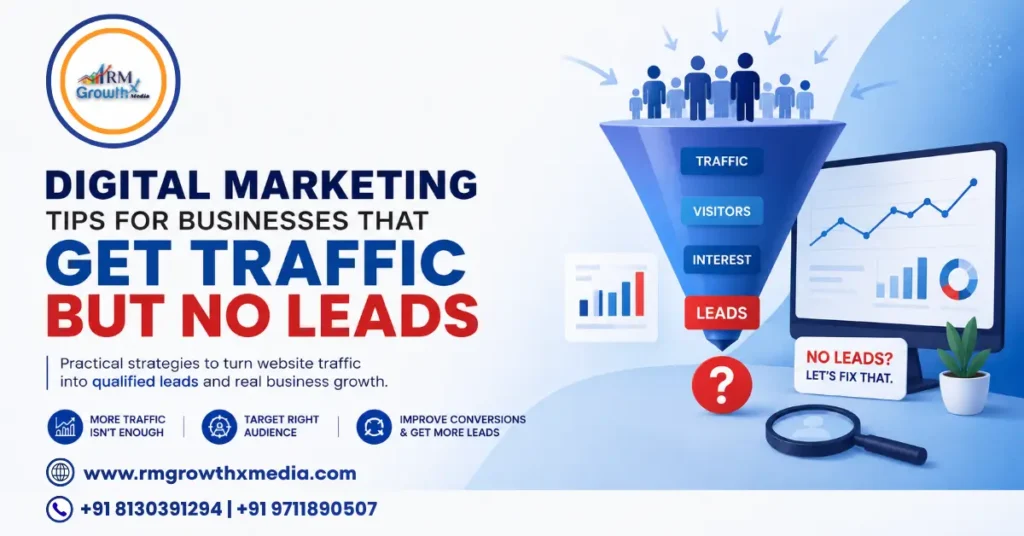
Traffic → Relevant Landing Page → Clear Value Proposition → Trust → CTA → Lead Capture → Follow-Up → Sales
If one stage is weak, the entire funnel can suffer.
For example:
High traffic + poor landing page = low conversions
Good landing page + weak offer = low conversions
Good offer + difficult form = low conversions
Strong lead generation + poor follow-up = lost opportunities
The objective is not to optimize one isolated marketing channel. It is to create a connected system.
Quick Conversion Checklist for Businesses
Before investing more money into traffic generation, check whether your website can convert the visitors you already have.
Ask:
- Is my target audience clearly defined?
- Are my highest-traffic pages attracting potential customers?
- Does each important page have a clear CTA?
- Is my value proposition easy to understand?
- Are my forms short and mobile-friendly?
- Do I have enough trust signals?
- Are my landing pages aligned with user intent?
- Can visitors contact me easily?
- Am I tracking form submissions and other conversions?
- Do I have a lead follow-up process?
- Am I retargeting relevant visitors?
- Am I nurturing prospects through email?
- Do my ads match my landing-page messaging?
- Am I measuring qualified leads rather than traffic alone?
If several answers are “no,” your business may have a conversion optimization problem rather than a traffic problem.
Frequently Asked Questions
The most common reasons include poor traffic quality, unclear messaging, weak calls to action, ineffective landing pages, complicated forms, lack of trust signals, poor user experience, and weak follow-up processes.
Start by understanding your audience and intent. Then improve your value proposition, landing pages, CTAs, forms, trust signals, lead magnets, conversion tracking, retargeting, and follow-up process.
If your website already receives relevant traffic but generates few leads, improving conversion rate should usually be investigated before simply increasing traffic. More traffic will not automatically fix a weak conversion funnel.
A strong conversion strategy connects relevant traffic with a relevant landing page, clear value proposition, compelling offer, visible CTA, simple lead capture, trust signals, and consistent follow-up.
Landing pages are extremely important when traffic comes from specific campaigns, advertisements, search queries, or social media posts. A focused landing page can provide a more relevant experience than sending visitors to a generic homepage.
Important informational and commercial content should ideally provide a relevant next step. However, the CTA should match the reader's intent rather than aggressively pushing a sales message.
Look beyond sessions and page views. Analyze engagement, landing-page performance, conversion events, qualified leads, cost per lead, lead-to-customer rate, and revenue generated by each channel.
Conclusion: Turn Existing Traffic Into Business Opportunities
Getting traffic but no leads can be frustrating, especially when your SEO, advertising, social media, or content marketing campaigns appear to be performing well.
But traffic is only the beginning.
The real objective of digital marketing is to connect the right audience with the right message, offer, experience, and next step.
The most effective Digital Marketing Tips for Businesses That Get Traffic but No Leads are therefore not limited to generating more visitors. Businesses should improve audience targeting, landing pages, value propositions, CTAs, forms, trust signals, content journeys, retargeting, email nurturing, analytics, and sales follow-up.
A successful digital marketing funnel should make it easy for the right visitor to understand your offer, trust your business, take the next step, and eventually become a customer.
If your business is getting visitors but those visitors are not becoming inquiries or customers, it may be time to look beyond traffic and examine the complete conversion journey.
Don’t just chase more clicks. Build a digital marketing system that turns attention into action and action into measurable business growth.
Start by auditing your existing traffic, identifying where visitors drop off, and improving the highest-impact conversion opportunities first.
Ready to turn more of your website traffic into qualified leads? Connect with RM GrowthX Media for a personalized growth strategy and discover where your digital funnel is losing potential customers.