Introduction
Customers rarely make purchasing decisions without leaving clues about what they need. They search for products, compare alternatives, revisit websites, respond to offers, and interact with brands across multiple channels. When businesses understand these patterns, they can make more informed decisions about what customers may want next.
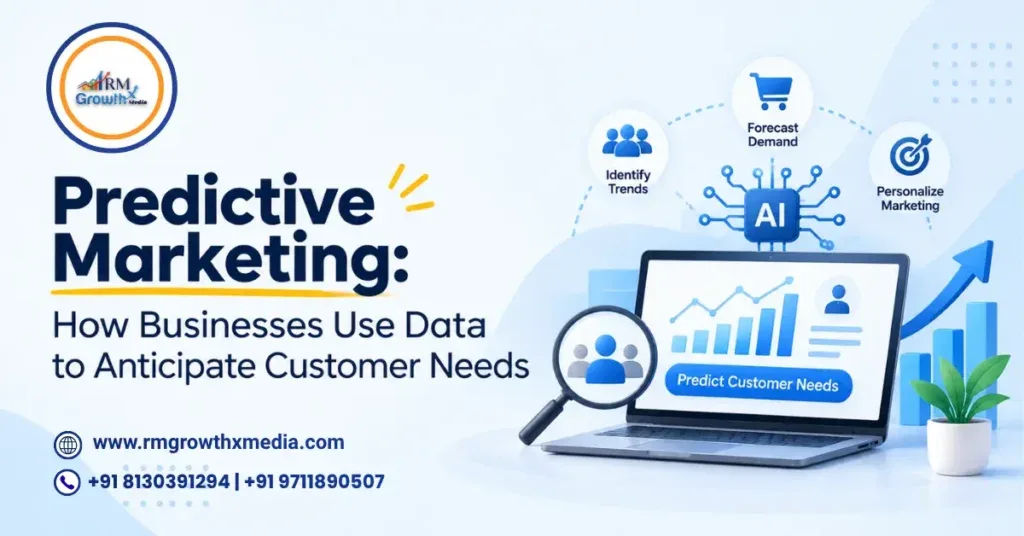
Predictive marketing uses historical customer data, behavioral patterns, statistical analysis, and artificial intelligence (AI) to estimate future customer actions. Instead of relying entirely on past campaign results, businesses can use these insights to identify potential buyers, personalize communications, improve customer retention, and allocate marketing budgets more effectively.
For small businesses, e-commerce brands, startups, and established companies, this approach creates opportunities to make marketing more relevant and proactive. However, successful implementation requires reliable data, clear objectives, appropriate technology, and responsible use of customer information.
This guide explains how predictive marketing works, where businesses can apply it, which tools can help, and how to build a practical strategy without relying on complicated systems or unrealistic promises.
What Is Predictive Marketing?
Predictive marketing is a data-driven approach that uses historical information, customer behavior, statistical models, and machine learning to estimate future customer needs, preferences, and actions. Businesses use these predictions to plan campaigns, personalize experiences, identify sales opportunities, and improve customer retention.
Unlike traditional marketing, which often reacts to completed purchases or campaign results, predictive marketing helps teams make decisions based on the likelihood of future behavior.
For example, an e-commerce business may identify customers who frequently purchase skincare products every two months. Instead of waiting for customers to return, the business can send a relevant replenishment reminder around the expected purchase period.
The prediction is not a guarantee that someone will buy. It is an informed estimate that helps the business choose a potentially useful next action.
Predictive Marketing vs. Traditional Marketing
Both approaches have a place in a well-planned marketing strategy. The difference is how customer information influences decisions.
|
Traditional marketing
|
Predictive marketing
|
|---|---|
|
Often responds to past campaign performance
|
Uses past and current data to estimate future outcomes
|
|
May rely on broad audience segments
|
Can identify audiences based on predicted behavior
|
|
Sends messages according to fixed schedules
|
Can adjust timing based on customer signals
|
|
Evaluates completed actions
|
Estimates the likelihood of future actions
|
|
Uses historical reports to guide decisions
|
Combines historical insights with predictive models
|
Predictive marketing does not replace human judgment or conventional campaign analysis. It adds another layer of insight to help businesses decide what to test, whom to target, and when to communicate.
Why Predictive Marketing Matters for Businesses
Customers interact with businesses through search engines, social media, websites, email, messaging platforms, and offline channels. Each interaction can reveal something about their interests or purchasing intentions.
The challenge is turning these signals into useful decisions.
Predictive marketing can help businesses:
- Identify customers who may be ready to purchase.
- Recognize customers who may stop engaging with a brand.
- Recommend relevant products, services, or content.
- Prioritize promising sales leads.
- Improve campaign timing and audience selection.
- Plan inventory and seasonal promotions using demand forecasts.
- Allocate marketing resources according to business objectives.
Consider a company that generates hundreds of enquiries every month. Its sales team may spend equal time following up with every prospect, even though some prospects have stronger buying signals than others.
A predictive lead-scoring approach can help the team prioritize enquiries based on factors such as previous interactions, service requirements, engagement, and historical conversion patterns.
The sales team still makes the final decision, but it has a more structured way to determine which opportunities deserve attention first.
For businesses investing in multiple channels, a connected strategy matters as much as individual predictions. Integrating insights from digital marketing and campaign tracking resources can help teams understand where customer interactions originate and how different marketing activities contribute to business goals.
How Does Predictive Marketing Work?
Predictive marketing generally follows a cycle: collect relevant data, identify patterns, estimate future outcomes, take action, and compare predictions with actual results.
1. Collect Relevant Customer Data
The quality of predictions depends heavily on the information available to the business.
Common data sources include:
- Website analytics: Pages visited, product views, form submissions, and checkout activity.
- CRM systems: Lead status, sales conversations, customer history, and purchase records.
- E-commerce platforms: Order frequency, product preferences, average order value, and repeat purchases.
- Email marketing platforms: Opens where reliably measured, clicks, conversions, unsubscribes, and campaign engagement.
- Customer support systems: Repeated questions, complaints, service requests, and reasons for cancellation.
- Advertising platforms: Campaign interactions, conversion events, and audience-level performance.
- Customer feedback: Reviews, surveys, and stated preferences.
Businesses should collect only information that is relevant to a legitimate business purpose and handle it according to applicable privacy requirements.
A small company does not need every possible data source to begin. A clean customer database, consistent conversion tracking, and a clearly defined business objective can provide a practical starting point.
2. Prepare and Organize the Data
Data collected from different platforms may contain duplicates, inconsistent labels, missing values, or outdated information.
For example, one customer might appear in a CRM under a personal email address and in an e-commerce platform under a different address. If the business cannot reliably connect these records, it may misunderstand that customer’s purchase history.
Before creating predictive models, teams should:
- Remove duplicate records where appropriate.
- Standardize dates, campaign names, and customer categories.
- Check whether important events are being recorded correctly.
- Separate reliable information from incomplete or outdated records.
- Document how customer data is collected and used.
This step may not appear as advanced as machine learning, but it is essential. Sophisticated models cannot automatically compensate for every data-quality problem.
3. Identify Patterns in Customer Behavior
Businesses then look for relationships between customer characteristics, interactions, and outcomes.
For example, a B2B company may discover that prospects who view a service page, download a relevant resource, and attend a product demonstration are more likely to progress through the sales pipeline.
An online retailer may identify patterns between product categories, purchase frequency, seasonality, and repeat orders.
Some patterns can be discovered through ordinary analytics and segmentation. More complex relationships may require statistical models or machine learning.
4. Generate Predictions
A predictive model estimates the likelihood of a specific outcome.
Depending on the business objective, it might estimate:
- The probability that a visitor will purchase within a particular period.
- The likelihood that an existing customer will stop engaging.
- The expected revenue associated with a customer.
- Which leads are more likely to become qualified opportunities.
- Which product categories may experience increased demand.
Google Analytics documents predictive metrics such as purchase probability, churn probability, and predicted revenue. Access to these metrics depends on meeting the platform’s eligibility requirements and collecting the necessary data. Businesses can review Google Analytics’ official predictive metrics documentation to understand the available capabilities and limitations.
5. Turn Predictions Into Marketing Actions
A prediction becomes valuable when it informs an appropriate action.
For example:
- A likely buyer may receive a relevant product recommendation.
- A customer showing signs of disengagement may receive a helpful re-engagement message.
- A promising lead may be prioritized for a sales consultation.
- A seasonal demand forecast may influence campaign planning.
- An audience with a high predicted purchase probability may become a candidate for a targeted advertising campaign.
Not every prediction should trigger an automated message. Some decisions, especially those involving sensitive customer circumstances or significant commercial consequences, require human review.
6. Measure Actual Results and Improve
Finally, compare predicted outcomes with what actually happened.
Did the recommended audience convert? Did customers who received a replenishment reminder purchase more frequently than a comparable group? Did the lead-scoring system help sales teams prioritize opportunities accurately?
Track both model quality and business outcomes. A model that predicts customer activity reasonably well may still fail to improve profitability if the resulting campaigns are expensive or poorly designed.
The process should be repeated as customer behavior, market conditions, and business objectives change.
7 Practical Ways Businesses Use Predictive Marketing
Predictive marketing can support several stages of the customer journey. The best applications depend on the business model, the quality of available data, and the decisions the company needs to improve.
1. Predicting Purchase Intent
Purchase-intent prediction helps businesses identify customers who may be approaching a buying decision.
Signals might include repeated product visits, comparisons between product options, visits to pricing pages, previous purchases, or additions to a shopping cart.
Example: An online electronics store notices that some visitors repeatedly view laptop models and compare specifications. A relevant campaign could highlight product differences, warranty information, or financing options rather than sending a generic brand advertisement.
The goal is to address a possible purchasing need without assuming that every interested visitor is ready to buy.
2. Personalizing Product Recommendations
Predictive models can help businesses estimate which products, services, or content may interest a customer.
Recommendations may be informed by previous purchases, browsing behavior, product relationships, and the preferences of similar customers.
Example: A skincare retailer could recommend a compatible moisturizer to someone who purchased a cleanser. A repeat customer might see replenishment options for products they have previously bought.
Effective personalization should remain relevant to the customer’s actual interests. Recommending unrelated products simply because they are commercially attractive can reduce trust and weaken the customer experience.
3. Improving Lead Scoring and Qualification
Lead scoring assigns values to prospects based on characteristics or actions that indicate their potential fit and readiness to purchase.
Traditional lead scoring may use manually defined rules. Predictive lead scoring uses patterns in historical lead and sales data to estimate which prospects are more likely to convert.
For a marketing agency, useful signals might include:
- The type of service requested.
- The prospect’s business requirements.
- Relevant website interactions.
- Previous responses to communications.
- Historical patterns associated with qualified opportunities.
Example: A web development company receives enquiries from businesses seeking anything from a basic website to a complex e-commerce platform. A structured scoring model can help identify enquiries that better match its services and sales capacity.
Lead scores should support sales judgment rather than automatically determine which people deserve a response. Low-scoring prospects may still have legitimate needs that the model does not recognize.
4. Reducing Customer Churn
Customer churn occurs when customers stop purchasing, renewing, or using a service.
Predictive churn models analyze historical patterns to identify customers whose behavior resembles that of customers who previously left.
Possible signals include declining purchase frequency, reduced product usage, fewer meaningful interactions, unresolved service problems, or missed renewals.
Example: A subscription-based software business notices that some customers who stop using a key feature later cancel their subscriptions. The company can investigate whether a product tutorial, customer-support conversation, or onboarding session would address the underlying problem.
A discount is not always the best response. If a customer is disengaging because the product is difficult to use, improving the experience may be more appropriate than offering a price reduction.
5. Improving Email and Marketing Automation
Predictive insights can help businesses determine which content to send, which customer segment to prioritize, and when a communication may be relevant.
Possible applications include:
- Product replenishment reminders.
- Renewal notifications.
- Personalized educational sequences.
- Re-engagement campaigns.
- Recommendations based on previous purchases.
- Follow-ups for leads showing meaningful interest.
Example: A customer who purchases a product with a predictable replacement cycle could receive a reminder near the expected replenishment period. The timing should be based on the product and available evidence, not an arbitrary schedule.
Marketing automation can help deliver these messages consistently, while performance analysis determines whether the communication is genuinely useful.
6. Optimizing Advertising Campaigns
Predictive insights can support audience selection, budget allocation, creative testing, and campaign optimization.
For example, an e-commerce business may use eligible predictive audiences to identify users with a higher estimated likelihood of purchasing. It can then test relevant campaigns against other audience strategies.
The important distinction is between predicted intent and actual profitability. An audience that converts more frequently is not necessarily the most profitable if its acquisition costs are substantially higher.
Marketers should evaluate:
- Cost per qualified lead or purchase.
- Conversion rate.
- Customer acquisition cost.
- Revenue and contribution margin where available.
- Repeat purchase behavior.
- Incremental results compared with a suitable comparison group.
Predictive targeting should complement campaign measurement, not replace it.
7. Forecasting Demand and Seasonal Interest
Predictive analytics can help businesses estimate demand by examining previous sales, seasonality, promotions, customer preferences, and other relevant factors.
Example: A home decor retailer may review previous festive-season orders, product categories, promotional periods, and stock availability before planning its next campaign.
These insights can influence product promotion, inventory preparation, creative planning, and campaign timing.
However, past demand does not guarantee future demand. New competitors, economic changes, pricing, supply issues, and shifts in consumer preferences can affect the forecast.
Benefits of Predictive Marketing
When applied to a clear business problem, predictive marketing can provide several practical advantages.
More Relevant Customer Experiences
Businesses can use customer signals to present information, recommendations, and offers that better match individual needs.
Relevance can improve the usefulness of marketing communications, provided personalization is accurate and respectful.
Better Allocation of Marketing Resources
Predictive insights may help teams prioritize promising leads, audiences, products, and campaigns rather than distributing resources equally across every opportunity.
This can make planning more focused, although the final allocation should also consider costs, margins, and strategic priorities.
Stronger Customer Retention
Early signs of disengagement can give businesses an opportunity to investigate customer concerns before a relationship ends.
The most effective response depends on the reason for disengagement, which may require customer feedback or direct support.
Improved Planning and Forecasting
Demand estimates and customer-behavior forecasts can support decisions about campaign schedules, inventory, sales capacity, and customer communications.
More Informed Marketing Decisions
Predictive models provide another source of evidence alongside customer research, campaign reports, sales feedback, and professional judgment.
The value lies in making better-informed decisions, not in removing uncertainty completely.
Tools and Technologies That Support Predictive Marketing
Businesses can begin with existing analytics and customer-management platforms before investing in specialized predictive systems.
|
Tool category
|
How it supports predictive marketing
|
Suitable starting point
|
|---|---|---|
|
Website analytics
|
Measures customer behavior and eligible predictive metrics
|
Review analytics events and conversion tracking
|
|
CRM software
|
Organizes lead, sales, and customer histories
|
Identify patterns in qualified and converted leads
|
|
Email marketing platforms
|
Supports segmentation and automated communication
|
Test relevant customer journeys
|
|
E-commerce analytics
|
Helps analyze purchases, product interest, and repeat orders
|
Examine product and customer purchase patterns
|
|
Business intelligence tools
|
Combines data and supports reporting
|
Build a consistent performance dashboard
|
The right tool depends on the organization’s size, budget, data maturity, and technical resources. A small business may gain meaningful insights from customer segmentation and a well-maintained spreadsheet before needing a custom machine learning model.
Technology should solve a defined problem rather than become a project without a measurable purpose.
How Small Businesses Can Get Started With Predictive Marketing
Predictive marketing does not have to begin with a large data-science team. A staged approach can help businesses test the value of customer insights before increasing complexity.
Step 1: Choose One Business Objective
Start with a clearly defined question, such as:
- Which leads are most likely to become customers?
- Which customers may need a renewal reminder?
- Which products are frequently purchased together?
- Which customers may be approaching their next purchase?
- Which marketing channels attract valuable customers?
Avoid trying to predict every possible outcome at once.
Step 2: Identify the Required Data
Determine which records are necessary to answer the question.
A lead-scoring project may require lead sources, enquiry details, sales stages, and closed outcomes. A repeat-purchase project may need transaction dates, product categories, and customer purchase histories.
Check whether the information is available, consistent, sufficiently representative, and collected appropriately.
Step 3: Establish a Baseline
Before changing campaigns, record the current performance.
For a retention initiative, this might include repeat purchase rate, customer churn, or renewal rate. For lead scoring, it might include the percentage of enquiries that become qualified opportunities.
A baseline helps determine whether the new approach improves results rather than simply producing more activity.
Step 4: Start With Simple Analysis
Look for meaningful patterns using reports, customer segments, and historical comparisons.
For instance, compare repeat purchases across customer groups or examine how qualified leads differ from enquiries that do not progress.
Simple analysis may reveal that a complex predictive model is unnecessary—or help identify the right problem for a model to solve.
Step 5: Test One Targeted Action
Create a small, controlled campaign based on the insight.
Examples include a replenishment reminder, a targeted follow-up sequence, or a campaign for an eligible predictive audience.
Where practical, compare the results with a suitable control group that does not receive the new intervention. This helps distinguish the effect of the marketing action from behavior that might have occurred anyway.
Step 6: Evaluate Business Outcomes
Measure the metrics that reflect the original objective.
|
Objective
|
Useful measures
|
|---|---|
|
Purchase prediction
|
Purchase conversion rate, revenue, acquisition cost
|
|
Lead qualification
|
Qualified lead rate, sales acceptance, lead-to-customer conversion
|
|
Customer retention
|
Churn rate, renewal rate, repeat purchases
|
|
Email personalization
|
Clicks, conversions, unsubscribes, revenue where measurable
|
|
Demand forecasting
|
Forecast error, stock availability, missed demand
|
|
Advertising optimization
|
Cost per acquisition, conversion value, profitability
|
Do not judge success by a single metric. Higher click-through rates, for example, do not necessarily mean higher revenue or better customer quality.
Step 7: Improve and Expand Gradually
If the initial test provides useful evidence, refine the targeting, messaging, and timing. Document what worked, what failed, and what remains uncertain.
Only expand the approach when the business can maintain data quality, monitor results, and manage the additional operational complexity.
For organizations combining analytics with broader digital campaigns, a coordinated approach to digital marketing automation and AI can help connect insights with campaign execution and ongoing measurement.
Common Predictive Marketing Mistakes to Avoid
Predictive marketing can support better decisions, but poor implementation can create unnecessary costs, irrelevant communications, and misleading conclusions.
1. Using Incomplete or Inaccurate Data
The problem: Customer records contain duplicates, missing purchase information, inconsistent campaign labels, or incorrect conversion events.
Why it matters: The model may learn patterns that do not reflect actual customer behavior.
What to do instead: Audit the data, validate tracking, standardize records, and document known limitations before relying on predictions.
2. Treating Predictions as Certainties
The problem: A customer identified as likely to purchase is treated as a guaranteed sale.
Why it matters: Models estimate probabilities, not future facts. Customers may change their minds or respond to circumstances the model cannot observe.
What to do instead: Use predictions to prioritize decisions, test outcomes, and retain human oversight where appropriate.
3. Automating Without a Clear Customer Benefit
The problem: Businesses send repeated messages simply because a customer has entered a predicted audience.
Why it matters: Excessive or irrelevant communication can reduce engagement and damage trust.
What to do instead: Match each predicted behavior with a useful, proportionate response. Apply frequency limits and respect communication preferences.
4. Ignoring Privacy and Data Protection
The problem: Customer information is collected, combined, or used without adequate consideration of permissions, transparency, or applicable requirements.
Why it matters: Poor data practices can undermine trust and create legal or regulatory risks.
What to do instead: Collect relevant information for defined purposes, restrict access, protect stored data, honor applicable consent and opt-out requirements, and review the laws governing your business and audience.
5. Confusing Correlation With Causation
The problem: A behavior associated with purchases is assumed to cause purchases.
Why it matters: Customers who visit a pricing page may already have stronger buying intent. Showing them another advertisement may not be what causes them to convert.
What to do instead: Use controlled experiments where practical, compare appropriate groups, and evaluate incremental outcomes instead of relying solely on correlations.
6. Overlooking Bias and Changing Customer Behavior
The problem: A model is trained on historical outcomes that reflect limited audiences or outdated market conditions.
Why it matters: Predictions may perform poorly for underrepresented groups or become less reliable as customer behavior changes.
What to do instead: Check model performance across relevant groups, review unusual outcomes, update models when justified, and provide human oversight for consequential decisions.
7. Investing in Complex Tools Too Early
The problem: A business purchases advanced software before deciding which problem it needs to solve.
Why it matters: Costs and implementation demands can increase without delivering useful decisions.
What to do instead: Begin with a measurable objective, existing data, a baseline, and a small pilot. Invest in additional technology only when the business case is clear.
The Future of Predictive Marketing
Predictive marketing is developing alongside AI, customer-data platforms, automation, and increasingly sophisticated analytics. These developments create opportunities, but their practical value will depend on data quality, customer expectations, and responsible implementation.
AI-Assisted Predictions and Recommendations
AI can help identify patterns in large datasets and generate recommendations for audience selection, content, and campaign planning. Businesses will still need to validate outputs, monitor errors, and assess whether recommendations serve their objectives.
More Connected Customer Journeys
Organizations are increasingly interested in connecting website behavior, CRM records, customer support, and campaign interactions. Better integration can provide a more useful view of the customer journey, subject to technical limitations and appropriate data permissions.
Faster Decision-Making
Predictive systems can support more frequent analysis as new information becomes available. However, real-time action is not always necessary. Some business decisions benefit more from carefully reviewed weekly or monthly forecasts than from immediate automated responses.
Greater Focus on Privacy and Trust
Businesses need to balance personalization with customer expectations. Clear communication, responsible data handling, appropriate consent practices, and controls over customer information will remain essential as predictive capabilities expand.
Human Judgment Will Remain Important
Predictions are most useful when combined with context. A model may identify a customer at risk of leaving, but a conversation with the customer may reveal the real issue and the most suitable response.
The practical direction is not simply to automate more decisions. It is to combine reliable data, useful technology, and human understanding to make better ones.
Frequently Asked Questions
Predictive marketing uses customer data and analytical models to estimate what customers may do next. Businesses use these estimates to improve targeting, personalize communications, prioritize leads, forecast demand, and support customer retention.
It identifies patterns in behavior such as repeat purchases, product views, declining engagement, and previous conversions. Businesses use these patterns to estimate future needs and offer relevant products, information, or support at appropriate times.
E-commerce stores, SaaS companies, B2B organizations, local businesses, service providers, subscription businesses, and larger enterprises can all use predictive insights. The suitable approach depends on the available data, business objective, budget, and technical resources.
Useful data may include purchase history, website interactions, CRM records, campaign engagement, product usage, and customer support history. The specific requirements depend on the outcome being predicted, and businesses should collect and use information responsibly.
Yes. Small businesses can begin with historical sales records, customer segmentation, simple forecasting, and existing analytics tools. They do not necessarily need a custom AI model to start making more informed marketing decisions.
Predictive analytics is the broader practice of using data and models to estimate future outcomes. Predictive marketing applies those techniques to marketing decisions, including audience targeting, lead scoring, campaign planning, personalization, and customer retention.
Businesses should measure both prediction quality and commercial outcomes. Depending on the objective, relevant metrics may include conversion rate, qualified lead rate, customer acquisition cost, churn, repeat purchases, forecast error, and incremental revenue or profit.
Conclusion: Turn Customer Data Into More Informed Marketing Decisions
Predictive marketing gives businesses a practical way to move beyond reacting to completed transactions and start planning around likely customer needs. By combining reliable data, behavioral analysis, appropriate technology, and continuous testing, companies can improve lead prioritization, personalize customer experiences, support retention, and make more informed campaign decisions.
The most effective approach is to begin with one measurable objective, establish a performance baseline, test a focused intervention, and expand only when the evidence supports it. Predictions should guide decisions rather than replace customer understanding, professional judgment, or responsible data practices.
For businesses looking to connect customer insights with measurable digital growth, RM GrowthX Media can help align data-driven marketing, campaign execution, and performance measurement with your business goals.
Ready to build a smarter marketing strategy? Connect with RM GrowthX Media to discuss your marketing objectives and identify practical opportunities to make your campaigns more targeted, informed, and effective.