Introduction
Marketing automation has moved far beyond scheduling emails and sending automated welcome messages. In 2026, marketing automation updates are changing how businesses attract leads, personalize customer experiences, analyze data, manage campaigns, and improve conversions. AI-powered workflows, predictive analytics, real-time customer signals, automated content operations, and increasingly autonomous AI agents are becoming part of modern marketing systems.
For businesses, the biggest opportunity is no longer simply automating repetitive tasks. It is creating connected customer journeys where technology can identify intent, trigger relevant actions, personalize communication, and continuously improve campaign performance. Modern marketing automation can now support everything from lead generation and email marketing automation to customer segmentation, content distribution, reporting, lead scoring, and campaign optimization.
According to Salesforce’s 2026 research, 81% of marketers in India have adopted AI, while disconnected or irrelevant customer data continues to limit effective AI-powered engagement. This highlights an important reality: automation works best when businesses combine intelligent technology with clean data, strong strategy, and human oversight.
So, what can businesses actually automate in 2026?
Let’s explore the most important marketing automation updates in 2026, the tasks businesses can automate today, and how companies can use automation without sacrificing personalization or customer trust.
What Is Marketing Automation in 2026?
Marketing automation is the use of software, AI, data, and automated workflows to execute marketing activities with limited manual intervention.
Traditional automation generally followed simple “if-this-then-that” rules. For example:
If a visitor downloads an ebook → send a follow-up email.
Modern AI-powered marketing automation can go much further. Systems can analyze customer behavior, identify patterns, predict intent, recommend next actions, personalize messaging, and in some cases execute tasks across multiple channels.
What Can Businesses Automate in 2026?
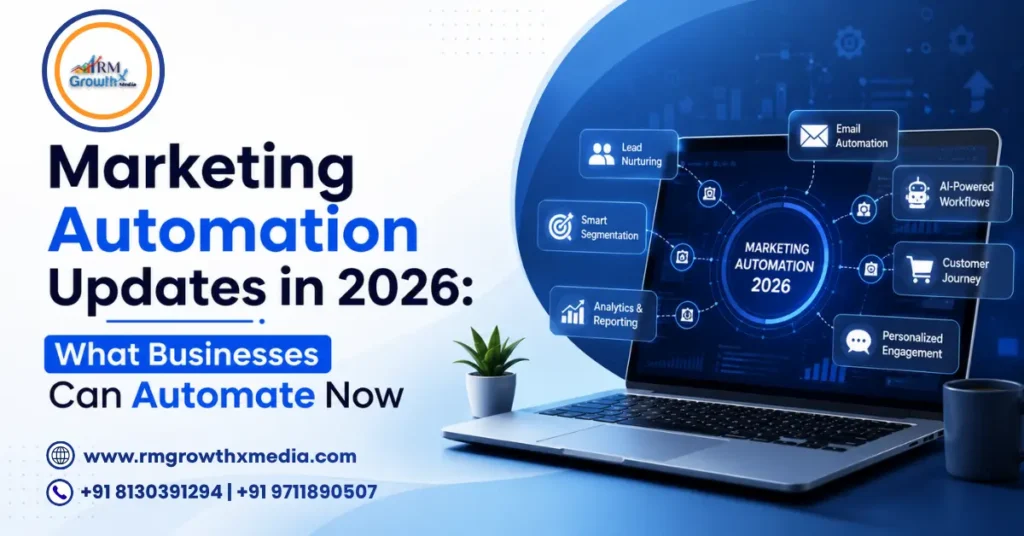
Businesses can now automate lead capture, email nurturing, customer segmentation, lead scoring, personalized content recommendations, campaign scheduling, social media workflows, ad optimization, customer re-engagement, reporting, predictive analytics, appointment reminders, and parts of customer communication using AI-powered marketing automation.
The important difference is that automation is becoming more intelligent, predictive, connected, and customer-centric rather than simply repetitive.
HubSpot’s marketing automation guide explains how behavior-triggered workflows can help businesses deliver more relevant content based on what prospects actually do rather than relying only on generic campaigns.
Marketing Automation Updates in 2026: What's Changed?
Several major developments are shaping marketing automation in 2026.
1. AI Is Becoming Part of the Workflow
AI is increasingly being integrated directly into marketing automation platforms rather than operating as a separate tool.
Instead of asking marketers to manually analyze customer data and then build a workflow, AI can assist with identifying segments, creating content variations, analyzing campaign performance, and recommending next steps.
This creates a new model:
Data → AI analysis → Automated decision → Personalized action → Performance feedback
The result is a marketing system that can react faster to customer behavior.
Salesforce’s AI marketing automation approach demonstrates the shift from static workflows toward systems that can use machine learning and real-time signals to determine timing, content, and channel.
2. Automation Is Moving Toward AI Agents
One of the most significant marketing automation trends 2026 is the emergence of AI agents.
Traditional automation executes predefined workflows. AI agents can potentially handle more complex tasks by interpreting goals, information, and context before deciding what action to take.
For example, instead of:
Lead fills form → send Email A → wait 3 days → send Email B
an AI-assisted system may evaluate:
- What page the lead visited
- Which content they downloaded
- Previous email engagement
- Product interest
- CRM information
- Recent interactions
- Potential purchase intent
The system can then recommend or initiate a more relevant next step.
This does not mean businesses should allow AI to operate without supervision. Human approval, brand guidelines, data governance, and quality controls remain essential.
Salesforce has also expanded its focus on AI agents capable of automating sales, service, and marketing-related tasks, demonstrating how quickly agentic workflows are entering mainstream business software.
3. Lead Capture and Lead Nurturing Can Be Automated
One of the easiest places for businesses to implement automation is the lead funnel.
Instead of manually checking every new lead, businesses can create workflows that automatically:
- Capture the lead.
- Add the contact to the CRM.
- Identify the source.
- Segment the lead.
- Assign a lead score.
- Send relevant information.
- Notify the sales team when buying intent increases.
- Continue nurturing leads that are not ready to purchase.
For example, a B2B company could create a workflow where someone downloading a pricing guide receives educational content first.
If that person later visits the pricing page several times, the system can increase the lead score and alert the sales team.
This is more useful than simply sending the same email to every lead.
Why Automated Lead Nurturing Matters
Potential customers do not always purchase immediately.
Marketing automation allows businesses to stay connected throughout the buying journey without requiring marketers to manually send every follow-up.
This is especially useful for:
- B2B companies
- Real estate businesses
- SaaS companies
- Education brands
- Professional services
- E-commerce businesses
- High-ticket services
Businesses can combine automated email sequences with CRM data, website behavior, and content engagement to create more relevant nurturing journeys.
4. Customer Segmentation Can Become Dynamic
Customer segmentation used to involve manually creating lists based on demographic information.
In 2026, businesses can build more dynamic segments using real-time behavior.
For example:
Segment A: Visitors who viewed a product page but did not purchase.
Segment B: Customers who purchased within the last 30 days.
Segment C: Leads who opened multiple emails but have not contacted sales.
Segment D: Customers showing signs of reduced engagement.
Automation can then trigger different campaigns for each group.
This approach supports behavior-based marketing automation and improves personalization without requiring marketers to manually update every list.
5. Personalized Email Marketing Can Be Automated
Email remains one of the strongest areas for marketing automation.
Businesses can automate:
- Welcome emails
- Lead nurturing
- Product recommendations
- Abandoned cart reminders
- Event reminders
- Appointment confirmations
- Re-engagement campaigns
- Post-purchase communication
- Customer feedback requests
- Upselling campaigns
- Cross-selling campaigns
- Renewal reminders
The bigger 2026 development is personalization.
Instead of:
“Hi Customer, check out our latest products.”
automation can use behavioral information to make the message more relevant.
For example:
“You recently viewed our analytics solutions. Here are three resources that can help you compare your options.”
The goal is not to generate more messages.
The goal is to generate more relevant interactions.
6. AI-Powered Content Workflows Are Expanding
Content marketing can involve dozens of repetitive activities.
Businesses can now automate parts of:
- Topic research
- Content briefs
- Content repurposing
- Social post creation
- Email variations
- Content recommendations
- Meta description drafts
- Content categorization
- Distribution workflows
- Performance summaries
However, businesses should not treat AI content generation as a replacement for expertise.
AI can accelerate production, but human marketers should remain responsible for:
- Brand voice
- Accuracy
- Original insights
- Fact checking
- Strategic positioning
- Industry expertise
- Editorial quality
This is particularly important for businesses investing in SEO and content marketing.
For brands that want automation to support organic visibility, combining automated workflows with professional Search Engine Optimization Services can create a stronger long-term strategy.
7. Social Media Workflows Can Be Automated
Social media marketing contains many repetitive processes that can be automated.
Businesses can automate:
- Post scheduling
- Content distribution
- Publishing reminders
- Campaign calendars
- Performance reporting
- Content repurposing
- Audience segmentation
- Basic engagement workflows
- Lead collection from social campaigns
However, social media should not become completely robotic.
Automation can handle repetitive execution while humans manage:
- Community conversations
- Brand personality
- Crisis responses
- Creative direction
- Customer complaints
- Relationship building
This balance is particularly important because audiences increasingly expect brands to have conversational, responsive interactions.
For businesses running paid social campaigns, automation can also support audience management, campaign monitoring, and performance workflows. A broader Digital Marketing Services strategy can connect these activities with SEO, paid advertising, email, content, and conversion optimization.
8. Lead Scoring Can Become Predictive
Lead scoring is another area undergoing major changes.
Traditional lead scoring might assign:
- +10 points for downloading an ebook
- +20 points for visiting the pricing page
- +5 points for opening an email
AI-powered systems can analyze much larger datasets to identify patterns associated with conversion.
A predictive model may consider:
- Website activity
- Email engagement
- CRM history
- Purchase behavior
- Content consumption
- Customer characteristics
- Previous conversion patterns
The objective is to identify which leads are more likely to become customers.
This helps sales teams prioritize high-intent prospects instead of treating every lead equally.
9. Customer Re-Engagement Can Be Automated
Not every customer or prospect stays engaged forever.
Marketing automation can identify users who have:
- Stopped opening emails
- Reduced website activity
- Abandoned purchases
- Not returned for several months
- Previously shown strong buying intent
- Cancelled or downgraded a service
The system can then trigger a re-engagement campaign.
For example:
No activity for 60 days → send educational content
No response → send personalized offer
Still inactive → reduce communication frequency
This creates a structured approach to customer retention.
10. Automated Campaign Reporting Is Becoming Smarter
Marketing teams spend significant time preparing reports.
Modern automation can reduce this workload by collecting and organizing data from multiple channels.
Automated reporting can track:
- Website traffic
- Leads
- Conversion rates
- Email engagement
- Ad performance
- Cost per lead
- Customer acquisition cost
- Revenue attribution
- Campaign ROI
- Customer lifetime value
AI can also help identify unusual changes.
For example:
“Lead volume increased 24%, but conversion rate declined 11%.”
Instead of simply displaying numbers, intelligent analytics can help marketers investigate what changed.
This supports faster decision-making.
11. Ad Optimization Can Become More Automated
Paid advertising platforms already use machine learning extensively.
Businesses can automate or partially automate:
- Audience targeting
- Bid optimization
- Budget allocation
- Creative testing
- Conversion tracking
- Retargeting
- Campaign alerts
- Performance reporting
The key is to avoid assuming that automation automatically equals better performance.
Campaign goals, conversion tracking, creative quality, landing pages, audience data, and budget strategy still matter.
Automation should optimize a strong campaign foundation rather than compensate for a weak one.
12. Website Personalization Can Be Automated
Your website does not have to show exactly the same experience to every visitor.
Marketing automation can support personalized experiences based on:
- Returning visitors
- Geographic information
- Referral source
- Previous interactions
- Product interests
- Funnel stage
- Customer status
For example, a returning visitor could see a more advanced resource rather than the same introductory content shown to a first-time visitor.
This is where website performance becomes important.
A slow, confusing, or poorly structured website can undermine even sophisticated automation.
Businesses looking to create conversion-focused digital experiences can combine automation with professional Web Design & Development Services to build landing pages, forms, tracking systems, and customer journeys that work together.
13. Customer Service and Marketing Can Work Together
Marketing automation is increasingly crossing departmental boundaries.
Marketing, sales, and customer service data can be connected to create a more complete customer journey.
For example:
Marketing interaction → sales conversation → purchase → onboarding → support → retention campaign
Instead of treating each stage as a separate system, connected automation can help businesses maintain continuity.
This is especially important because customers do not think in terms of departments.
They simply expect the brand to understand their history.
14. What Should Businesses NOT Automate Completely?
Automation does not mean removing humans from marketing.
Some activities still require human judgment.
Do Not Fully Automate:
Brand strategy: AI can provide suggestions, but strategic positioning requires business understanding.
Sensitive customer communication: Complaints, crises, and emotionally important interactions should have human oversight.
Creative direction: AI can accelerate ideation, but distinctive brand creativity still benefits from human input.
Fact checking: Automated content should be reviewed for accuracy.
Major budget decisions: AI recommendations can support decisions, but significant spending changes deserve human review.
High-value sales communication: Complex B2B or high-ticket prospects often require human relationships.
The best model in 2026 is not human versus automation.
It is human + automation.
A Practical 2026 Marketing Automation Framework
Businesses do not need to automate everything at once.
A better approach is to build automation progressively.
Step 1: Identify Repetitive Tasks
List activities your marketing team performs repeatedly.
Examples include:
- Sending follow-ups
- Updating CRM fields
- Generating reports
- Scheduling posts
- Segmenting contacts
- Sending reminders
Step 2: Prioritize High-Impact Workflows
Start with tasks that are both repetitive and measurable.
A useful formula is:
High frequency + low strategic value + measurable outcome = strong automation candidate
Step 3: Connect Your Data
Automation becomes more powerful when customer information is connected.
Review your:
- CRM
- Website analytics
- Email platform
- Advertising platforms
- Forms
- E-commerce systems
- Customer service tools
Disconnected data can limit personalization and AI performance.
Salesforce’s 2026 India research specifically highlights fragmented data as a major obstacle to effective AI-powered customer engagement.
Step 4: Build Simple Workflows First
Do not create a complicated 50-step workflow immediately.
Start with something simple:
Lead form → CRM → segmentation → welcome email → lead scoring → sales notification
Once it works reliably, expand it.
Step 5: Add AI Where It Provides Real Value
Use AI for tasks such as:
- Predictive scoring
- Personalization
- Content recommendations
- Data analysis
- Campaign insights
- Workflow suggestions
Do not add AI simply because it is trending.
Step 6: Monitor and Optimize
Every automated workflow should have a measurable goal.
Track:
- Open rate
- Click-through rate
- Conversion rate
- Lead quality
- Revenue
- Customer retention
- Cost savings
- Response time
Automation should continuously improve—not simply run forever.
Benefits of Marketing Automation for Businesses
When implemented correctly, marketing automation can provide several advantages.
Increased Efficiency
Teams spend less time on repetitive execution.
Faster Customer Response
Automated systems can react to customer actions immediately.
Better Personalization
Behavioral data allows businesses to deliver more relevant messages.
Improved Lead Management
Sales teams can prioritize higher-intent leads.
Scalable Marketing
Businesses can manage larger audiences without increasing manual work at the same rate.
Better Reporting
Automated data collection reduces manual reporting workload.
More Consistent Customer Journeys
Automation helps ensure customers receive appropriate communication at different funnel stages.
Common Marketing Automation Mistakes to Avoid
Automation can create problems when implemented without strategy.
Automating Too Much Too Quickly
Start with important workflows instead of automating every activity.
Using Poor-Quality Data
AI cannot compensate for inaccurate or incomplete customer data.
Sending Too Many Messages
Automation can easily turn into spam if frequency is not controlled.
Ignoring Human Oversight
High-impact customer interactions should have appropriate human review.
Measuring Vanity Metrics
More emails or clicks do not necessarily mean more revenue.
Focus on meaningful business outcomes.
Forgetting the Customer Experience
The best automated workflow is useless if customers find it confusing or intrusive.
The Future of Marketing Automation Beyond 2026
The next phase of marketing automation will likely focus on orchestration rather than individual automation.
Instead of having separate tools for email, CRM, advertising, analytics, and customer communication, businesses will increasingly connect these systems.
The workflow could look like:
Customer signal → AI interpretation → audience decision → content selection → channel selection → automated execution → performance analysis → optimization
This creates a continuous marketing feedback loop.
The shift is already visible. HubSpot reports that automation is increasingly being used for data analysis and reporting, while Salesforce is emphasizing connected data and AI-led customer journeys.
The companies that benefit most will not necessarily be those using the most AI.
They will be the companies that connect good data + smart automation + strong strategy + human expertise.
How RM GrowthX Media Can Help
Marketing automation should be connected to your complete digital growth strategy.
At RM GrowthX Media, businesses can combine automation with SEO, content marketing, paid advertising, social media, email marketing, and conversion-focused web experiences.
Whether your goal is generating more qualified leads, improving customer engagement, increasing website conversions, or building a scalable digital marketing system, the right automation strategy can help reduce repetitive work while creating more consistent customer journeys.
Our approach focuses on strategy, execution, measurement, and continuous optimization rather than simply adding more tools.
If your business is ready to identify which marketing processes can be automated, start with a strategy-focused evaluation and build your automation system around measurable business objectives.
Frequently Asked Questions About Marketing Automation in 2026
Marketing automation uses software, workflows, customer data, and increasingly AI to automate repetitive marketing activities such as lead nurturing, email campaigns, segmentation, reporting, and customer engagement.
Businesses can automate lead capture, email marketing, customer segmentation, lead scoring, campaign reporting, social media scheduling, content workflows, customer re-engagement, personalized recommendations, and parts of advertising and customer communication.
No. AI is becoming an intelligence layer within marketing automation. Traditional automation follows predefined rules, while AI-powered systems can analyze data, identify patterns, personalize actions, and recommend or execute next steps.
Yes. Small businesses can benefit significantly from automation because it reduces repetitive work and allows small marketing teams to manage customer journeys more efficiently.
One of the biggest trends is the transition from basic rule-based workflows toward AI-powered, predictive, and agent-assisted automation that can respond to customer behavior in real time.
Yes. Automation can capture leads, segment prospects, nurture them with relevant content, score their engagement, and notify sales teams when prospects show stronger buying intent.
AI-powered automation works best with accurate, relevant, and connected data such as website interactions, CRM records, email engagement, purchase history, and customer behavior.
No. Businesses should automate repetitive, predictable, and measurable activities while keeping humans involved in strategy, creativity, sensitive customer interactions, and important decisions.
Conclusion
The biggest marketing automation updates in 2026 are not about simply sending automated emails faster. They are about creating intelligent, connected, and personalized customer journeys.
Businesses can now automate lead nurturing, segmentation, email marketing, reporting, content workflows, customer re-engagement, lead scoring, advertising processes, and many other repetitive activities. AI is adding another layer of intelligence by helping systems interpret customer behavior, predict intent, personalize interactions, and optimize workflows.
But successful automation still depends on strategy.
Clean data, relevant content, strong customer journeys, human oversight, accurate measurement, and continuous optimization remain essential.
For businesses that want to scale efficiently, the opportunity is clear: automate the repetitive work, use AI where it adds intelligence, and keep humans focused on strategy, creativity, relationships, and growth.
Ready to find out what your business can automate in 2026? Partner with RM GrowthX Media to build a data-driven digital marketing strategy that combines automation, AI, SEO, content, paid advertising, social media, and conversion-focused digital experiences.