Introduction
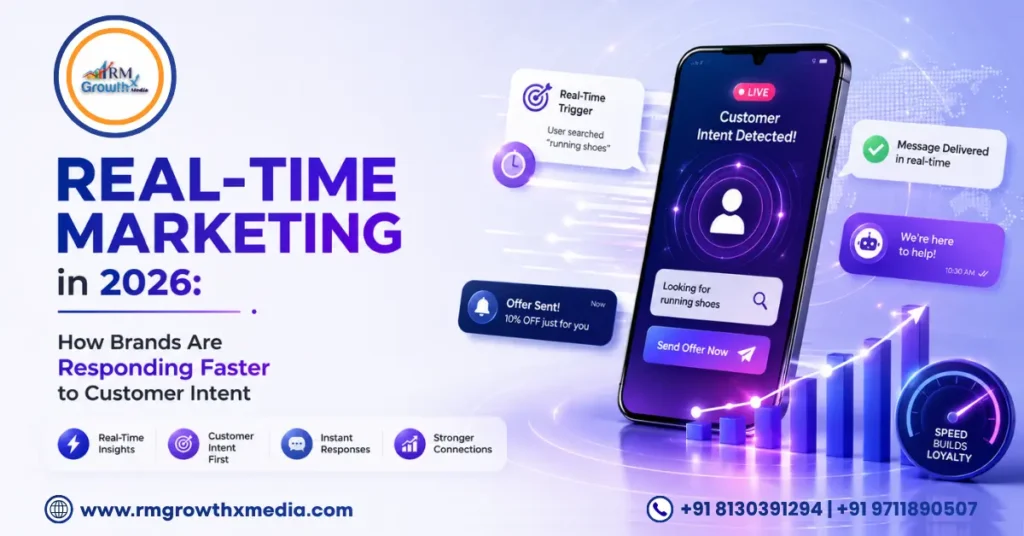
Customer expectations have changed dramatically. People expect brands to understand what they need, answer questions quickly, and provide relevant experiences at the moment they are ready to act. This is where real-time marketing in 2026 is becoming increasingly important.
Modern customers can search for a product, compare alternatives, watch a review, ask an AI assistant for recommendations, visit a website, and contact a business within minutes. Brands that wait days to respond to these signals can easily lose attention to faster competitors.
Real-time marketing in 2026 is not simply about posting on social media quickly. It is about identifying customer intent, understanding behavioral signals, and responding with the right message, offer, content, or experience at the right moment.
From AI-powered personalization and real-time analytics to social listening and intent-driven advertising, brands are increasingly using technology to react faster without sacrificing relevance or customer trust.
What Is Real-Time Marketing?
Real-time marketing is a digital marketing approach in which brands respond quickly to current customer behavior, conversations, trends, events, or intent signals.
In simple terms:
Real-time marketing means identifying what customers are doing or interested in right now and delivering a relevant marketing response while that interest is still active.
These signals can include:
- Search behavior
- Website activity
- Product views
- Content engagement
- Social media conversations
- Video interactions
- Cart activity
- Previous purchases
- Location signals
- Email engagement
- Customer service interactions
- AI search behavior
- Changes in customer preferences
For example, if someone repeatedly visits a service page, downloads an industry guide, and returns to a pricing page, those actions may indicate stronger purchase intent than a simple website visit.
A real-time marketing strategy can use these signals to deliver a more relevant next step.
Why Real-Time Marketing in 2026 Matters
Real-time marketing in 2026 matters because customers are generating more digital intent signals than ever before, while AI and analytics technologies allow businesses to respond to those signals faster.
Customers no longer move through a simple linear funnel.
A traditional journey might look like:
Awareness → Consideration → Purchase
Today’s journey can look more like:
Search → Social Media → AI Recommendation → Website → Comparison → Video → Review → Search Again → Purchase
Customers can move between these stages within minutes.
This creates a major opportunity for businesses.
Instead of waiting for a customer to complete a journey and analyzing the data afterward, marketers can increasingly respond while the journey is happening.
Google Analytics 4’s Realtime reporting, for example, allows businesses to monitor active users, traffic sources, content views, events, and key events as activity occurs. Google Analytics 4 Realtime Reports
The goal is not to react to every signal.
The goal is to identify high-value intent signals and respond appropriately.
Real-Time Marketing vs Traditional Marketing
Traditional marketing often depends on planned campaigns.
A business might:
- Research the audience.
- Develop a campaign.
- Create advertisements.
- Launch the campaign.
- Analyze results.
- Optimize the next campaign.
This process remains useful.
However, real-time marketing adds another layer.
Instead of only analyzing historical behavior, marketers monitor current behavior and adapt when necessary.
Traditional Marketing
Traditional campaign optimization may ask:
- What worked last month?
- Which advertisement generated the most clicks?
- Which landing page converted best?
- Which audience performed better?
Real-Time Marketing
Real-time marketing asks:
- What are customers interested in right now?
- Which content are they engaging with?
- What questions are they asking?
- Which product or service are they researching?
- What signals indicate purchase intent?
- What response would be most useful at this moment?
Both approaches can work together.
The difference is that real-time marketing gives brands the ability to respond faster.
How Customer Intent Has Changed in 2026
Customer intent is becoming more complex.
A person searching for “best SEO agency” has different intent from someone searching for “what is SEO?”
Similarly, someone visiting a homepage once has a different level of intent from someone who:
- Visits a service page multiple times
- Reads case studies
- Checks pricing
- Downloads a guide
- Watches a product video
- Starts a form
- Returns through branded search
These behavioral signals can help marketers understand where someone may be in their decision-making process.
Informational Intent
The customer wants to learn something.
Examples include:
- What is technical SEO?
- How does content marketing work?
- What is real-time marketing?
The appropriate response is educational content.
Commercial Intent
The customer is researching solutions.
Examples include:
- Best digital marketing agency
- SEO agency pricing
- Digital marketing services for startups
The appropriate response may include comparisons, case studies, service pages, or detailed guides.
Transactional Intent
The customer is ready to take action.
Examples include:
- Book SEO consultation
- Buy marketing software
- Request digital marketing quote
The experience should make conversion simple.
Understanding these differences allows businesses to create intent-based marketing campaigns instead of treating every visitor the same way.
AI Is Accelerating Real-Time Marketing
Artificial intelligence is one of the biggest developments influencing real-time marketing.
AI can process large amounts of behavioral and contextual information much faster than manual analysis.
Businesses can use AI to support:
- Customer segmentation
- Recommendation systems
- Predictive analytics
- Chatbots
- Content personalization
- Lead scoring
- Ad optimization
- Customer journey analysis
- Automated responses
- Audience targeting
This does not mean marketers should automate every interaction.
Instead, AI can help marketers identify patterns and prioritize opportunities.
Google’s current guidance for AI features in Search emphasizes the importance of helpful, reliable, people-first content and notes that foundational SEO practices remain relevant for appearing in AI-powered Search experiences. Google Search Central: AI Features and Your Website
This is important because real-time marketing should not become an excuse for producing irrelevant or automated content.
The response still needs to be useful.
Real-Time Personalization Is Becoming More Important
Personalization has moved beyond simply adding someone’s name to an email.
Modern personalization can consider:
- Previous interactions
- Current browsing behavior
- Purchase history
- Content preferences
- Location
- Device
- Referral source
- Engagement level
- Stage in the customer journey
For example, a returning visitor who previously downloaded an SEO guide may see content related to advanced SEO strategy rather than an introductory article.
The objective is to reduce irrelevant experiences.
Context Matters More Than Personalization Alone
Personalization without context can feel intrusive.
Imagine receiving a promotional message for something you purchased yesterday.
The brand technically personalized the communication, but the timing is wrong.
Real-time marketing combines:
Personalization + Context + Timing + Intent
That combination creates a much more useful customer experience.
Social Listening and Real-Time Marketing
Social media is one of the most obvious environments for real-time marketing.
Customers constantly discuss:
- Products
- Brands
- Industry trends
- Problems
- Competitors
- Experiences
- Complaints
- Recommendations
Brands can use social listening to identify relevant conversations.
For example, if customers are repeatedly asking the same question about a product, a company can quickly create:
- An explanatory post
- A short video
- A FAQ
- A tutorial
- A customer-service response
- A product update
This turns customer conversations into content opportunities.
However, brands should avoid forcing themselves into every trending conversation.
Relevance matters more than speed.
A fast response that has no connection to the brand can create more damage than value.
Real-Time Content Marketing
Content marketing is also becoming more responsive.
Instead of planning every article months in advance, marketers can maintain a flexible content calendar.
A strong approach combines:
Evergreen Content
Long-term resources such as:
- SEO guides
- How-to articles
- Industry tutorials
- Service explanations
Responsive Content
Content created around:
- Emerging trends
- Customer questions
- Industry developments
- New technologies
- Seasonal opportunities
- Breaking developments relevant to the audience
This combination creates stability while allowing brands to respond to changing customer interests.
Businesses can strengthen this strategy by investing in Digital Marketing Services that connect SEO, content, social media, paid campaigns, and audience insights into a unified marketing approach.
Real-Time SEO and Search Intent
SEO is also becoming increasingly intent-focused.
Search engines have become better at understanding the meaning behind queries rather than relying only on exact keyword matches.
This means businesses should create content that answers the actual needs behind searches.
For example, instead of creating separate pages simply because users search:
- SEO agency
- SEO company
- SEO services
- SEO marketing agency
A better strategy is to understand what users actually need to know when they search those terms.
Google recommends creating helpful, reliable, people-first content that provides original value rather than producing content primarily to manipulate search rankings.
For businesses looking to build stronger search visibility, Search Engine Optimization Services can support a broader strategy focused on search intent, technical foundations, useful content, and sustainable organic growth.
Real-Time Advertising and Dynamic Campaigns
Paid advertising is another area where real-time marketing can have a significant impact.
Advertising platforms can use signals such as:
- Search behavior
- Website interactions
- Audience characteristics
- Previous conversions
- Engagement
- Device
- Location
- Campaign performance
Marketers can then adjust campaigns based on performance.
For example, if a particular audience segment begins showing unusually strong engagement with a service, marketers may increase budget allocation toward that segment.
However, automation should be monitored carefully.
Real-time optimization does not mean allowing campaigns to operate without human oversight.
Marketers still need to evaluate:
- Brand safety
- Audience quality
- Conversion quality
- Budget efficiency
- Creative relevance
- Customer experience
Real-Time Marketing and Customer Experience
Marketing cannot operate separately from customer experience.
Imagine an advertisement promises fast support, but the customer receives a response three days later.
The marketing message and actual experience contradict each other.
Real-time marketing therefore requires coordination between:
- Marketing
- Sales
- Customer support
- Website
- CRM
- Analytics
- Product teams
A customer who submits a high-intent inquiry should not receive generic awareness-stage advertising for weeks.
Instead, the marketing system should recognize that the customer’s journey has changed.
The Role of First-Party Data
First-party data is becoming increasingly important for real-time marketing.
First-party data is information collected directly through a company’s own interactions with customers.
Examples include:
- Website activity
- Purchase history
- Email engagement
- Account information
- Customer support interactions
- Form submissions
- Loyalty activity
This data can help brands understand customer behavior while maintaining greater control over their customer relationships.
However, businesses must use customer data responsibly.
Real-time marketing should never mean collecting and using every possible piece of personal information simply because technology makes it possible.
Trust should remain a central principle.
How to Build a Real-Time Marketing Strategy
Step 1: Define High-Value Intent Signals
Not every action indicates strong intent.
Identify behaviors that matter to your business.
For example:
- Multiple service-page visits
- Pricing-page visits
- Demo requests
- Product comparisons
- High-value content downloads
- Repeat visits
- Cart activity
Step 2: Connect Your Data Sources
Your website, CRM, advertising platforms, email systems, and analytics tools should provide useful information that marketers can interpret.
Disconnected data makes real-time decision-making difficult.
Step 3: Create Response Playbooks
Decide what should happen when important signals appear.
For example:
Signal: Visitor repeatedly views pricing page.
Possible response: Offer a consultation, comparison guide, or relevant case study.
Signal: Customer abandons cart.
Possible response: Send an appropriate reminder or assistance message.
Signal: Audience engagement suddenly increases around a topic.
Possible response: Create timely content addressing that interest.
Step 4: Use Automation Carefully
Automation can help speed up repetitive processes.
But high-value customer interactions may still require human involvement.
The best model is often:
AI + Automation + Human Judgment
Step 5: Measure Outcomes
Do not measure only speed.
Track:
- Conversion rate
- Lead quality
- Customer engagement
- Revenue
- Retention
- Customer satisfaction
- Response time
- Assisted conversions
The objective is not simply to respond faster.
It is to respond better and more relevantly.
Real-Time Marketing Metrics to Track
Businesses can monitor several key performance indicators.
Response Time
How quickly does your business respond to customer actions or questions?
Conversion Rate
Does a real-time intervention actually improve conversion?
Engagement Rate
Are customers interacting with the content or message?
Qualified Lead Rate
Are faster responses producing better-quality leads?
Customer Retention
Does improved personalization contribute to stronger customer relationships?
Revenue per Customer
Does real-time marketing create measurable business value?
Customer Satisfaction
Fast marketing that frustrates customers is not successful marketing.
Quality matters alongside speed.
Common Real-Time Marketing Mistakes
Reacting Without Context
A brand may notice a trend and immediately create content without understanding why customers are discussing it.
Speed without context can damage credibility.
Over-Automating Communication
Customers can quickly recognize generic automated messages.
Automation should support relevance rather than replace human judgment.
Using Too Much Personal Data
Personalization should be useful, not invasive.
Customers need confidence that their information is handled responsibly.
Ignoring Brand Voice
Real-time content still needs to sound like your brand.
A sudden change in tone can create inconsistency.
Optimizing Only for Short-Term Results
A campaign may produce immediate engagement while damaging long-term trust.
Real-time marketing should support sustainable customer relationships.
The Future of Real-Time Marketing in 2026 and Beyond
Real-time marketing is likely to become increasingly connected with AI, predictive analytics, customer data platforms, and automated decision-making.
The next stage is not simply reacting to customer intent.
It is anticipating likely intent while still respecting customer choice.
For example, an AI system may identify that a customer who has read several educational articles is approaching a commercial decision.
Instead of immediately showing a hard sales message, the system could recommend a case study or comparison guide.
That creates a smoother transition from research to consideration.
The future of real-time marketing will therefore be less about “selling immediately” and more about being useful at the right moment.
Google’s current AI-search guidance similarly emphasizes unique, valuable, reliable content and a satisfying experience for users rather than creating large amounts of content simply to target every possible query.
How RM Growth X Media Can Help
Real-time marketing requires more than individual tools.
It requires a connected digital strategy that understands customer intent and turns it into meaningful action.
From SEO and content marketing to website optimization and broader digital campaigns, every channel should contribute to the customer journey.
A strong website is particularly important because it becomes the destination where many high-intent interactions eventually lead. Businesses looking to improve their online customer experience can explore Web Design & Development Services to create a faster, clearer, and more conversion-focused digital experience.
At RM Growth X Media, the goal should not simply be to help businesses generate traffic.
The bigger objective is to help brands become more visible, more relevant, more responsive, and more valuable to their target customers.
If your business wants to understand customer intent, strengthen digital visibility, improve engagement, and turn marketing signals into meaningful opportunities, RM Growth X Media can help you develop a digital marketing strategy built for the speed and expectations of 2026.
Frequently Asked Questions About Real-Time Marketing
Real-time marketing is a strategy in which businesses respond quickly to current customer behavior, intent signals, conversations, trends, or events with relevant marketing content, offers, or experiences.
Real-time marketing is important because customers increasingly expect relevant and timely experiences. AI, analytics, automation, and connected marketing platforms allow businesses to identify and respond to customer signals faster.
Customer intent refers to what a person is likely trying to accomplish through a digital interaction, such as learning, comparing options, researching a product, requesting information, or making a purchase.
AI can help marketers analyze behavioral signals, identify patterns, segment audiences, personalize experiences, score leads, recommend content, and automate certain responses.
No. Real-time marketing can be used across SEO, paid advertising, email marketing, websites, e-commerce, CRM, customer service, social media, and content marketing.
Important metrics can include response time, engagement rate, conversion rate, qualified lead rate, customer satisfaction, retention, revenue, and assisted conversions.
Yes. Small businesses can begin with simple tools such as website analytics, CRM alerts, email automation, social listening, and customer feedback. The strategy should start with a small number of high-value intent signals.
No. Real-time marketing complements traditional campaign planning. Businesses can combine long-term brand and content strategies with real-time responses to customer behavior and market changes.
Conclusion: Respond Faster, But Stay Relevant
Real-time marketing in 2026 is changing how businesses communicate with customers.
The competitive advantage is no longer simply having the biggest advertising budget or publishing the most content.
It is increasingly about understanding what customers want right now and responding with something genuinely useful.
Customer intent can appear through a search, website visit, product interaction, social media conversation, content download, or repeated engagement.
Brands that can identify these signals and respond appropriately can create more relevant customer experiences.
But speed alone is not enough.
A fast response that is irrelevant can damage trust.
A personalized message that feels invasive can push customers away.
An automated response without human judgment can create frustration.
The strongest real-time marketing strategies combine data, technology, AI, automation, human expertise, and customer empathy.
Businesses should therefore focus on five principles:
Listen to customer signals.
Understand intent.
Respond quickly.
Stay relevant.
Measure business outcomes.
As digital journeys become faster and AI continues changing how customers discover information, brands that respond intelligently to customer intent will be better positioned to compete.
The future of marketing is not simply about being faster.
It is about being faster at understanding what matters to the customer.
And that is what makes real-time marketing in 2026 such an important part of modern digital strategy.