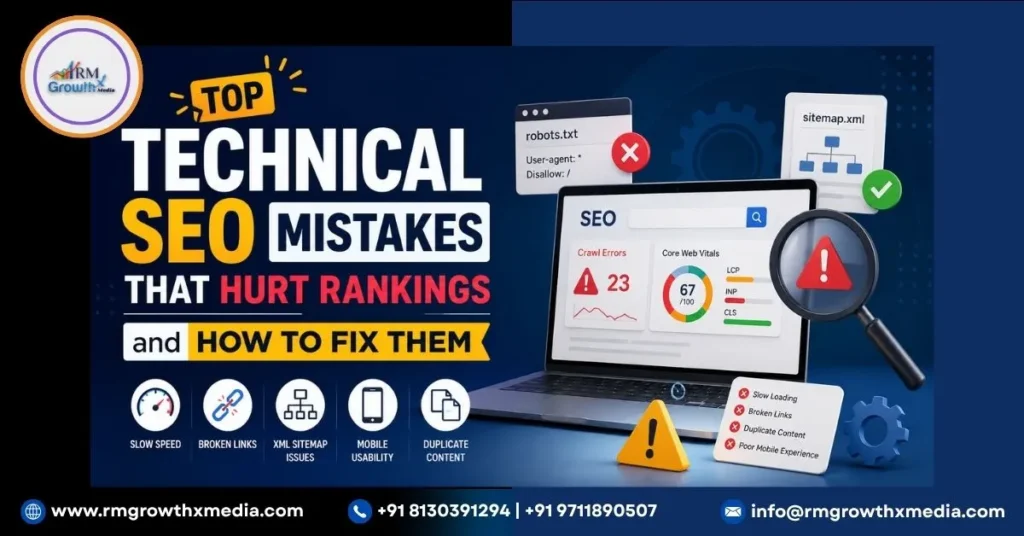
Search Engine Optimization (SEO) has evolved significantly over the past few years. While high-quality content and backlinks remain essential ranking factors, Technical SEO Mistakes have become one of the biggest reasons websites fail to achieve higher rankings on Google. Even the most valuable content may never appear in search results if search engines cannot properly crawl, index, or understand your website.
Many businesses unknowingly lose valuable organic traffic due to technical issues that silently affect their website’s performance. Problems such as incorrect robots.txt configurations, slow-loading pages, broken links, duplicate content, poor Core Web Vitals, and mobile usability issues can significantly reduce your website’s visibility in search results and create a poor user experience.
In this comprehensive guide, we’ll explore the top Technical SEO Mistakes that hurt rankings, explain why they matter, and provide practical solutions to fix them. Whether you manage a small business website, a corporate website, or a large eCommerce store, avoiding these common technical SEO issues can improve your website’s crawlability, indexing, page speed, user experience, and overall search performance.
If you’re looking for expert assistance, RM Growth X Media offers SEO Services, Digital Marketing Services, and Website Development Services to help businesses build technically optimized websites that rank higher, attract qualified organic traffic, and achieve long-term online growth.
Why Technical SEO Matters for Search Rankings
Technical SEO acts as the foundation of your entire SEO strategy.
Imagine building a beautiful house on a weak foundation—it won’t last. The same principle applies to websites. Without strong technical optimization, even excellent content and quality backlinks struggle to achieve sustainable rankings.
A technically optimized website helps search engines:
- Crawl every important page efficiently
- Index content correctly
- Understand website structure
- Deliver a better user experience
- Improve page loading speed
- Enhance mobile usability
Google has increasingly emphasized user experience through ranking signals such as Core Web Vitals, mobile-first indexing, HTTPS security, and page experience.
Ignoring technical SEO can result in:
- Lower rankings
- Reduced organic traffic
- Crawl budget wastage
- Indexing problems
- Higher bounce rates
- Lost conversions
If you’re looking to improve your website’s overall search performance, investing in Professional SEO Services is one of the most effective long-term strategies.
Top Technical SEO Mistakes That Hurt Rankings
1. Slow Website Speed
Website speed is no longer optional. A slow-loading website frustrates users and signals poor experience to Google.
Common causes include:
- Large image files
- Excessive JavaScript
- Unoptimized CSS
- Cheap hosting
- No caching
- Too many plugins
How to Fix It
- Compress images
- Enable browser caching
- Use CDN
- Minify CSS & JavaScript
- Upgrade hosting
- Enable GZIP compression
Recommended Tool: Google PageSpeed Insights
2. Poor Core Web Vitals
Core Web Vitals measure real-world user experience.
Google evaluates:
- Largest Contentful Paint (LCP)
- Interaction to Next Paint (INP)
- Cumulative Layout Shift (CLS)
Poor scores negatively affect rankings.
How to Fix It
- Reduce server response time
- Optimize images
- Remove render-blocking resources
- Reserve image dimensions
- Improve JavaScript execution
3. Missing XML Sitemap
Without an XML sitemap, Google may miss important pages. A sitemap helps search engines discover new and updated pages quickly.
Best Practices
- Include only indexable pages
- Update automatically
- Submit in Google Search Console
- Remove redirected URLs
4. Broken Internal Links
Broken links waste crawl budget and create poor user experience.
Examples include:
- 404 pages
- Deleted service pages
- Wrong URLs
- Incorrect redirects
Solution:
Regularly audit your website using:
5. Incorrect Robots.txt Configuration
Many websites accidentally block important pages.
Example:
Disallow: /
This prevents Google from crawling the website.
Always verify Robots.txt after website migration.
6. Duplicate Content Issues
Duplicate content confuses Google.
Examples include:
- HTTP vs HTTPS
- WWW vs Non-WWW
- Product variations
- Printer-friendly pages
- URL parameters
How to Fix It
Use:
- Canonical Tags
- 301 Redirects
- Proper URL structure
7. Missing Canonical Tags
Canonical tags tell Google which version of a page should be indexed. Without canonicalization, duplicate pages compete against each other.
8. Poor Mobile Optimization
More than half of searches come from mobile devices.
Common issues:
- Tiny fonts
- Buttons too close
- Horizontal scrolling
- Slow mobile speed
Use responsive web design.
9. Improper Redirects
Common redirect mistakes include:
- Redirect chains
- Redirect loops
- Temporary redirects instead of permanent
- Broken redirects
Always use 301 redirects for permanent page changes.
10. HTTPS Problems
Security is a confirmed ranking factor.
Issues include:
- Mixed content
- Expired SSL certificate
- HTTP pages still accessible
Always redirect HTTP to HTTPS.
11. Crawl Budget Waste
Large websites often waste crawl budget.
Reasons include:
- Faceted URLs
- Duplicate pages
- Broken links
- Parameter URLs
Optimize crawling efficiency.
12. Thin Content Pages
Pages with very little information often struggle to rank
Improve them by adding:
- Detailed explanations
- FAQs
- Images
- Examples
- Statistics
13. Missing Structured Data
Schema helps search engines understand content.
Useful schema types:
- Organization
- Local Business
- FAQ
- Article
- Breadcrumb
- Review
Structured data increases chances of rich results.
14. Poor URL Structure
Bad URL:
website.com/page?id=1289
Good URL:
website.com/technical-seo-mistakes/
Keep URLs:
- Short
- Descriptive
- Keyword-rich
15. Orphan Pages
Orphan pages have no internal links pointing to them.
Search engines struggle to discover them.
Always connect important pages through internal linking.
Technical SEO Audit Checklist
Before publishing or auditing your website, ensure that you have:
- XML Sitemap
- Robots.txt
- HTTPS
- Mobile-Friendly Design
- Core Web Vitals Optimization
- Canonical Tags
- Structured Data
- Internal Linking
- Image Optimization
- Fast Hosting
- No Broken Links
- Clean URL Structure
- Breadcrumb Navigation
- Optimized Redirects
- Google Search Console Setup
Best Tools for Finding Technical SEO Mistakes
Professional SEO experts rely on multiple tools to identify hidden issues that affect search visibility. Using these tools regularly can help maintain a healthy website and quickly detect problems before they impact rankings.
Google Search Console
One of the most essential free tools for monitoring indexing, crawl errors, mobile usability, Core Web Vitals, and security issues. It also provides valuable insights into keyword performance and search visibility.
Google PageSpeed Insights
Analyzes website speed and provides actionable recommendations to improve performance across desktop and mobile devices.
Screaming Frog SEO Spider
A powerful desktop crawler that identifies broken links, redirect chains, duplicate content, missing metadata, orphan pages, and technical issues across your website.
Ahrefs Site Audit
Offers comprehensive technical audits, backlink analysis, and website health scores to help prioritize SEO fixes.
Semrush Site Audit
Scans websites for technical SEO errors, HTTPS issues, crawlability problems, and on-page optimization opportunities. Regularly using these tools helps maintain a technically healthy website and ensures search engines can crawl and index your content effectively.
Common Technical SEO Mistakes During Website Redesign
Website redesigns often introduce new technical issues if SEO is not considered from the beginning. Some of the most common mistakes include:
- Changing URLs without implementing 301 redirects.
- Removing high-performing pages.
- Forgetting to migrate metadata.
- Blocking search engines through robots.txt during development and leaving it unchanged after launch.
- Failing to update XML sitemaps.
- Ignoring mobile responsiveness.
- Losing structured data.
- Creating duplicate pages during migration.
Planning SEO before launching a redesigned website helps preserve existing rankings and organic traffic.
How RM Growth X Media Can Help
At RM Growth X Media, we understand that technical SEO is the backbone of sustainable organic growth. Our team conducts detailed website audits to uncover hidden issues affecting your search performance.
Our services include:
From improving website speed and Core Web Vitals to fixing crawl errors and implementing structured data, we ensure your website is technically sound and ready to compete in search results.
Frequently Asked Questions (FAQs)
Technical SEO refers to optimizing a website's infrastructure so search engines can efficiently crawl, index, and rank its pages.
Technical issues can prevent pages from being indexed, reduce crawl efficiency, slow website performance, and negatively impact user experience, ultimately lowering search rankings.
A complete technical SEO audit should be performed at least every three to six months, or immediately after a website redesign or migration.
Yes. Resolving technical issues enhances crawlability, page speed, mobile usability, and overall user experience, all of which contribute to better search engine rankings.
Google Search Console is one of the best free tools for identifying indexing, crawling, mobile usability, and Core Web Vitals issues.
Conclusion
Ignoring Technical SEO Mistakes can severely limit your website’s ability to rank, no matter how valuable your content or how strong your backlink profile may be. By regularly auditing your website, improving page speed, fixing crawl errors, optimizing Core Web Vitals, implementing structured data, and maintaining a clean site architecture, you create a solid foundation for long-term SEO success.
Technical SEO is not a one-time task—it requires continuous monitoring as search engine algorithms evolve and websites grow. Businesses that prioritize technical excellence gain a competitive edge through improved user experience, higher search visibility, and sustainable organic traffic.
If you’re ready to eliminate Technical SEO Mistakes and maximize your website’s ranking potential, the experts at RM Growth X Media are here to help. Our team specializes in technical SEO audits, on-page optimization, website development, and digital marketing strategies tailored to your business goals.
Contact RM Growth X Media today for a comprehensive Technical SEO audit and take the first step toward stronger rankings, increased traffic, and long-term online success.