
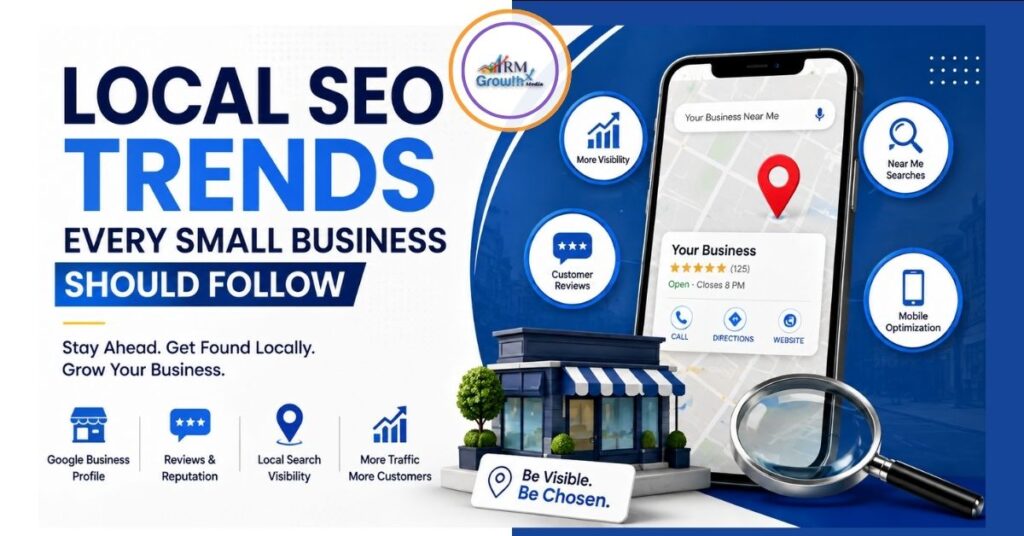
For small businesses, being visible to customers in the right location can make a major difference. When someone searches for a nearby restaurant, service provider, retailer, agency, clinic, or professional, appearing prominently in local search results can bring highly relevant customers to your business. This is why understanding the latest Local SEO Trends is becoming increasingly important for small businesses that want to compete in their local markets.
Search behavior continues to evolve. Customers are using Google Search, Google Maps, mobile devices, voice searches, reviews, and increasingly conversational search experiences to discover local businesses. At the same time, Google is becoming better at understanding search intent, business information, location, relevance, and customer experience.
For small businesses, this means local SEO is no longer just about adding a city name to a website or creating a Google Business Profile. A successful local SEO strategy requires accurate business information, strong reviews, useful local content, optimized landing pages, consistent online signals, and a technically sound website.
In this guide, we’ll explore the most important Local SEO Trends every small business should follow, explain why they matter, and share practical ways to use them to increase local visibility, website traffic, leads, and customers.
What Are the Latest Local SEO Trends?
The most important Local SEO Trends for small businesses include Google Business Profile optimization, review management, localized content, mobile optimization, local keyword targeting, consistent business information, local citations, structured data, high-quality visual content, and optimization for conversational and “near me” searches.
Following these trends helps businesses improve their visibility across Google Search and Maps while creating a better experience for local customers.
Why Local SEO Matters for Small Businesses
Local SEO focuses on improving a business’s visibility when people search for products or services in a specific geographic area.
For example, a customer might search for:
- Digital marketing agency near me
- Best bakery in Delhi
- Dentist near me
- Web development company in Noida
- AC repair service near me
- SEO agency in Delhi
- Best restaurant near me
These searches often have strong purchase intent. Someone searching for a service near their location may be much closer to making a decision than someone performing a general informational search.
Google explains that local search visibility is influenced by factors including relevance, distance, and prominence. Google also recommends keeping Business Profile information complete and accurate.
For small businesses, this makes local SEO an important channel for reaching customers who are actively looking for what they offer.
Top Local SEO Trends Every Small Business Should Follow
1. Google Business Profile Optimization Is More Important Than Ever
One of the most important Local SEO Trends is the continued importance of Google Business Profile optimization.
Your Google Business Profile can appear when customers search for your business, services, products, or relevant local queries on Google Search and Google Maps.
A verified Business Profile allows businesses to manage important information such as:
- Business name
- Address
- Phone number
- Website
- Business hours
- Photos
- Services
- Products
- Reviews
Google states that businesses can use their Business Profile to manage how they appear on Search and Maps and interact with customers through photos, videos, and reviews.
How to Optimize Your Google Business Profile
Make sure your profile:
- Is claimed and verified
- Uses accurate business information
- Has the correct primary category
- Includes relevant secondary categories where appropriate
- Has updated business hours
- Includes high-quality photos
- Lists relevant services
- Contains an accurate website URL
- Actively responds to customer reviews
Avoid adding unnecessary keywords to your business name. Your profile should accurately represent how your business is known in the real world and follow Google’s Business Profile guidelines.
2. Reviews and Reputation Management Are Critical
Online reviews have become a major part of the local customer journey.
Before contacting a business, customers often check its:
- Star rating
- Number of reviews
- Recent reviews
- Customer responses
- Photos
- Overall reputation
A business with hundreds of genuine, recent, positive reviews can create more confidence than a competitor with very few reviews.
Google also notes that reviews and positive ratings can contribute to local prominence.
Best Practices for Local Reviews
Encourage genuine customers to leave honest feedback.
You should also:
- Respond professionally to positive reviews
- Respond constructively to negative reviews
- Avoid buying fake reviews
- Avoid offering rewards in exchange for positive reviews
- Monitor reviews regularly
- Learn from recurring customer complaints
Remember, reputation management is not simply about getting five-star ratings. It is about building genuine customer trust.
3. “Near Me” Searches Continue to Matter
Local intent is often clearly visible in searches containing phrases such as:
- Near me
- Nearby
- Open now
- In my area
- Near [location]
- Best [service] in [city]
However, businesses should not create awkward pages filled with repetitive “near me” keywords.
Instead, optimize your website for the underlying local search intent.
For example, a restaurant can create useful content around:
- Restaurant near [neighborhood]
- Family dining in [city]
- Best lunch options in [area]
- Restaurants open late in [city]
A service business can create location-specific pages describing the areas it genuinely serves.
4. Localized Content Is Becoming a Competitive Advantage
Generic content is easy to create, but genuinely useful local content is harder for competitors to replicate.
This makes localized content one of the most valuable Local SEO Trends for small businesses.
Instead of publishing generic articles such as:
“Why Digital Marketing Is Important”
A local agency could create:
“How Small Businesses in Delhi Can Use Digital Marketing to Generate Local Leads”
The second topic has stronger local relevance.
Examples of Local Content
You could create:
- Local buying guides
- Neighborhood guides
- City-specific service pages
- Local industry insights
- Case studies
- Customer success stories
- Local event guides
- Frequently asked questions from local customers
The objective should always be to provide genuine value rather than simply inserting location keywords into existing content.
5. Mobile-First Local SEO Is Essential
Local searches frequently happen when customers are away from their computers.
Someone may search for a business while:
- Driving
- Shopping
- Traveling
- Comparing nearby businesses
- Looking for immediate services
This makes mobile optimization extremely important.
Your website should:
- Load quickly
- Use readable fonts
- Have easy navigation
- Make phone numbers clickable
- Make contact forms mobile-friendly
- Display location information clearly
- Avoid intrusive pop-ups
- Work properly across different screen sizes
A potential customer who cannot easily use your website on mobile may simply choose a competitor.
6. Local Keyword Research Is Becoming More Intent-Focused
Local keyword research is moving beyond simply finding high-volume keywords.
Small businesses should focus on search intent + service + location.
For example:
Broad keyword:
SEO services
Local keyword:
SEO services in Delhi
High-intent local keyword:
SEO company for small businesses in Delhi
The third keyword may have lower search volume, but it can be significantly more relevant to a specific business.
Build Keyword Groups Around:
- Your core service
- Your city
- Your neighborhoods
- Nearby service areas
- Customer problems
- Commercial intent
- “Near me” searches
- Local questions
This creates a more comprehensive local keyword strategy.
7. Consistent Business Information Across the Web
Consistency is an important part of local SEO.
Your business's key information should be accurate across your:
- Website
- Google Business Profile
- Local directories
- Social profiles
- Industry directories
- Review platforms
Pay particular attention to:
NAP — Name, Address, Phone Number
If your business information is outdated or inconsistent across important platforms, customers may become confused and search engines may have less confidence in which information is correct.
Google also explains that Business Profile information can be compiled from multiple sources, including websites, third-party data, users, and business owners.
8. Local Citations Still Have a Role
A local citation is a mention of your business information on another website or directory.
Examples include:
- Business directories
- Local chambers of commerce
- Industry directories
- Local publications
- Professional associations
- Relevant business listing websites
The focus should not be on creating hundreds of low-quality directory listings. Instead, prioritize relevant, trustworthy, and legitimate platforms.
A few high-quality local citations can be more valuable than a large collection of irrelevant listings.
9. Local Business Schema and Structured Data
Structured data helps search engines understand information about your business.
Google’s documentation explains that LocalBusiness structured data can communicate details such as business hours, departments, reviews, and other business information.
Depending on the business, relevant structured data may include:
- LocalBusiness
- Organization
- Restaurant
- Dentist
- Store
- ProfessionalService
- Breadcrumb
However, structured data should be implemented accurately and according to Google’s guidelines. It should not be used to create misleading information.
10. Visual Content Is Becoming More Important
Photos can influence how customers perceive a local business before they ever visit its website.
For example, a restaurant can showcase:
- Interior
- Exterior
- Food
- Staff
- Events
A service business can show:
- Team members
- Completed projects
- Office
- Equipment
- Before-and-after work
Keep your visual content authentic and relevant. Avoid using generic stock images when real photos of your business would provide more trust and context.
11. Conversational Search and AI Are Changing Local Discovery
Search is becoming increasingly conversational.
Customers may ask questions such as:
“What is the best digital marketing agency near me for a small business?”
or:
“Which restaurants near me are open right now?”
This means businesses should create content that directly answers real customer questions.
Rather than focusing only on short keywords, consider the questions your customers actually ask before contacting you.
Create Content Around:
- What does your service cost?
- How long does the service take?
- Which areas do you serve?
- What should customers expect?
- What makes your service different?
- How can customers contact you?
- What questions do customers frequently ask?
Clear, helpful content can support visibility across increasingly conversational search experiences.
12. Location-Specific Landing Pages Can Capture More Local Searches
Businesses serving multiple locations can benefit from well-designed location pages.
For example:
- /seo-services-delhi/
- /seo-services-noida/
- /seo-services-gurgaon/
However, each page should contain genuinely useful, unique information.
Avoid creating dozens of nearly identical pages where only the city name changes.
A useful location landing page could include:
- Services offered in the area
- Local customer needs
- Areas served
- Local case studies
- Relevant testimonials
- Contact information
- FAQs
- Directions or service details
Quality matters more than the number of location pages.
Local SEO Trends vs Traditional SEO
Local SEO and traditional SEO share many principles, but local SEO has a stronger geographic focus.
|
Traditional SEO
|
Local SEO
|
|---|---|
|
Targets broader search queries
|
Targets location-based searches
|
|
Focuses heavily on organic rankings
|
Focuses on organic + local visibility
|
|
Content and backlinks are important
|
Reviews, local relevance, and business information are also important
|
|
Targets national/global audiences
|
Targets customers in specific areas
|
|
General keyword research
|
Local intent and geographic keyword research
|
For small businesses that primarily serve a specific geographic market, local SEO should be an important part of the overall SEO strategy.
Local SEO Checklist for Small Businesses
Use this checklist to evaluate your current local SEO strategy:
- Business Profile claimed and verified
- Correct business category
- Accurate business information
- Updated business hours
- High-quality business photos
- Services/products added where relevant
- Reviews monitored and answered
Website
- Local keywords naturally incorporated
- Location/service pages optimized
- Mobile-friendly design
- Fast loading speed
- Clear contact information
- Click-to-call phone number
- LocalBusiness structured data where appropriate
Off-Page SEO
- Consistent NAP information
- Relevant local citations
- Industry directory listings
- Local backlinks
- Genuine customer reviews
Content
- Local FAQs
- Location-specific content
- Helpful service pages
- Local case studies
- Customer-focused blog content
How to Measure Local SEO Success
Implementing local SEO strategies without tracking results makes it difficult to know what is working.
Small businesses should monitor metrics such as:
- Local search visibility
- Google Business Profile interactions
- Website organic traffic
- Calls from local customers
- Form submissions
- Direction requests
- Website clicks
- Review growth
- Local keyword rankings
- Leads generated from organic search
The most important metric is not simply ranking higher. The goal is to generate qualified local customers and measurable business growth.
How RM Growth X Media Can Help With Local SEO
Implementing Local SEO Trends effectively requires more than adding keywords to a website. Businesses need a complete strategy covering technical optimization, content, website performance, local visibility, and digital marketing.
RM Growth X Media can help businesses strengthen their online presence through:
- Search Engine Optimization Services
From keyword research and on-page optimization to technical SEO and search visibility, professional SEO can help create a stronger foundation for long-term organic growth. - Digital Marketing Services
A strong local presence can work alongside broader digital marketing activities to attract potential customers across multiple online channels. - Website Design & Development Services
Your website is an important part of your local search strategy. A fast, mobile-friendly, user-focused website can help turn local visitors into leads and customers.
Whether you operate a local service business, retail store, professional practice, agency, or growing company, a customized local SEO strategy can help you compete more effectively in your target market.
Frequently Asked Questions About Local SEO Trends
The most important trends include Google Business Profile optimization, review management, localized content, mobile optimization, local keyword targeting, consistent business information, local citations, structured data, and conversational search optimization.
Yes. A verified and accurately maintained Google Business Profile helps eligible businesses manage how their information appears across Google Search and Maps.
Reviews can influence customer trust and contribute to a business's prominence in local search. Google specifically identifies reviews and positive ratings as factors that can contribute to local ranking.
Only when those locations are genuinely served and each page can provide useful, unique information. Creating large numbers of nearly identical location pages can result in low-value content.
Businesses should review their profile regularly and update information whenever details such as hours, services, contact information, photos, or other business details change.
Eligibility depends on the business model and Google's Business Profile guidelines. Businesses that interact with customers face-to-face at a physical location or travel to customers in a service area may be eligible.
There is no guaranteed timeline. Results depend on factors such as competition, website authority, existing local visibility, business category, location, reviews, content quality, and the overall SEO strategy. Consistent optimization is generally more effective than expecting immediate results.
Conclusion
The local search landscape continues to evolve, and small businesses need to keep up with the latest Local SEO Trends to remain competitive. Optimizing your Google Business Profile, building a strong review strategy, creating useful local content, improving mobile experience, maintaining consistent business information, targeting local search intent, and implementing appropriate structured data can create a stronger foundation for local visibility.
However, local SEO should not be treated as a one-time task. Business information changes, customer expectations evolve, competitors publish new content, and search technology continues to develop. Regular monitoring and optimization are essential for sustainable results.
For small businesses, the goal should not simply be to rank for more keywords. The real objective is to become more visible when potential customers are actively looking for your products or services in the areas you serve.
If you want to improve your local search visibility and turn more nearby searches into qualified leads, RM Growth X Media can help you build a customized SEO and digital marketing strategy for your business.
Get started today and strengthen your local online presence with RM Growth X Media.