Introduction
Publishing content consistently is easier when every post has a purpose, a deadline, and a clear place in your marketing strategy. Yet many businesses struggle to maintain a regular publishing schedule. Ideas run out, campaigns overlap, and social media posts are often created at the last minute.
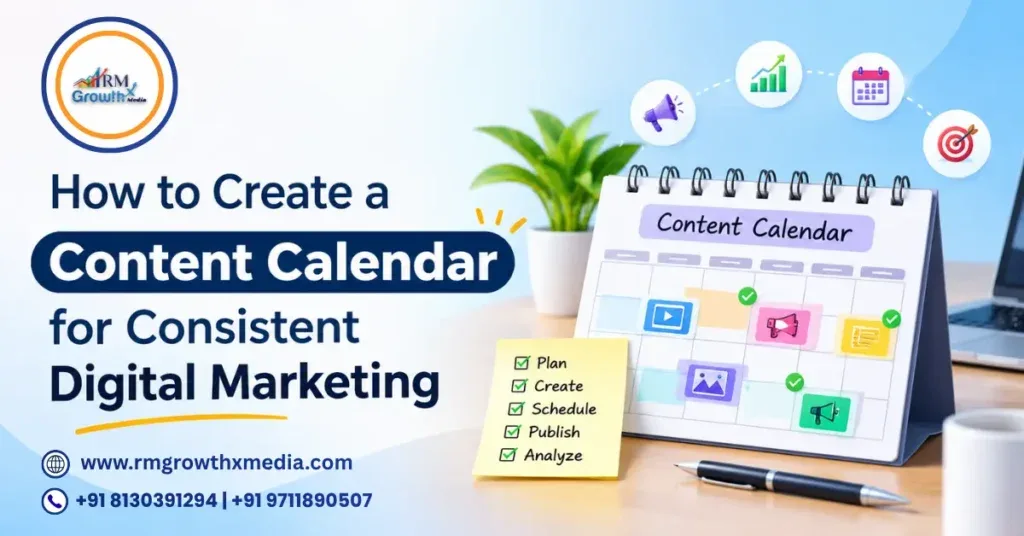
A well-planned content calendar for digital marketing helps solve these challenges by organizing topics, formats, publishing dates, platforms, and responsibilities in one place. It gives your team a clear direction while leaving enough flexibility to respond to audience needs and industry developments.
In this guide, you’ll learn how to create a content calendar, choose the right content themes, plan across marketing channels, manage production, and measure performance. You’ll also find a practical monthly example and a repeatable workflow that can work for small businesses, startups, and growing marketing teams.
What Is a Content Calendar in Digital Marketing?
A content calendar is a planning document that organizes the content a business intends to create, publish, and distribute over a specific period.
It typically includes content topics, publishing dates, formats, platforms, target audiences, campaign objectives, and production responsibilities.
A content calendar helps marketers move from reactive publishing to a more organized approach. Instead of deciding what to post each morning, teams can plan ahead, coordinate campaigns, and make sure content supports business objectives.
A content calendar may cover:
- Blog articles and website content
- Social media posts
- Email newsletters
- Video content and Reels
- Promotional campaigns
- Seasonal content
- Case studies and customer stories
- Educational resources
A content calendar is not necessarily the same as a content strategy. The strategy defines what you want to achieve and why. The calendar translates that strategy into specific publishing activities.
Why Is a Content Calendar Important for Digital Marketing?
A content calendar is valuable because it connects content planning with execution. It helps businesses maintain consistency without sacrificing relevance or quality.
Here are the major benefits.
1. Maintains Consistent Publishing
Consistency helps audiences understand when and where they can expect useful content from your brand.
A calendar makes publishing more manageable by allowing teams to prepare content in advance. If a business plans three social media posts each week, those posts can be drafted, reviewed, and scheduled before the week begins.
Consistency does not mean publishing every day. It means choosing a realistic schedule and maintaining it.
2. Supports Better Marketing Strategy
Every piece of content should contribute to a broader objective.
For example:
- Educational blog posts can support organic search visibility.
- Social media content can build awareness and engagement.
- Email newsletters can nurture existing subscribers.
- Case studies can help prospective customers evaluate your services.
- Product demonstrations can support purchase decisions.
A calendar makes these objectives visible, helping marketers avoid publishing content simply to fill a schedule.
3. Improves Team Collaboration
Content production often involves multiple people, including writers, designers, editors, social media managers, and marketing executives.
Without a shared calendar, team members may not know who owns a task or when a deliverable is due.
A well-maintained calendar clarifies:
- Who is responsible for each asset
- When the first draft is due
- Who needs to approve the content
- When the content will be published
- Whether the content is ready or delayed
This reduces confusion and makes the workflow easier to manage.
4. Helps Businesses Plan Seasonal Campaigns
Festivals, product launches, industry events, and seasonal promotions often require advance preparation.
For example, an Indian e-commerce business may need to plan Diwali campaigns several weeks before the festival. The campaign could include product photography, promotional emails, social media creatives, blog content, and paid advertisements.
A calendar allows these activities to be coordinated instead of rushed.
5. Makes Content Performance Easier to Evaluate
When content is planned around specific objectives, performance can be evaluated more meaningfully.
A business can compare:
- Which topics attract organic traffic
- Which social posts generate meaningful engagement
- Which email campaigns encourage website visits
- Which content assets contribute to qualified leads
- Which formats are worth producing again
This information helps marketers improve future content decisions.
How to Create a Content Calendar for Digital Marketing: 10 Practical Steps
Creating a useful content calendar does not require a complicated system. The most important thing is to establish a repeatable process that connects audience needs, marketing goals, content production, and performance measurement.
Follow these ten steps.
Step 1: Define Your Marketing Goals
Start by identifying what your content needs to accomplish.
A content calendar should be built around business objectives rather than an arbitrary number of posts.
Common content marketing goals include:
|
Marketing goal
|
Suitable content
|
Measurement
|
|---|---|---|
|
Increase brand awareness
|
Short videos, educational posts
|
Reach, impressions
|
|
Improve organic visibility
|
SEO blog articles, guides
|
Organic clicks, impressions
|
|
Generate leads
|
Webinars, lead magnets, landing pages
|
Qualified leads, conversion rate
|
|
Build audience engagement
|
Polls, questions, interactive posts
|
Engagement rate, comments
|
|
Support customer retention
|
Email newsletters, tutorials
|
Repeat visits, retention
|
|
Support sales
|
Case studies, product comparisons
|
Assisted conversions, enquiries
|
Choose one primary objective for each content campaign.
For example, a B2B company may prioritize lead generation through educational blog content and downloadable resources. A local service business may focus on visibility, trust, and enquiries.
These goals will influence your topics, formats, publishing frequency, and calls to action.
Step 2: Understand Your Target Audience
The most effective content calendar reflects what your audience wants to learn, solve, compare, or achieve.
Start by identifying your audience’s:
- Demographics and professional background, where relevant
- Interests and common challenges
- Questions about your products or services
- Preferred content formats
- Online behavior
- Buying journey
For example, a digital marketing agency targeting small business owners may discover that its audience wants practical guidance on SEO, social media management, website performance, and lead generation.
These insights can become content themes.
Useful sources of audience information include:
- Customer enquiries
- Sales conversations
- Website search queries
- Social media comments
- Customer reviews
- Google Search Console
- Website analytics
- Frequently asked questions
Avoid assuming that your audience wants the same content as your competitors’ audiences. Use actual customer questions and behavior to guide your decisions.
Step 3: Conduct Content and Keyword Research
Once you understand your audience, identify topics that deserve a place in your calendar.
For SEO-focused content, keyword research helps you understand the language people use when searching for information.
Consider the following example:
|
Primary topic
|
Supporting topic
|
Search intent
|
|---|---|---|
|
Content calendar
|
How to create a content calendar
|
Informational
|
|
Social media marketing
|
Social media posting schedule
|
Informational
|
|
SEO content
|
Content planning for SEO
|
Informational
|
|
Content marketing
|
Content marketing strategy examples
|
Informational
|
|
Digital marketing
|
Digital marketing campaign planning
|
Informational
|
Look beyond search volume. Consider whether the topic is relevant to your business, whether you can provide a useful answer, and whether the content supports a meaningful objective.
You can also review existing content to identify:
- Articles that need updating
- Topics that have not been covered
- Pages with declining traffic
- Content that can be repurposed
- Questions that existing articles do not answer
Google recommends creating helpful, reliable, people-first content rather than producing pages primarily to manipulate search rankings. Its guidance on creating helpful content is a useful reference when evaluating your content ideas.
Step 4: Choose Your Content Pillars
Content pillars are broad themes that organize your content around your business expertise and audience interests.
They help prevent your calendar from becoming a collection of unrelated topics.
For a digital marketing agency, possible content pillars include:
Educational content: Guides, tutorials, explanations, and practical marketing tips.
Industry insights: Relevant platform updates, marketing developments, and emerging practices.
Service-related content: Information about SEO, paid advertising, social media management, and web development.
Trust-building content: Team insights, customer questions, process explanations, and genuine project examples.
Conversion-focused content: Consultation invitations, service explainers, and resources that help prospective customers take the next step.
A business can adjust these pillars according to its industry and goals.
For example, an e-commerce brand may prioritize product education, customer reviews, buying guides, and seasonal promotions.
The objective is to maintain a useful balance between educational, engaging, and business-focused content.
Step 5: Select the Right Content Formats and Channels
Not every topic needs to become a blog article, and not every platform requires identical content.
Choose formats according to the audience, topic, and marketing objective.
|
Content format
|
Suitable channels
|
Typical purpose
|
|---|---|---|
|
Blog articles
|
Website, LinkedIn
|
Education, organic visibility
|
|
Short-form videos
|
Instagram, YouTube
|
Awareness, engagement
|
|
Infographics
|
Pinterest, LinkedIn
|
Simplifying information
|
|
Email newsletters
|
Email
|
Nurturing subscribers
|
|
Case studies
|
Website, LinkedIn
|
Building trust
|
|
Polls and questions
|
LinkedIn, Instagram
|
Audience interaction
|
|
Product demonstrations
|
Website, YouTube
|
Supporting purchase decisions
|
A useful approach is to create one primary content asset and adapt it for different channels.
For example, a blog article about improving lead quality could be repurposed into:
- A LinkedIn carousel explaining five practical tips
- An Instagram Reel covering one common mistake
- An email newsletter summarizing the key lessons
- A short infographic highlighting the main takeaways
Repurposing allows you to extend the usefulness of existing content without requiring a completely new idea for every platform.
Step 6: Decide Your Publishing Frequency
Your publishing frequency should reflect your resources, audience expectations, and content objectives.
A small business may be able to maintain two or three social media posts each week and publish one detailed blog article every two weeks.
A larger marketing team may support a more frequent schedule.
The key is to select a realistic publishing frequency that your team can maintain without compromising quality.
Consider:
- How much time is available for research and writing?
- How many designs or videos can the team produce?
- How long does approval usually take?
- Which channels deserve the most attention?
- How frequently does the audience engage with your content?
Start with a manageable schedule and adjust it as you learn more about content performance.
Step 7: Build Your Content Calendar
Now bring your research, goals, content pillars, and publishing schedule into one shared document.
Your calendar should provide enough information for the team to understand what needs to be created and when.
Recommended fields include:
|
Calendar field
|
Purpose
|
|---|---|
|
Publish date
|
Planned publication date
|
|
Topic
|
Subject of the content
|
|
Content pillar
|
Main content theme
|
|
Format
|
Blog, Reel, carousel, email
|
|
Channel
|
Website, Instagram, LinkedIn
|
|
Objective
|
Awareness, engagement, leads
|
|
Primary keyword
|
SEO focus, where relevant
|
|
Owner
|
Person responsible
|
|
Status
|
Current production stage
|
|
CTA
|
Intended audience action
|
|
Asset link
|
Draft, design, or final file
|
|
Performance
|
Results after publication
|
A spreadsheet is sufficient for many small businesses. Larger teams may prefer project management or social media scheduling tools.
The best calendar is one that your team can update and use consistently.
Step 8: Establish a Content Production Workflow
A calendar becomes more useful when it includes a clear production process.
A practical workflow might look like this:
Research Topics
Add to Content Calendar
Assign Content Owner
Review and Approve
Schedule or Publish
Measure Performance
Improve Future Content
Each stage should have a clear owner and deadline.
For example, a blog article scheduled for the 20th of the month might follow this timeline:
- 8th: Topic research and outline
- 11th: First draft
- 14th: Editorial review
- 16th: SEO and design work
- 18th: Final approval
- 20th: Publication
This timeline is only an example. The actual schedule should reflect the complexity of the content and the team’s available resources.
Step 9: Schedule Content and Prepare for Changes
Scheduling tools help teams publish content at planned times without requiring someone to manually post every asset.
However, scheduling should not remove the need for regular review.
Before publishing, check:
- Whether the content is accurate
- Whether the creative matches the message
- Whether the CTA works
- Whether the links are correct
- Whether the content is appropriate for the platform
- Whether a recent event makes the post irrelevant or insensitive
Leave some space in your calendar for timely content.
A rigid schedule can become a problem when important industry developments, customer questions, or unexpected events require a response.
Step 10: Review Performance and Improve the Calendar
Your content calendar should evolve based on actual results.
At the end of each week or month, review the performance of published content.
Look at metrics that align with the original objective.
For example:
- Awareness content: reach and impressions
- SEO content: organic clicks and search impressions
- Engagement content: meaningful interactions
- Lead generation content: qualified enquiries and conversions
- Email content: clicks and downstream actions
Avoid evaluating every piece of content using the same metric.
A detailed educational article may be valuable because it attracts relevant search traffic over time. A social media post may be useful because it generates meaningful conversations, even if its reach is modest.
Use these insights to decide which topics to expand, update, repurpose, or discontinue.
Monthly Content Calendar Example for Digital Marketing
A monthly content calendar makes the planning process easier to visualize.
The following example is designed for a digital marketing agency that wants to build brand awareness, educate its audience, improve organic visibility, and generate enquiries.
It uses a manageable publishing schedule rather than requiring daily content production.
Sample 4-Week Content Calendar
|
Week
|
Day
|
Content topic
|
Format
|
Channel
|
Objective
|
|---|---|---|---|---|---|
|
1
|
Monday
|
5 Digital Marketing Mistakes Businesses Should Avoid
|
Carousel
|
LinkedIn, Instagram
|
Awareness
|
|
1
|
Wednesday
|
How to Create a Content Calendar
|
Blog
|
Website
|
Organic traffic
|
|
1
|
Friday
|
One Marketing Tip for Better Lead Quality
|
Short video
|
Instagram, YouTube
|
Engagement
|
|
2
|
Monday
|
SEO vs. Paid Advertising: What Should Businesses Choose?
|
Carousel
|
LinkedIn
|
Education
|
|
2
|
Wednesday
|
Website Optimization Checklist
|
Blog
|
Website
|
Organic traffic
|
|
2
|
Friday
|
Ask Your Audience: Which Marketing Challenge Is Biggest?
|
Poll
|
LinkedIn
|
Engagement
|
|
3
|
Monday
|
5 Ways to Improve Social Media Content
|
Infographic
|
Instagram, Pinterest
|
Awareness
|
|
3
|
Wednesday
|
How Businesses Can Improve Their Online Visibility
|
Blog
|
Website
|
Organic traffic
|
|
3
|
Friday
|
Behind the Scenes of Content Planning
|
Short video
|
Instagram
|
Trust
|
|
4
|
Monday
|
Common Website Conversion Mistakes
|
Carousel
|
LinkedIn, Instagram
|
Education
|
|
4
|
Wednesday
|
Digital Marketing Campaign Planning Guide
|
Blog
|
Website
|
Organic traffic
|
|
4
|
Friday
|
Book a Free Growth Strategy Call
|
Promotional post
|
LinkedIn, Instagram
|
Lead generation
|
This example demonstrates how different formats can support different objectives throughout the month.
It is not a fixed publishing formula. A business should adjust the schedule according to its audience, available resources, and performance data.
How to Adapt This Calendar for Different Businesses
The same planning framework can be adapted to different industries.
For an e-commerce business:
Prioritize product demonstrations, buying guides, customer reviews, seasonal campaigns, product comparisons, and promotional emails.
For a B2B company:
Focus on industry insights, LinkedIn articles, educational webinars, case studies, research-based content, and lead-generation resources.
For a local business:
Include local SEO content, service explanations, customer FAQs, community updates, seasonal offers, and location-specific social media posts.
For a startup:
Build awareness through educational content, founder insights, product demonstrations, and content that explains the problem the business solves.
The calendar should reflect the business model rather than follow a generic posting schedule.
How to Organize a Content Calendar Across Multiple Marketing Channels
Managing content across several platforms can become difficult when every channel has different formats, audiences, and publishing requirements.
A useful solution is to create one central calendar with separate channel views.
Website and Blog Content
Website content should be planned around audience questions, search intent, business expertise, and the customer journey.
For each blog article, include:
- Topic and working title
- Primary keyword
- Supporting keywords
- Search intent
- Target audience
- Internal linking opportunities
- Author and reviewer
- Draft and publication deadlines
- Content update date
Businesses investing in organic visibility can connect their publishing schedule with their broader search engine optimization services strategy, ensuring that content planning supports website visibility and user needs.
Social Media Content
Social media calendars should include platform-specific requirements.
For example, an Instagram Reel and a LinkedIn carousel may discuss the same subject, but the presentation and messaging should reflect the audience on each platform.
Your social media calendar may include:
- Caption
- Creative format
- Platform
- Hashtags, where appropriate
- CTA
- Creative approval
- Scheduled time
- Engagement review
Businesses can also coordinate organic content with their social media advertising strategy when paid campaigns support the same marketing objectives.
Email Marketing Content
Email calendars should consider subscriber interests, campaign timing, and the purpose of each message.
Examples include:
- Monthly newsletters
- Educational email sequences
- Product announcements
- Promotional campaigns
- Customer onboarding emails
- Re-engagement campaigns
Avoid sending emails simply because a date appears on the calendar. Every message should provide a relevant reason for the recipient to engage.
Paid Marketing Campaigns
Paid campaigns should also be included in the overall content planning process.
This is especially useful when a business is launching a product, promoting an event, or running a seasonal campaign.
For example, a campaign may require:
- Awareness creatives
- Educational content
- Landing page copy
- Lead-generation advertisements
- Retargeting messages
- Follow-up email content
A shared calendar helps marketing teams coordinate these assets and maintain a consistent message across channels.
Best Tools for Creating a Content Calendar
You do not need expensive software to create a useful content calendar. The right tool depends on the size of your team, your workflow, and the number of channels you manage. Here are some practical options.
|
Tool
|
Best suited for
|
Useful capabilities
|
|---|---|---|
|
Google Sheets
|
Small businesses and freelancers
|
Shared spreadsheets, filters, editable schedules
|
|
Google Calendar
|
Individual marketers and small teams
|
Date-based planning, reminders
|
|
Trello
|
Teams managing content production
|
Boards, cards, workflow stages
|
|
Notion
|
Teams managing content and documentation
|
Databases, editorial planning, content briefs
|
|
Asana
|
Marketing teams with multiple contributors
|
Task ownership, deadlines, project tracking
|
|
Social media scheduling platforms
|
Teams managing several social accounts
|
Publishing schedules, platform management
|
Tool availability and features may change, so evaluate the current plans and capabilities before choosing a platform.
How to Choose the Right Content Calendar Tool
Consider these questions before selecting a tool:
- Does your team need to collaborate?
- Do you need separate views for blogs, social media, and email?
- Can you assign responsibilities and deadlines?
- Can you store creative files and content drafts?
- Does the tool support your publishing workflow?
- Can you track content status and performance?
For a small business, a shared spreadsheet may be the simplest starting point.
As the team grows, a more structured project management system may become useful.
The objective is not to use the most advanced tool. It is to make content planning easier, clearer, and more consistent.
Common Content Calendar Mistakes and How to Avoid Them
Even a well-organized calendar can become ineffective if it is built around the wrong priorities.
Here are some common mistakes businesses should avoid.
1. Planning Content Without Clear Objectives
The problem: A business creates posts simply to maintain activity.
Why it matters: Content may receive attention without contributing to meaningful marketing outcomes.
Potential impact: The team spends time producing content that does not support awareness, engagement, leads, or customer retention.
Solution: Assign a clear objective to every campaign and important content asset. Review whether the content contributes to that objective.
2. Focusing Only on Promotional Content
The problem: Every post promotes a product, service, or offer.
Why it matters: Audiences may have little reason to engage with content that repeatedly asks them to buy.
Potential impact: The brand misses opportunities to educate, build trust, and establish expertise.
Solution: Include educational, informative, engaging, and promotional content. Maintain a balance that reflects audience needs and business priorities.
3. Using the Same Content on Every Platform
The problem: Identical captions, visuals, and formats are published everywhere.
Why it matters: Each platform has different audience expectations and content formats.
Potential impact: Content may feel irrelevant or poorly adapted to the channel.
Solution: Repurpose the core idea while adapting the presentation, messaging, and CTA for each platform.
4. Creating an Unrealistic Publishing Schedule
The problem: The calendar includes more content than the team can produce.
Why it matters: Production deadlines become difficult to meet, and quality may suffer.
Potential impact: Publishing becomes inconsistent despite the detailed plan.
Solution: Start with a manageable frequency. Increase production only when the team has sufficient time, resources, and evidence that additional content is useful.
5. Ignoring Content Performance
The problem: Content is published but never reviewed.
Why it matters: The team misses opportunities to identify successful topics and formats.
Potential impact: Future planning relies on assumptions rather than evidence.
Solution: Schedule a monthly review of content performance. Use the findings to update the calendar and improve future campaigns.
6. Leaving No Room for Timely Content
The problem: Every publishing slot is fixed weeks in advance.
Why it matters: The business may struggle to respond to relevant industry updates or audience conversations.
Potential impact: The content becomes less timely or misses relevant opportunities.
Solution: Reserve some capacity for timely content and review scheduled posts before publication.
7. Failing to Assign Clear Responsibilities
The problem: Tasks are added to the calendar without identifying who owns them.
Why it matters: Team members may assume someone else is responsible.
Potential impact: Drafts, designs, and approvals are delayed.
Solution: Assign a content owner, reviewer, and deadline for each important asset.
Content Calendar Best Practices for Consistent Digital Marketing
A content calendar works best when it becomes part of your regular marketing workflow.
Use these practices to keep it useful.
Plan in Advance, but Stay Flexible
Planning one month ahead gives your team time to research, create, review, and schedule content.
For larger campaigns, planning may begin several months earlier.
However, keep the calendar flexible enough to accommodate important developments and audience feedback.
Maintain a Centralized Content Library
Store content briefs, drafts, approved designs, captions, and final assets in an organized location.
Use consistent naming conventions so that team members can find files quickly.
For example:
2026-11-20_LinkedIn_ContentPlanning_Carousel_Final
A centralized library reduces duplication and makes it easier to repurpose existing content.
Create a Repeatable Content Review Process
Before publication, review each asset for:
- Accuracy
- Relevance
- Brand consistency
- Readability
- SEO requirements, where applicable
- Visual quality
- CTA clarity
- Link functionality
For website content, check that the article answers the intended audience question and provides useful information beyond generic explanations.
Repurpose High-Value Content
Repurposing can make content production more efficient.
For example, a comprehensive blog article can become a series of social posts, a short video, an email newsletter, or an infographic.
However, repurposing should add value rather than simply duplicate the same content everywhere.
Review Your Calendar Regularly
A content calendar should not remain unchanged after the month begins.
Review it weekly to identify delayed tasks, missing assets, and changes in campaign priorities.
At the end of the month, evaluate performance and use those findings to improve the next calendar.
Future Trends in Content Calendar Planning
Content planning continues to evolve as marketing teams adopt new technologies and respond to changing audience behavior.
A few developments are particularly relevant to businesses building a long-term content strategy.
AI-Assisted Content Planning
AI tools can help marketers brainstorm topics, organize content ideas, develop outlines, summarize research, and adapt content for different formats.
For example, a marketer could use an AI tool to generate several social media angles from an existing blog article.
However, AI-generated suggestions should be reviewed for accuracy, originality, relevance, and brand voice.
The goal is to use AI to support the planning process, not to replace audience research or editorial judgment.
Greater Focus on Original and Helpful Content
As more businesses produce content at scale, generic information may become less useful to readers.
Businesses can make their content more valuable by including:
- Original insights
- Practical examples
- Relevant industry experience
- Clear explanations
- Useful templates and checklists
- First-hand observations where available
Google’s people-first content guidance emphasizes creating content that genuinely helps users rather than content produced primarily to attract search traffic.
Content Planning Across Search and Social Discovery
People discover information through different channels, including search engines, social platforms, videos, and online communities.
A content calendar can account for these discovery paths by planning content that meets the audience where they are.
For example, a business might publish a detailed website guide, create a short video explaining one key takeaway, and share a professional discussion on LinkedIn.
This approach allows the same subject to serve different audience needs without relying on one channel alone.
More Data-Informed Editorial Decisions
Marketing teams can use analytics to identify which subjects attract relevant visitors, encourage engagement, and support business goals.
Over time, this can help them make better decisions about:
- Which topics deserve deeper coverage
- Which formats are worth prioritizing
- Which content should be refreshed
- Which channels need more attention
- Which campaigns should be adjusted
These developments do not eliminate the need for a clear content strategy. They make it more important to plan, measure, and improve content systematically.
Frequently Asked Questions
A content calendar for digital marketing is a planning document that organizes content topics, formats, publishing dates, channels, and responsibilities. It helps businesses publish consistently and align content with their marketing objectives.
Start by defining your marketing goals and understanding your target audience. Conduct topic research, choose content pillars, select formats and channels, establish a realistic publishing schedule, and organize everything in a shared calendar. Review performance regularly and update your plan.
Many businesses find it useful to plan their content approximately one month in advance. Larger campaigns, seasonal promotions, and product launches may require several months of preparation. Keep some flexibility for timely content and changing priorities.
A content calendar should include the publishing date, topic, content format, platform, objective, content owner, status, CTA, and relevant asset links. SEO-focused content may also include primary keywords, search intent, and internal linking opportunities.
Google Sheets is a practical option for small businesses and freelancers. Trello, Notion, Asana, and social media scheduling platforms may be useful for teams that need more structured workflows, collaboration, and publishing management.
Publishing frequency depends on the business, audience, channels, and available resources. A business may begin with a few social media posts each week and one or two blog articles per month. The priority should be maintaining a realistic schedule and producing useful content.
Measure success using metrics connected to your objectives. Track organic clicks and impressions for SEO content, reach and engagement for social media, email clicks for newsletters, and qualified leads or conversions for lead-generation campaigns. Review the results regularly to improve your content strategy.
Conclusion: Build a Content Calendar That Supports Consistent Digital Marketing
A well-organized content calendar for digital marketing helps businesses turn scattered ideas into a structured, repeatable marketing process.
By defining clear objectives, understanding your audience, researching relevant topics, choosing suitable formats, and establishing a realistic publishing schedule, you can make content production more manageable and purposeful.
The most effective calendars are not simply lists of publishing dates. They connect content with audience needs, business goals, production responsibilities, and performance insights.
Start with a manageable monthly plan, review your results, and improve your approach as you learn what works for your audience.
Consistency becomes easier when your team has a clear plan and a reliable process.
Plan Smarter Content With RM GrowthX Media
Creating useful content consistently requires more than good ideas. It requires a connected strategy, thoughtful execution, and ongoing optimization.
RM GrowthX Media helps businesses develop digital marketing strategies that connect content, SEO, social media, and performance marketing with their broader business goals.
If your business needs a more organized approach to content planning, audience engagement, and online visibility, connect with RM GrowthX Media to discuss a strategy tailored to your requirements.