
Introduction
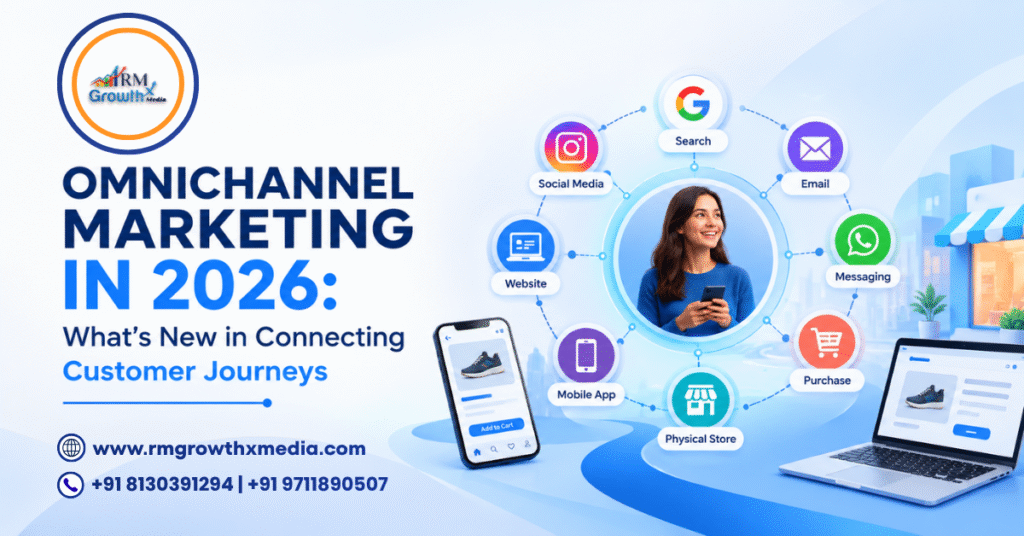
Omnichannel Marketing in 2026 is changing the way businesses think about customer interactions. Customers no longer follow a predictable path from an advertisement to a website and then directly to a purchase. Instead, they may discover a brand through social media, search for it on Google, watch a video, visit the website, read reviews, receive an email, ask a question through messaging, and finally make a purchase on a different device.
The challenge for marketers is not simply being present on all these channels. The real challenge is connecting these touchpoints into one consistent customer journey.
For example, a customer may discover a business through an Instagram post, visit its website several hours later, return through Google Search two days later, subscribe to an email list, and eventually contact the company through WhatsApp. If every channel understands the customer’s stage and previous interactions, the journey feels smooth. If every channel operates independently, the customer may receive repetitive or irrelevant messages.
This is where omnichannel marketing in 2026 is becoming increasingly important. AI-powered personalization, first-party data, unified customer profiles, conversational marketing, cross-channel analytics, and real-time customer signals are changing how brands connect different stages of the customer journey.
The goal is no longer to simply “be everywhere.” The goal is to make every relevant interaction feel like part of the same brand experience.
What Is Omnichannel Marketing?
Omnichannel marketing is a customer-centric strategy that connects multiple marketing, communication, sales, and service channels to create a consistent customer experience.
These channels can include:
- Search engines
- Social media
- Websites
- SMS
- Mobile apps
- Messaging platforms
- Paid advertising
- Online marketplaces
- Physical stores
- Customer service channels
The defining characteristic of omnichannel marketing is integration.
A multichannel business may use Instagram, Google, email, and a website simultaneously. However, those channels might operate independently.
An omnichannel business attempts to connect those interactions so that customer information, messaging, and journey stages work together.
For example:
Social Media → Website → Email → Messaging → Purchase → Retention
The customer may use five different channels, but the brand experience should still feel like one continuous journey.
Omnichannel Marketing vs. Multichannel Marketing
The terms “multichannel” and “omnichannel” are often used interchangeably, but there is an important difference.
What Is Multichannel Marketing?
Multichannel marketing means using multiple channels to reach customers.
A company might have:
- An Instagram account
- A website
- Email marketing
- Google Ads
- YouTube
Each channel can generate awareness and engagement, but the customer experience may not be connected.
What Is Omnichannel Marketing?
Omnichannel marketing connects those channels around the customer.
For example:
- A customer discovers a product through social media.
- They visit the website.
- They read an educational article.
- They sign up for email updates.
- They receive relevant information based on their interests.
- They return through search.
- They contact customer support.
- They purchase.
- They receive post-purchase communication.
The major difference is that omnichannel marketing focuses on continuity rather than simply channel presence.
Why Omnichannel Marketing Is Important in 2026
Customer behavior has become increasingly fragmented.
People can discover, research, compare, and purchase products across completely different environments.
A customer might:
Watch → Search → Compare → Read → Ask → Purchase → Review
Another customer might:
Search → Website → Email → Social Media → Purchase
This means marketers can no longer assume that one channel controls the entire customer journey.
Customers Expect Consistency
When customers move between channels, they increasingly expect the brand to remain consistent.
If a customer has already purchased a product, receiving an advertisement telling them to purchase the exact same product may feel irrelevant.
If a customer has already explained a problem to customer support, being asked to explain it again on another channel creates friction.
Omnichannel marketing attempts to reduce these disconnects.
What’s New in Omnichannel Marketing in 2026?
Several developments are changing the way businesses approach connected customer journeys.
1. AI Is Moving From Campaign Automation to Journey Orchestration
One of the biggest changes in omnichannel marketing in 2026 is the expanding role of artificial intelligence.
Traditional automation usually follows predefined rules.
For example:
If a customer downloads an ebook, send an email after two days.
AI-powered marketing can potentially evaluate multiple customer signals and help determine what action should happen next.
These signals may include:
- Recent website activity
- Previous purchases
- Content engagement
- Email interactions
- Search behavior
- Product interests
- Customer lifecycle stage
- Previous support interactions
This moves marketing from:
“What campaign should we send?”
toward:
“What should this customer experience next?”
That is an important change.
Instead of designing isolated campaigns for individual platforms, marketers can increasingly think about next-best-action marketing.
AI-Powered Personalization
AI can also help marketers personalize content and recommendations at scale.
For example, two people may visit the same website but receive different recommendations based on their previous interactions.
However, personalization should always have a purpose.
The objective should not be to personalize every possible element.
The objective should be to provide more relevant information at the right stage of the customer journey.
2. First-Party Data Is Becoming a Strategic Asset
Another major trend in omnichannel marketing is the growing importance of first-party data.
First-party data is information a business collects directly through interactions with its customers and prospects.
Examples include:
- Website behavior
- Purchases
- Email subscriptions
- Customer preferences
- Account information
- Survey responses
- Loyalty activity
- Customer support interactions
The advantage is that businesses can use information they directly collect and have permission to use rather than relying entirely on third-party data.
A unified customer profile can help businesses understand how different interactions relate to the same customer.
For example, Salesforce explains how unified customer profiles can bring together interactions across different channels to create a more connected customer view. Salesforce: Unified Customer Profile
This becomes particularly useful when customers move between marketing, sales, commerce, and support.
Why First-Party Data Matters
Imagine a customer has already purchased a product.
A disconnected system might continue showing the customer acquisition advertisement.
A connected system could instead recommend:
- Complementary products
- Accessories
- Tutorials
- Upgrades
- Loyalty benefits
- Relevant educational content
This creates a more useful customer experience.
3. Customer Journeys Are Becoming More Conversational
Customers increasingly expect brands to answer questions quickly.
Instead of filling out a form and waiting for a response, customers may prefer:
- Website chat
- Social messaging
- SMS
- AI-powered chat
- Voice interfaces
This is creating new opportunities for conversational marketing.
However, conversational marketing becomes more powerful when it is connected to previous customer interactions.
For example:
A customer visits a product page and later asks a question through a messaging channel.
A connected system can potentially use appropriate customer context to make that conversation more relevant.
The important word here is context.
Automation without context can feel robotic.
Automation with useful context can feel convenient.
4. Personalization Is Becoming Journey-Based
Personalization used to mean simple tactics such as:
“Hi, John.”
In 2026, effective personalization is much broader.
Businesses can potentially personalize experiences based on:
- Previous interactions
- Purchase history
- Content interests
- Customer lifecycle stage
- Engagement behavior
- Product preferences
- Recent activity
- Communication preferences
The goal is to understand where the customer is in the journey.
Example of Journey-Based Personalization
Consider an online clothing business.
A new visitor might see:
“Discover Our Latest Collection.”
A returning visitor who has viewed running shoes might see:
“Explore Running Shoes Designed for Your Training Goals.”
A recent customer might receive:
“How to Get the Most From Your New Running Shoes.”
All three customers are interacting with the same brand, but the content reflects different journey stages.
That is more meaningful than simply inserting a customer’s name.
5. Search, Social, Content, and AI Discovery Are Becoming Connected
Customer discovery is no longer limited to traditional search engines.
People can discover brands through:
- Google Search
- YouTube
- Short-form video
- Online communities
- Marketplaces
- AI-powered search experiences
- Influencer content
This means SEO, content marketing, social media, and paid advertising should increasingly support one another.
For example:
Social Video → Search → Blog → Service Page → Lead Form
A customer might first encounter a brand through a short video but eventually convert after reading a detailed search-optimized article.
This is why businesses should not evaluate every channel only by its last-click conversion.
A strong search presence can support multiple stages of the customer journey. Businesses looking to strengthen this foundation can integrate their customer journey strategy with RM Growth X Media’s SEO services.
6. Cross-Channel Measurement Is Becoming More Important
One of the biggest challenges in omnichannel marketing is measurement.
Suppose a customer:
- Sees an Instagram post.
- Searches for the brand on Google.
- Visits the website.
- Returns through an email.
- Converts after clicking a paid advertisement.
Which channel generated the conversion?
The answer may not be as simple as assigning all credit to the final click.
Google Analytics provides tools for understanding cross-channel performance and customer journeys. Its documentation explains how cross-channel measurement can help businesses connect interactions across different domains and understand activity as customers move between them. Google Analytics: Cross-Channel Measurement
Google Analytics also provides path exploration capabilities that can help marketers examine sequences of customer interactions across sessions. Google Analytics: Path Exploration
This makes customer journey analytics an increasingly important part of marketing strategy.
Metrics to Track
Businesses should consider measuring:
- Customer acquisition cost
- Conversion rate
- Customer lifetime value
- Retention rate
- Repeat purchase rate
- Assisted conversions
- Engagement rate
- Return on ad spend
- Lead-to-customer rate
- Customer journey completion
The exact metrics should depend on business objectives.
7. Real-Time Customer Signals Are Becoming More Valuable
Historical data tells marketers what a customer did previously.
Real-time signals can indicate what the customer may be interested in right now.
For example:
A customer viewed a service page once last month.
That is useful information.
But if the same customer visits the service page three times today, downloads a related guide, and starts a contact form, the combined signals may indicate stronger intent.
Real-time signals can include:
- Website visits
- Product views
- Search activity
- Cart activity
- Email engagement
- Content downloads
- Customer support conversations
- Recent purchases
When used responsibly, these signals can help businesses respond to changing customer intent.
8. Mobile Experiences Are Becoming Central to Omnichannel Journeys
Mobile devices are an important part of modern customer journeys.
A customer might discover a product on a smartphone, research it on a laptop, and purchase it later through another device.
This makes mobile-first omnichannel marketing increasingly important.
Google Analytics explains that reporting identity can use different identity spaces, including User-ID, Device ID, and modeling, to help create a more unified view of user activity across devices and platforms. Google Analytics: Reporting Identity
What Businesses Should Improve
A mobile-friendly omnichannel experience should include:
- Responsive website design
- Fast-loading pages
- Simple navigation
- Easy checkout
- Mobile-friendly forms
- Click-to-call options
- Messaging integration
- Consistent branding
- Easy access to customer support
A strong campaign cannot compensate for a frustrating mobile website.
9. Content Marketing Is Becoming More Journey-Centric
Content should not exist simply because a business needs to “publish a blog every week.”
In an omnichannel strategy, content should support specific customer journey stages.
Awareness Content
The customer is discovering a problem.
Examples:
- Educational blog posts
- Social media posts
- Short-form videos
- Industry guides
- Infographics
Consideration Content
The customer is evaluating possible solutions.
Examples:
- Comparison articles
- Case studies
- Expert guides
- Product demonstrations
- FAQs
Conversion Content
The customer is closer to taking action.
Examples:
- Service pages
- Product pages
- Testimonials
- Reviews
- Pricing information
- Consultation pages
Retention Content
The customer has already converted.
Examples:
- Product tutorials
- Email newsletters
- Loyalty campaigns
- Maintenance guides
- Upgrade information
This approach makes content a connected part of the customer journey rather than an isolated marketing activity.
10. The Website Is Becoming the Central Experience Layer
Even though customers may discover a business through social media, search, email, or advertising, the website often remains a critical destination.
A customer may use the website to:
- Learn about services
- Compare options
- Read content
- Submit a form
- Purchase a product
- Contact the business
- Book a consultation
That means website experience has a direct impact on omnichannel performance.
Businesses should ensure that their website provides:
- Consistent messaging
- Clear navigation
- Strong calls to action
- Mobile responsiveness
- Fast performance
- Relevant landing pages
- Simple conversion paths
For businesses building a connected digital presence, RM Growth X Media’s web design and development services can support the website experience that connects multiple marketing touchpoints.
How to Build an Omnichannel Marketing Strategy in 2026
Creating an omnichannel strategy does not mean activating every available platform.
The better approach is to identify the channels that actually matter to your customers.
Step 1: Map the Customer Journey
Start by documenting:
Awareness → Consideration → Conversion → Retention → Advocacy
Then identify every interaction that can occur at each stage.
Step 2: Identify Your Most Important Channels
Determine where your audience actually discovers and evaluates businesses.
Potential channels include:
- Search
- Website
- Social media
- YouTube
- Messaging
- Paid advertising
- Mobile apps
- Physical locations
Do not choose channels simply because competitors are using them.
Step 3: Connect Your Customer Data
Identify where customer information currently exists.
For example:
- CRM
- Website analytics
- Email platform
- Advertising platforms
- E-commerce system
- Customer service software
Then determine how these systems can share appropriate information while respecting consent and privacy requirements.
Step 4: Create Consistent Messaging
Your messaging should feel consistent across channels.
However, consistency does not mean copying the same content everywhere.
An Instagram post, email, blog article, and messaging conversation should be adapted to the platform while supporting the same overall brand message.
Step 5: Personalize According to Intent
Ask:
- What does the customer already know?
- What have they already done?
- What are they trying to accomplish?
- What information do they need next?
These questions can help businesses create more relevant experiences.
Step 6: Measure the Entire Journey
Avoid measuring channels completely independently.
Look at how interactions work together.
For example:
Social Media → Website → Email → Search → Conversion
The social media interaction may not receive the final conversion credit, but it may have played an important role in creating awareness.
Omnichannel Marketing Mistakes Businesses Should Avoid
1. Treating Every Channel Independently
If your marketing channels operate separately, customers may receive inconsistent messages.
2. Collecting Data Without a Strategy
More data does not automatically mean better marketing.
Businesses need a clear process for turning relevant data into useful customer experiences.
3. Over-Personalizing the Customer Experience
Personalization should be helpful.
If customers feel that a brand knows too much about them or uses information unexpectedly, trust can suffer.
4. Focusing Only on Customer Acquisition
The customer journey continues after conversion.
Retention, loyalty, advocacy, and customer support are important parts of an omnichannel strategy.
5. Ignoring Customer Service
A customer does not separate marketing from service.
If an advertisement promises an excellent experience but customer support is slow or disconnected, the entire brand journey suffers.
6. Measuring Only Last-Click Conversions
Customers can interact with multiple channels before converting.
Looking only at the final interaction can provide an incomplete view of marketing performance.
The Role of Digital Marketing in an Omnichannel Strategy
Omnichannel marketing works best when different digital marketing activities support the same customer journey.
For example:
SEO helps customers discover the business.
Content marketing helps educate and build trust.
Social media creates engagement.
Paid advertising increases visibility and reach.
Email marketing supports nurturing and retention.
Web design creates the environment where visitors take action.
These activities should not operate as isolated marketing projects.
They should work together around customer needs and business objectives.
For businesses that want to connect SEO, content, paid campaigns, social media, and other digital channels into a more integrated strategy, RM Growth X Media’s digital marketing services can be part of that broader approach.
What Is Omnichannel Marketing in 2026?
Omnichannel Marketing in 2026 is a customer-centric strategy that connects search, social media, websites, email, messaging, advertising, apps, and other relevant touchpoints to create a consistent customer journey. It increasingly uses AI, first-party data, personalization, conversational marketing, real-time customer signals, and cross-channel analytics to deliver relevant experiences throughout the customer lifecycle.
Future of Omnichannel Marketing
The future of omnichannel marketing will focus less on managing individual channels and more on managing connected customer experiences.
AI will increasingly help marketers analyze customer signals, personalize experiences, and determine the next best action.
First-party data will remain important for creating useful and responsible personalization.
Customer journey analytics will become increasingly valuable as businesses attempt to understand how different interactions contribute to conversions.
Conversational interfaces may also create additional opportunities for customers to discover information, ask questions, and interact with brands.
However, technology alone will not create a great omnichannel experience.
Businesses will also need:
- Clear customer journey strategies
- High-quality content
- Consistent branding
- Strong websites
- Responsible data practices
- Useful personalization
- Effective measurement
- Cross-team collaboration
The brands that succeed will not necessarily be those using the greatest number of channels.
They will be the brands that make their most important channels work together effectively.
FAQs About Omnichannel Marketing in 2026
Omnichannel marketing is a strategy that connects multiple customer touchpoints to create a consistent and integrated experience throughout the customer journey.
Multichannel marketing uses several channels, while omnichannel marketing connects those channels so customers can move between them with a more consistent experience.
Customers increasingly interact with businesses through multiple channels before making a decision. Omnichannel marketing helps businesses connect these interactions and reduce friction throughout the customer journey.
AI can help marketers analyze customer signals, personalize experiences, segment audiences, automate communication, predict behavior, and determine potential next-best actions.
First-party data can help businesses understand customer interactions and preferences while giving them greater control over how customer information is collected and used.
Businesses can track metrics such as conversion rate, customer acquisition cost, customer lifetime value, retention, repeat purchases, assisted conversions, engagement, and return on advertising spend.
Yes. Small businesses do not need to use every channel. They can start by connecting a few important channels, such as their website, Google Search, social media, email, or messaging, depending on their audience.
No. E-commerce businesses can benefit significantly from omnichannel marketing, but service businesses, B2B companies, healthcare organizations, professional services, education companies, and local businesses can also use connected customer journeys.
Conclusion: Building Better Customer Journeys With Omnichannel Marketing in 2026
Omnichannel Marketing in 2026 is moving beyond the idea of simply marketing across multiple platforms. The real opportunity is to connect those platforms so that every relevant customer interaction contributes to one consistent journey.
Customers do not think in terms of separate marketing channels. They simply expect businesses to provide useful information, consistent messaging, convenient communication, and a smooth experience.
That means your search strategy, social media, website, content marketing, email, advertising, messaging, sales process, and customer service should work toward the same customer experience.
The objective is not to be everywhere.
It is to be connected where your customers actually are.
By combining AI-powered personalization, first-party data, customer journey mapping, conversational experiences, useful content, mobile-first design, and cross-channel measurement, businesses can create more relevant and frictionless customer experiences.
For brands looking to grow in an increasingly connected digital environment, omnichannel marketing in 2026 should be viewed as a long-term customer experience strategy rather than just another marketing trend.
At RM Growth X Media, the focus should be on connecting digital marketing activities with measurable business goals and creating experiences that move customers from discovery to conversion and, ultimately, loyalty.
If your marketing channels are working separately instead of working together, 2026 is the right time to build a more connected customer journey.