Introduction
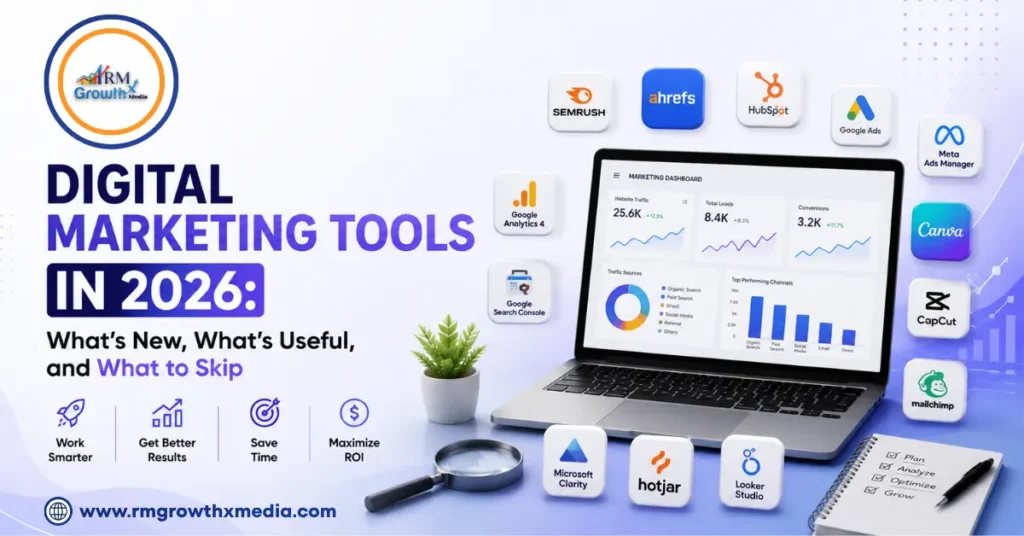
Digital Marketing Tools in 2026 are doing far more than helping marketers schedule posts or track website visits. Modern marketing software now covers SEO research, search performance, analytics, paid advertising, social media, content creation, email automation, CRM, conversion optimization, reporting, and AI-powered search visibility.
But there’s a problem: more tools don’t automatically mean better marketing.
A business can subscribe to Semrush, Ahrefs, Google Analytics 4, Google Search Console, Canva, HubSpot, Mailchimp, Hootsuite, Hotjar and several AI platforms—and still struggle to generate qualified leads or sales.
The real challenge in 2026 is knowing which digital marketing tools are genuinely useful, which new capabilities deserve attention, and which tools or features are simply adding cost and complexity.
This matters because marketing technology is changing quickly. Google Analytics introduced dedicated measurement for traffic coming from AI assistants such as ChatGPT, Gemini and Claude in 2026. Google Search Console has also introduced new reporting for visibility within generative AI features in Search, including AI Overviews and AI Mode.
So, instead of creating a list of every marketing platform available, this guide focuses on the tools that marketers can actually use to research, execute, measure and improve digital marketing campaigns in 2026.
What Are Digital Marketing Tools?
Digital marketing tools are software platforms that help businesses plan, execute, measure, automate or optimize online marketing activities.
They can support areas such as:
- SEO and keyword research
- Website analytics
- Search performance
- Content marketing
- Social media management
- Video marketing
- Paid advertising
- Email marketing
- CRM and lead management
- Conversion rate optimization
- Marketing automation
- Reporting
- AI and generative-search visibility
The important thing is that different tools solve different problems.
For example:
Google Search Console helps you understand how your website performs in Google Search.
Semrush and Ahrefs help with SEO research and competitor analysis.
Screaming Frog helps identify technical SEO problems.
GA4 helps analyze website and campaign behavior.
Canva helps create visual content.
HubSpot helps manage leads, customers and marketing automation.
Looker Studio helps turn marketing data into dashboards.
Therefore, choosing a tool should always begin with the marketing problem, not with the popularity of the software.
Best Digital Marketing Tools in 2026 by Category
Here’s a practical overview before we examine each category in detail:
|
Marketing Need
|
Useful Tools in 2026
|
|---|---|
|
Website Analytics
|
Google Analytics 4
|
|
Search Performance
|
Google Search Console
|
|
SEO Research
|
Semrush, Ahrefs
|
|
Technical SEO
|
Screaming Frog
|
|
Keyword Research
|
Google Keyword Planner
|
|
Content Design
|
Canva
|
|
Video Editing
|
CapCut
|
|
Social Scheduling
|
Buffer, Hootsuite
|
|
Paid Search
|
Google Ads
|
|
Paid Social
|
Meta Ads Manager
|
|
CRM & Automation
|
HubSpot
|
|
Email Marketing
|
Mailchimp
|
|
User Behavior
|
Microsoft Clarity, Hotjar
|
|
Reporting
|
Looker Studio
|
|
AI Search Visibility
|
Emerging AEO/GEO platforms
|
You don’t need every tool on this list.
In fact, you probably shouldn’t use every tool on this list.
The right combination depends on your business model, website size, marketing channels, budget and team.
1. Google Analytics 4: The Core Analytics Tool
Google Analytics 4 (GA4) remains one of the most important digital marketing tools for businesses that want to understand what happens after visitors arrive on their website.
It can help track:
- Users and sessions
- Traffic sources
- Events
- Conversions
- Landing pages
- Engagement
- Ecommerce activity
- Campaign performance
- Customer journeys
- Revenue
What's New in GA4 in 2026?
Google has continued adding capabilities to Analytics throughout 2026.
One particularly relevant development for marketers is AI Assistant traffic measurement. Google Analytics now provides an AI Assistant channel that can identify visits originating from recognized AI assistants, including ChatGPT, Gemini and Claude.
This is significant because website discovery is no longer limited to traditional Google searches.
A potential customer might:
Ask an AI assistant → discover your brand → visit your website → read a product/service page → convert.
Previously, that traffic could be harder to identify as a distinct acquisition source.
Marketers can now begin asking a more useful question:
“Are AI assistants sending visitors to my website, and what do those visitors do after arriving?”
When GA4 Is Useful
GA4 is particularly valuable for:
- SEO performance measurement
- Paid advertising analysis
- Ecommerce tracking
- Lead-generation websites
- Campaign attribution
- Conversion analysis
When GA4 Isn't Enough
GA4 tells you what happened, but not always why it happened.
If visitors leave a page, for example, you may need Microsoft Clarity or Hotjar to investigate their actual behavior.
So GA4 should be viewed as the foundation of analytics—not the entire analytics stack.
2. Google Search Console: Essential for Modern SEO
For businesses investing in SEO, Google Search Console remains one of the most important free digital marketing tools.
It provides first-party search data including:
- Search queries
- Clicks
- Impressions
- Average position
- Indexing information
- Page performance
- Core Web Vitals
- Search appearance
- Links
What's New in Search Console?
Search is changing rapidly because Google is incorporating more generative AI experiences.
In June 2026, Google announced new Search Console performance reports specifically for generative AI visibility. These reports provide information about impressions and pages appearing in generative AI features such as AI Overviews and AI Mode.
Google has also published an official guide explaining that traditional SEO fundamentals remain important for visibility in generative AI features.
That makes Search Console even more relevant for businesses trying to understand modern search visibility.
For official guidance on crawling, indexing, search appearance and Google’s evolving search systems, marketers should also refer to Google Search Central rather than relying entirely on third-party SEO advice.
Why Search Console Should Be in Your Stack
Suppose your page gets:
20,000 impressions but only 300 clicks.
That suggests an opportunity.
You might improve:
- Title
- Meta description
- Search intent alignment
- Content relevance
- Page structure
Search Console helps you identify these opportunities using Google’s own search data.
If you want professional SEO execution alongside these tools, RM Growth X Media’s Search Engine Optimization Services can complement keyword research, technical optimization, content strategy and ongoing performance monitoring.
3. Semrush: A Powerful All-in-One SEO Platform
Semrush is one of the most widely used SEO and digital marketing platforms.
Its capabilities include:
- Keyword research
- Competitor analysis
- Backlink research
- Site audits
- Rank tracking
- Content research
- Local SEO
- Advertising research
- Organic traffic analysis
- AI visibility features
Why Marketers Use Semrush
Imagine you’re launching a new service page.
Semrush can help you investigate:
- Which keywords competitors target.
- How competitive those keywords are.
- What pages currently rank.
- Which related topics searchers care about.
- What backlink opportunities exist.
- How competitors are building organic visibility.
That makes it useful for SEO strategy rather than simply keyword collection.
Semrush in 2026
The platform has also moved further into AI visibility and generative-search analysis.
This reflects a larger shift in SEO:
Traditional SEO → Search + AI visibility + brand presence
However, businesses shouldn’t purchase Semrush simply because it has more AI features.
The core SEO capabilities remain the reason most businesses need it.
4. Ahrefs: Strong for SEO, Backlinks and Competitor Research
Ahrefs is another major SEO platform.
It is especially useful for:
- Backlink analysis
- Keyword research
- Competitor research
- Content research
- Rank tracking
- Site audits
- Organic search analysis
Ahrefs vs Semrush
Both tools overlap significantly.
A simple distinction is:
Semrush: Broad SEO and digital marketing functionality.
Ahrefs: Particularly strong for backlinks, content research and SEO analysis.
You don’t automatically need both.
For many businesses, choosing one major SEO platform and combining it with Google Search Console provides enough data.
When Ahrefs Is Worth It
Ahrefs becomes particularly useful when you:
- Manage a large website
- Conduct competitor research
- Build backlinks
- Run content campaigns
- Monitor organic competitors
- Need detailed SEO data
For a small five-page website, however, paying for advanced enterprise-level SEO data may not be necessary.
5. Screaming Frog: Technical SEO Made Practical
Screaming Frog SEO Spider is different from Semrush and Ahrefs because its major strength is website crawling and technical analysis.
It can identify problems such as:
- Broken links
- Redirect chains
- 404 errors
- Missing title tags
- Duplicate titles
- Missing meta descriptions
- Canonical problems
- Indexability issues
- Duplicate URLs
- Internal linking problems
Who Should Use Screaming Frog?
It’s especially valuable for:
- Ecommerce websites
- Large websites
- SEO agencies
- Website migrations
- Website redesigns
- Technical SEO audits
If you have 20 pages, manually checking some issues may be possible.
If you have 20,000 URLs, crawling software becomes far more valuable.
6. Google Keyword Planner: Useful for Search Demand and Paid Campaigns
Google Keyword Planner remains a useful keyword research tool, especially for businesses running Google Ads.
It can provide:
- Keyword ideas
- Search demand estimates
- Related search terms
- Competition information
- Commercial keyword opportunities
- Bid estimates
However, it should not be treated as a complete SEO research platform.
For organic SEO, combine it with:
Google Search Console + competitor analysis + SERP analysis + Semrush/Ahrefs.
This provides a broader picture of search intent.
7. Canva: A Practical Content Marketing Tool
Not every important marketing tool is analytical.
Canva remains extremely useful for creating marketing visuals such as:
- Blog banners
- Social media posts
- LinkedIn carousels
- Infographics
- Ad creatives
- Presentations
- PDFs
- Promotional graphics
For small businesses, Canva can reduce the time required to create everyday marketing assets.
What to Avoid
Don’t publish every design exactly as the template provides it.
Your visuals should reflect your:
- Brand identity
- Typography
- Messaging
- Visual style
- Audience
- Content strategy
The goal is to use Canva for speed and consistency, not to make your brand look like everyone else.
8. CapCut: Useful for Short-Form Video
Short-form video remains a major content format, and CapCut is a practical editing tool for marketers producing:
- Instagram Reels
- YouTube Shorts
- TikTok videos
- Product videos
- Educational clips
- Video advertisements
Its biggest advantage is accessibility.
A small marketing team can create professional-looking short videos without needing advanced editing software.
What CapCut Is Good For
Use it for:
- Captions
- Quick cuts
- Vertical video
- Transitions
- Short-form editing
- Content repurposing
But remember:
Good editing ≠ good marketing.
A beautifully edited video won’t perform if the hook, audience targeting and message are weak.
9. Buffer and Hootsuite: Social Media Management Tools
Managing social media manually becomes difficult when businesses publish across multiple channels.
Buffer and Hootsuite can help marketers with:
- Content scheduling
- Publishing
- Content calendars
- Social analytics
- Team workflows
- Multiple account management
Which One Should You Choose?
If you need a relatively straightforward scheduling workflow, Buffer may be sufficient.
If you manage larger teams, multiple accounts and more complex reporting requirements, Hootsuite may be more appropriate.
You don’t need both unless they solve different problems in your workflow.
For businesses that also need paid social campaigns, RM Growth X Media’s Social Media Advertising Services covers platforms including Facebook, Instagram, LinkedIn, Pinterest and YouTube, with audience targeting, creative development, optimization and reporting.
10. Google Ads: The Core Paid Search Platform
Google Ads remains essential for businesses that want to reach users actively searching for products or services.
It can support:
- Search campaigns
- Display campaigns
- YouTube campaigns
- Shopping campaigns
- Remarketing
- Conversion-focused campaigns
Why Google Ads Is Useful
SEO can take time.
Google Ads allows businesses to compete for visibility much faster.
But paid search only works efficiently when marketers get the fundamentals right:
- Search intent
- Keyword selection
- Ad copy
- Landing pages
- Conversion tracking
- Bidding
- Budget allocation
For example, sending a user searching for “buy running shoes online” to a generic homepage isn’t ideal.
A dedicated product or category page is usually much more relevant.
11. Meta Ads Manager: Essential for Paid Social
Meta Ads Manager is another major digital marketing tool for businesses using Facebook and Instagram advertising.
It can be used for:
- Lead generation
- Ecommerce campaigns
- Brand awareness
- Retargeting
- Product promotion
- Traffic campaigns
- Conversion campaigns
What Makes Meta Ads Useful?
The platform allows businesses to work with different:
- Audiences
- Creatives
- Placements
- Campaign objectives
- Budgets
- Retargeting strategies
However, automation doesn’t eliminate the need for strategy.
The platform can optimize delivery.
It can’t fix a poor product, weak offer or irrelevant creative.
RM Growth X Media also provides Paid Advertising Services covering Google Ads, Meta Ads, YouTube, ecommerce/shopping campaigns and remarketing.
12. HubSpot: CRM + Marketing Automation
HubSpot is useful when a business needs to connect marketing activities with sales and customer management.
It can help manage:
- Contacts
- Leads
- Sales pipelines
- Email campaigns
- Automation
- Customer journeys
- Reporting
- Marketing activities
Why CRM Integration Matters
Consider this journey:
Website visitor
↓
Lead form submission
↓
CRM record
↓
Email nurture
↓
Sales follow-up
↓
Customer
↓
Retention campaign
A connected CRM makes this journey easier to manage.
When You Should Skip HubSpot
HubSpot may be too complex or expensive for a very small business that only needs basic contact management.
Start with the simplest CRM that can handle your actual sales process.
13. Mailchimp: Useful for Email Marketing
Mailchimp remains a practical email marketing platform for many small and medium-sized businesses.
It can support:
- Newsletters
- Email campaigns
- Automated emails
- Lead nurturing
- Segmentation
- Signup forms
- Campaign reporting
Useful Email Automations
Businesses can create:
Welcome sequence
New subscriber → welcome email → educational email → offer.
Lead nurture
Content download → educational sequence → consultation CTA.
Ecommerce
Product view → reminder → offer → post-purchase email.
The tool is useful, but strategy remains more important than the software.
14. Microsoft Clarity and Hotjar: Understand Why Users Behave the Way They Do
Analytics can show that a visitor leaves your page.
Microsoft Clarity and Hotjar can help you investigate what the visitor actually did.
Depending on the platform and configuration, marketers can analyze:
- Heatmaps
- Session recordings
- Scroll behavior
- Click patterns
- User frustration
- Form interactions
Example
GA4 shows:
Mobile conversion rate = 1.2%
Clarity may reveal:
Users repeatedly tap an element that looks clickable but isn’t.
That insight can lead to a practical UX improvement.
This is why combining quantitative analytics with qualitative behavior analysis can produce better optimization decisions.
15. Looker Studio: Turn Data Into Marketing Reports
Looker Studio is useful when marketers need to bring data into one reporting environment.
It can connect with sources such as:
- Google Analytics
- Google Search Console
- Google Ads
- Google Sheets
- Other supported data sources
Instead of manually creating reports every month, marketers can build dashboards that provide an ongoing view of performance.
What Should a Marketing Dashboard Include?
Depending on your goals:
- Website traffic
- Organic traffic
- Leads
- Conversions
- Paid campaign performance
- Cost per lead
- Revenue
- Top landing pages
- Search visibility
Don’t create a dashboard simply because you can.
Every metric should answer a business question.
16. AEO and AI Visibility Tools: What's Actually New in 2026?
One of the newer categories among Digital Marketing Tools in 2026 is software designed to monitor visibility in AI-generated answers.
These tools may help marketers understand:
- Whether their brand appears in AI answers
- Which competitors are mentioned
- Which prompts generate brand mentions
- Which sources are cited
- How brand visibility changes across AI platforms
Examples include emerging capabilities from platforms such as Semrush, Ahrefs and HubSpot.
Google itself has emphasized that traditional SEO fundamentals remain foundational for visibility in generative AI search experiences.
So businesses shouldn’t assume that buying an “AEO tool” automatically creates AI visibility.
What Should You Do First?
Before investing heavily in AI visibility software, build:
- Useful content
- Strong technical SEO
- Clear brand information
- Authoritative pages
- Relevant backlinks and mentions
- Strong first-party data
- Good user experience
Then use AI visibility tools to measure and refine your strategy.
What Digital Marketing Tools Should You Skip in 2026?
The answer isn’t “all expensive tools.”
The tools worth skipping are those that don’t solve a meaningful business problem.
1. Skip Tools That Promise Guaranteed Rankings
Be extremely cautious about software promising:
- Guaranteed Google rankings
- Instant backlinks
- Overnight organic traffic
- Secret ranking formulas
- Automated authority
No legitimate SEO tool can guarantee sustainable Google rankings.
Use SEO tools for:
Research → Audit → Monitor → Analyze → Optimize
Not:
Buy tool → Press button → Rank #1.
2. Skip Mass AI Content Generators
AI can help marketers research, outline, brainstorm and repurpose content.
But generating hundreds of generic articles simply because a platform allows it isn’t a strategy.
Content should demonstrate:
- Expertise
- Original insights
- Accurate information
- First-hand experience
- Useful examples
- Strong editorial judgment
Google’s own 2026 guidance emphasizes valuable, unique, non-commodity content when discussing visibility in generative AI features.
So the smarter approach is:
AI-assisted production + human expertise + fact-checking + original value.
3. Skip Duplicate Tools
One of the easiest ways to waste a marketing budget is paying for multiple platforms that perform almost the same function.
For example:
- Semrush + Ahrefs + several other SEO platforms
- Buffer + Hootsuite + another scheduler
- Multiple CRMs
- Multiple analytics systems
Sometimes businesses genuinely need more than one platform.
But if two tools produce essentially the same information, ask whether both are necessary.
4. Skip Tools With Features Your Team Won't Use
A tool with 100 features isn’t automatically better than one with 20.
Before purchasing software, ask:
What problem does this tool solve?
If there isn’t a clear answer, don’t buy it.
Who will use it?
Assign an owner.
How frequently?
Daily, weekly or monthly?
What outcome will it improve?
Traffic? Leads? Revenue? Productivity? Reporting?
Does it integrate with our current stack?
If not, implementation may become unnecessarily complicated.
How to Build a Digital Marketing Tool Stack in 2026
Instead of buying tools randomly, build your stack around the customer journey.
Step 1: Website and Analytics
Start with:
GA4 + Google Search Console
These provide foundational information about website and search performance.
Step 2: SEO
Add:
Semrush OR Ahrefs + Screaming Frog when required
You don’t necessarily need every SEO platform.
Step 3: Content
Use:
Canva + CapCut + appropriate AI assistance
The goal is faster production without sacrificing originality.
Step 4: Social Media
Choose:
Buffer OR Hootsuite
Then use native platform analytics where appropriate.
Step 5: Paid Advertising
Use:
Google Ads + Meta Ads Manager
Connect conversion tracking properly before judging campaign performance.
Step 6: CRM and Email
Depending on your business:
HubSpot + Mailchimp
Or choose a platform that combines both functions where appropriate.
Step 7: Conversion Optimization
Add:
GA4 + Microsoft Clarity/Hotjar
This combination can help you understand both numbers and behavior.
Step 8: Reporting
Use:
Looker Studio
Create a dashboard that management can actually understand.
How to Choose the Right Digital Marketing Tools in 2026
1. Start With the Problem
Don’t ask:
“What’s the newest marketing tool?”
Ask:
“What marketing problem are we trying to solve?”
For example:
Problem: Organic traffic is falling.
Possible tools:
Google Search Console + GA4 + Semrush/Ahrefs.
Problem: Visitors aren’t converting.
Possible tools:
GA4 + Clarity/Hotjar + landing-page testing.
Problem: Social posting is taking too much time.
Possible tools:
Buffer or Hootsuite.
2. Define Your KPI
Every tool should connect to a measurable outcome.
Examples:
- Organic leads
- Conversion rate
- Cost per acquisition
- Revenue
- Customer retention
- Email engagement
- Productivity
- Reporting time
This prevents businesses from measuring tool activity instead of business performance.
3. Check Integration
Your marketing tools should ideally communicate with one another.
For example:
Google Ads → GA4 → CRM → Dashboard
This creates a connected measurement system.
4. Test Before Buying
Use:
- Free versions
- Trials
- Demos
- Limited plans
Test the tool with an actual marketing workflow before making a long-term commitment.
What Are the Best Digital Marketing Tools in 2026?
The best Digital Marketing Tools in 2026 include Google Analytics 4 for website analytics, Google Search Console for search performance, Semrush or Ahrefs for SEO research, Screaming Frog for technical SEO, Google Keyword Planner for keyword research, Canva for visual content, CapCut for short-form video, Buffer or Hootsuite for social media management, Google Ads and Meta Ads Manager for paid advertising, HubSpot for CRM and automation, Mailchimp for email marketing, Microsoft Clarity or Hotjar for user behavior, and Looker Studio for reporting.
Businesses should choose tools based on their marketing goals, budget, team size and customer journey rather than trying to use every available platform.
Frequently Asked Questions
Some of the most useful tools include Google Analytics 4, Google Search Console, Semrush, Ahrefs, Screaming Frog, Google Keyword Planner, Canva, CapCut, Buffer, Hootsuite, Google Ads, Meta Ads Manager, HubSpot, Mailchimp, Microsoft Clarity, Hotjar and Looker Studio.
Small businesses should begin with essential tools such as GA4, Google Search Console, one SEO platform if needed, a social media scheduling tool, an email platform and a CRM appropriate to their size.
Neither is universally better. Semrush offers broad SEO and digital marketing functionality, while Ahrefs is particularly strong for backlink and SEO research. Choose based on your specific workflow.
No. AI can improve productivity, research and automation, but businesses still need SEO, analytics, content strategy, paid advertising, CRM, conversion optimization and human decision-making.
Not necessarily. Both platforms overlap. Using both makes sense when your team needs capabilities that one platform doesn't adequately provide.
Avoid tools that promise guaranteed rankings, instant backlinks, mass low-quality content, unrealistic results or expensive features that your team will not actually use.
There is no fixed number. A small business may need only a handful of core tools, while a large organization may need a much broader marketing technology stack.
Conclusion
The biggest lesson from Digital Marketing Tools in 2026 is simple: the best marketing stack isn’t the one with the most software—it is the one that helps your business make better decisions and achieve measurable results.
GA4 can help you understand customer behavior.
Google Search Console can show how your content performs in Google Search and, increasingly, in generative AI experiences.
Semrush and Ahrefs can support SEO research.
Screaming Frog can uncover technical problems.
Canva and CapCut can speed up content production.
Buffer and Hootsuite can simplify social media workflows.
Google Ads and Meta Ads Manager can support paid acquisition.
HubSpot can connect marketing and sales.
Mailchimp can automate email communication.
Clarity and Hotjar can reveal user behavior.
Looker Studio can turn scattered marketing data into useful reports.
And emerging AI visibility tools can help brands understand how they appear in the changing search environment.
But none of these tools can replace strategy, expertise, creativity, accurate data and understanding of the customer.
The smartest approach in 2026 is to build a focused marketing technology stack, measure the results, remove tools that aren’t delivering value, and invest more deeply in the platforms that genuinely improve your marketing performance.
If you need help deciding which channels, tools and strategies make sense for your business, RM Growth X Media can build a data-driven digital marketing approach around your specific goals. The agency’s current service portfolio includes SEO, paid advertising, social media, content marketing, email marketing, ecommerce product listings and web development.
For ecommerce brands specifically, RM Growth X Media also provides E-Commerce Product Listing Services covering product title and description optimization, image and alt-tag optimization, category structuring, marketplace SEO and performance tracking.
Ready to stop collecting marketing tools and start using the right ones? Contact RM Growth X Media and build a smarter, measurable and growth-focused digital marketing strategy for 2026.