Introduction
SEO in 2026 looks very different from the SEO strategies many businesses used just a few years ago. Google Search is increasingly influenced by AI-powered experiences, changing search behavior, stronger quality systems, and more sophisticated ways of understanding content.
For businesses, this means simply publishing more articles and adding keywords is no longer enough.
In fact, Technical SEO Mistakes can become even more costly when search engines need to understand a website across traditional results, AI-powered search experiences, mobile devices, local results, and other search surfaces.
So, what is actually working after Google’s latest updates?
The answer is not one secret ranking trick. The strongest SEO strategies in 2026 combine technically sound websites, genuinely useful content, clear search intent, trustworthy information, strong topical relevance, good user experience, and consistent measurement.
Google’s own guidance confirms that traditional SEO fundamentals remain important for its generative AI search experiences. Google also states that AI Overviews and AI Mode are built on its existing Search systems and quality signals.
This guide explains the most important SEO trends in 2026, what businesses should prioritize, which outdated tactics to avoid, and how to build a search strategy that can adapt to Google’s evolving ecosystem.
What Are the Most Important SEO Trends in 2026?
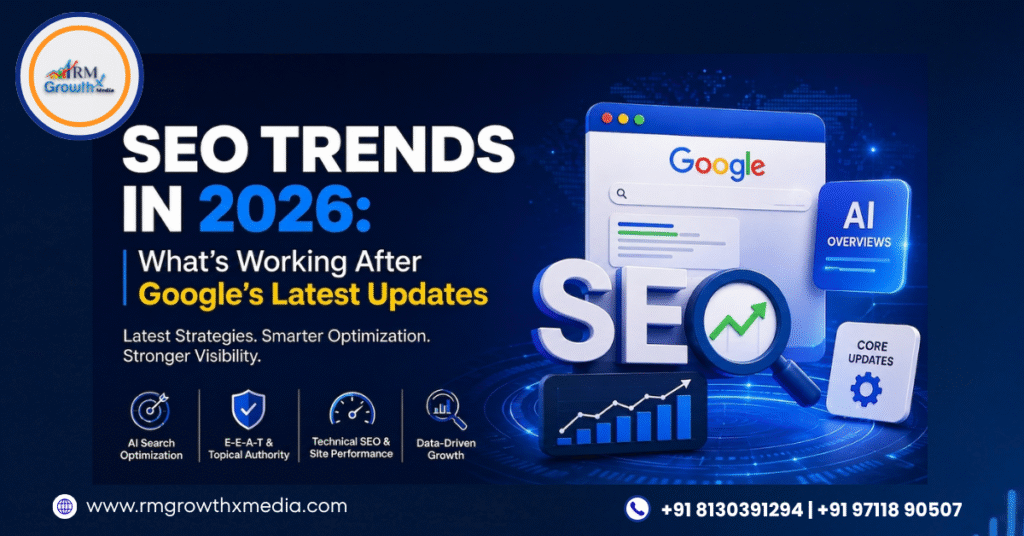
The most important SEO trends in 2026 include:
- Optimizing for AI-powered search experiences
- Creating genuinely helpful, original content
- Strengthening E-E-A-T and topical authority
- Improving technical SEO and website performance
- Matching content with search intent
- Building topic clusters instead of isolated articles
- Optimizing for conversational and long-tail searches
- Strengthening internal linking and website architecture
- Using structured data appropriately
- Measuring visibility beyond traditional organic rankings
These trends are connected. A technically excellent website with weak content may struggle, while excellent content on a poorly crawlable website can also underperform.
The goal in 2026 is therefore to create a complete search experience, not simply chase individual ranking factors.
1. AI Search Is Changing SEO — But SEO Is Not Dead
One of the biggest developments in search is the growth of generative AI experiences.
Google now provides AI-powered experiences such as AI Overviews and AI Mode, which can help users explore complex questions and discover information from multiple sources.
Google’s official guidance makes an important point: websites do not need an entirely separate form of SEO for generative AI search. Existing SEO fundamentals remain relevant because Google’s AI search experiences rely on content from its Search index and existing quality systems. Businesses can also refer to Google Search Central — AI Features and Your Website for guidance on how their websites can appear in Google’s AI-powered search experiences.
What Does This Mean for Businesses?
Instead of asking:
“How do I rank specifically in AI?”
A better question is:
“How can I make my website useful, understandable, trustworthy, and easy for search systems to discover?”
That means businesses should focus on:
- Original information
- Clear answers
- Strong topical coverage
- Helpful page structure
- Reliable sources
- Descriptive headings
- Natural language
- Strong internal linking
- Technical accessibility
AI Search Optimization Is Becoming Part of Modern SEO
Terms such as AEO (Answer Engine Optimization) and GEO (Generative Engine Optimization) are increasingly discussed in the industry.
However, Google itself explains that these approaches should not be treated as completely separate from SEO. Its guidance emphasizes foundational SEO practices for generative AI experiences.
This is important because businesses shouldn’t abandon established SEO principles simply because search results are becoming more AI-driven.
2. Helpful, Original Content Matters More Than Content Volume
One of the biggest SEO mistakes businesses can make in 2026 is assuming that more content automatically means more rankings.
It doesn’t.
Publishing 100 generic articles that repeat information already available online may be less valuable than publishing 20 genuinely useful resources with original insights.
Google’s guidance for generative AI search specifically emphasizes valuable, unique, non-commodity content.
What Does Helpful Content Look Like in 2026?
Useful content should:
- Answer the reader’s actual question
- Demonstrate knowledge or experience
- Provide practical examples
- Explain concepts clearly
- Avoid unnecessary repetition
- Add original perspectives
- Use trustworthy information
- Be easy to navigate
Add First-Hand Experience
For example, instead of writing:
“SEO is important for businesses.”
A stronger article might explain:
“During an SEO audit, businesses often discover that important service pages are not receiving enough internal links, making them harder for search engines and users to discover.”
The second statement is more useful because it provides a practical observation.
This is where E-E-A-T becomes important.
3. E-E-A-T and Topical Authority Are Becoming More Important
E-E-A-T stands for:
- Experience
- Expertise
- Authoritativeness
- Trustworthiness
It isn’t a single ranking factor that can simply be “turned on.” Instead, it represents qualities Google wants its systems to recognize when evaluating helpful and trustworthy information.
How Can You Improve E-E-A-T?
Businesses can strengthen credibility by including:
- Author information
- Relevant credentials where appropriate
- Original research
- Case studies
- Real examples
- References to authoritative sources
- Transparent business information
- Updated information
- Clear contact details
- Consistent brand information
For YMYL topics such as health, finance, and legal information, credibility and accuracy are particularly important.
Build Topical Authority
Instead of publishing random blogs around unrelated keywords, create content around a clear subject area.
For example, a digital marketing agency could build a topic cluster around SEO:
Pillar page:
SEO Services
Supporting content:
- Technical SEO
- Local SEO
- Keyword research
- Internal linking
- SEO audits
- Core Web Vitals
- Content optimization
- SEO reporting
- AI search optimization
This helps create a more logical website structure and gives users multiple useful resources.
4. Technical SEO Still Matters — and Technical SEO Mistakes Can Hurt Visibility
AI search does not eliminate technical SEO.
If anything, having a technically accessible website remains fundamental.
Search engines need to crawl, render, understand, and index your content before that content can perform effectively.
Common Technical SEO Mistakes to Watch in 2026
Some of the most important Technical SEO Mistakes include:
- Poor website architecture
- Broken internal links
- Incorrect canonical tags
- Unnecessary redirects
- Slow-loading pages
- Poor mobile usability
- Indexing valuable pages incorrectly
- Duplicate content
- Missing or poorly implemented structured data
- Orphan pages
- Incorrect robots.txt configuration
- XML sitemap problems
- JavaScript rendering issues
- Poor Core Web Vitals
Google continues to update its Search systems, including core updates and other ranking system changes. Businesses should therefore monitor their website performance regularly instead of relying on a one-time SEO strategy. For a better understanding of how Google’s ranking systems and core updates work, see Google Search Central — Core Updates and Ranking Systems
This means technical SEO should not be treated as a one-time project.
How to Reduce Technical SEO Problems
Conduct regular technical audits covering:
Crawling
Check whether important pages can be discovered and crawled.
Indexing
Verify that valuable pages are actually eligible for indexing.
Site Architecture
Make sure important pages are accessible through logical navigation and internal links.
Performance
Monitor page speed and Core Web Vitals.
Mobile Experience
Ensure the website works properly across mobile devices.
Security
Use HTTPS and maintain a secure website environment.
5. Search Intent Is More Important Than Exact-Match Keywords
Keyword optimization remains important, but modern SEO is increasingly about search intent.
Consider the keyword:
“SEO services”
A user searching this phrase may be looking for:
- An SEO agency
- SEO pricing
- SEO packages
- An explanation of SEO
- Local SEO services
- Technical SEO services
A page that understands the likely intent can provide a better experience than a page that simply repeats “SEO services” dozens of times.
The Four Common Search Intent Types
Informational Intent
The user wants to learn something.
Example:
“What is technical SEO?”
Navigational Intent
The user wants to find a specific website or brand.
Example:
“RM GrowthX Media”
Commercial Investigation
The user is comparing options.
Example:
“best SEO agency for small businesses”
Transactional Intent
The user is ready to take action.
Example:
“hire SEO agency”
Successful SEO strategies in 2026 should map each target keyword to the correct type of page.
6. Long-Tail and Conversational Search Are Growing
Search queries are becoming increasingly conversational.
Users don’t always search for:
“SEO trends 2026.”
They may ask:
“What SEO strategies are actually working after Google’s latest updates?”
That longer query provides much more information about user intent.
How to Optimize for Conversational Search
Use natural questions throughout your content:
- What SEO trends are important in 2026?
- Is SEO still worth investing in?
- How do Google’s updates affect rankings?
- How can businesses optimize for AI search?
- What technical SEO problems should I fix first?
Then answer those questions clearly.
This approach can also help your content target long-tail searches and question-based queries.
7. Internal Linking Is Becoming Even More Valuable
Internal links help users navigate your website and help search engines understand the relationships between pages.
For a digital marketing website, internal linking can connect:
SEO blog → SEO services → Digital marketing services → Web design and development
For example, when discussing technical SEO, you can naturally link readers to your Search Engine Optimization Services page.
Similarly, when explaining how SEO fits into a larger digital strategy, you can link to your Digital Marketing Services page.
Internal links should be useful rather than forced.
Best Practices for Internal Linking
Use:
- Descriptive anchor text
- Relevant destination pages
- Logical contextual placement
- Links from authoritative pages
- A balanced site architecture
Avoid adding dozens of irrelevant internal links simply to manipulate SEO.
8. Website Experience and Core Web Vitals Still Matter
SEO isn’t just about what search engines see.
It is also about what users experience.
A website can have excellent content but still lose potential customers if it:
- Loads slowly
- Has intrusive pop-ups
- Is difficult to navigate
- Doesn’t work well on mobile
- Contains layout shifts
- Has confusing calls to action
Google’s Search ecosystem continues to place importance on technical quality and user experience.
What Should Businesses Monitor?
Pay attention to:
- Page loading performance
- Mobile usability
- Core Web Vitals
- Navigation
- Accessibility
- HTTPS
- Intrusive interstitials
- Conversion paths
For businesses investing in SEO, website development and SEO should therefore work together.
A technically strong, responsive website can support both organic visibility and conversions.
9. Structured Data Helps Search Engines Understand Your Content
Structured data gives search engines additional information about the content of a page.
Depending on the page type, businesses may use structured data for eligible content such as:
- Organization
- Local business
- Product
- Article
- Breadcrumb
- Event
- Recipe
- FAQ-related content where applicable
However, structured data should accurately represent visible page content.
Don’t add schema simply because you want a particular rich result.
Structured Data Is Not a Shortcut to Rankings
One common misconception is:
“Adding schema will automatically improve rankings.”
It won’t.
Structured data can help search engines understand content and may make pages eligible for certain search features, but it isn’t a replacement for valuable content, strong technical SEO, or good user experience.
10. Google Search Console Is Becoming More Important for SEO Reporting
SEO reporting is changing as search becomes more complex.
Traditional metrics such as:
- Clicks
- Impressions
- CTR
- Average position
are still valuable.
But businesses should increasingly consider visibility across different search experiences.
In June 2026, Google announced dedicated Search Console reporting for visibility from generative AI features, including AI Overviews and AI Mode, while continuing to include this data within overall Search performance reporting.
This is a major development for SEO measurement.
What Should You Monitor?
Track:
- Organic clicks
- Organic impressions
- CTR
- Average position
- Query trends
- Page-level performance
- Branded vs. non-branded searches
- Search visibility from AI experiences where available
- Conversions from organic traffic
The goal should be business growth, not simply ranking for a large number of keywords.
11. Local SEO Remains Important for Location-Based Businesses
For businesses serving specific geographic areas, local SEO remains a major opportunity.
A local SEO strategy should include:
- Google Business Profile optimization
- Accurate business information
- Local landing pages
- Customer reviews
- Location-specific content
- Consistent business details
- Relevant local links
- Mobile optimization
- Local structured data where appropriate
For example, a digital marketing agency targeting Delhi, Gurgaon, or other Indian markets can create useful location-specific pages that explain its services, expertise, audience, and local market understanding.
However, location pages should provide genuine value.
Creating dozens of nearly identical pages with only the city name changed is unlikely to create a strong user experience.
12. Visual, Video, and Multimodal Search Should Be Part of the Strategy
Search is no longer purely text-based.
Users discover information through:
- Images
- Videos
- Product results
- Local listings
- Maps
- Social platforms
- AI-powered search experiences
Google’s guidance for generative AI search also discusses the importance of local, shopping, image, and video content where relevant.
How to Optimize Visual Content
Use:
- Descriptive filenames
- Accurate ALT text
- Relevant surrounding text
- High-quality images
- Proper image dimensions
- Compressed file sizes
- Relevant captions when useful
Don’t add keywords to ALT text unnaturally.
For example:
Poor ALT text:
“SEO SEO trends SEO 2026 best SEO agency”
Better ALT text:
“SEO trends and Google search optimization strategy for 2026”
13. AI Can Help With SEO — But Human Expertise Still Matters
AI tools can help SEO teams with:
- Keyword research
- Content outlines
- Content briefs
- Topic clustering
- Metadata ideas
- Content refreshes
- Competitor analysis
- Technical documentation
- Data analysis
But using AI to mass-produce generic content isn’t a sustainable SEO strategy.
Google’s guidance emphasizes valuable and unique content rather than content produced simply at scale.
A Better AI + Human Workflow
Use AI for:
Research → Organization → Draft assistance → Analysis
Use humans for:
Expertise → Fact checking → Original insights → Brand voice → Editorial judgment
This combination can make content production more efficient without sacrificing quality.
14. What SEO Tactics Should You Stop Relying On in 2026?
Some outdated strategies should no longer be at the center of an SEO campaign.
Keyword Stuffing
Repeating a keyword unnaturally can damage readability and doesn’t create useful content.
Publishing Hundreds of Generic AI Articles
Quantity without originality is not a sustainable content strategy.
Buying Low-Quality Backlinks
Backlinks should come from relevant and credible sources rather than artificial link networks.
Creating Thin Location Pages
Location pages should offer genuinely useful local information.
Obsessing Over One Ranking Position
Rankings fluctuate. Business outcomes matter more.
Ignoring Technical SEO
A great article can’t compensate for serious crawling, indexing, or performance problems.
15. A Practical SEO Strategy for 2026
Businesses don’t need to implement every SEO tactic simultaneously.
Instead, follow a structured process.
Step 1: Audit Your Website
Identify:
- Technical SEO problems
- Indexing issues
- Broken links
- Slow pages
- Duplicate content
- Missing metadata
- Poor internal linking
Step 2: Understand Your Audience
Identify:
- What your customers search for
- Their biggest problems
- Their buying questions
- Their preferred content formats
- Their search intent
Step 3: Build Topic Clusters
Create pillar pages and supporting content around your most important services and topics.
Step 4: Improve Existing Content
Don’t only publish new blogs.
Review older pages for:
- Outdated information
- Weak sections
- Missing questions
- Poor internal links
- Missing examples
- Search intent mismatches
Step 5: Strengthen Technical SEO
Fix important technical issues before continuously publishing more content.
Step 6: Improve E-E-A-T
Add expertise, evidence, authorship, business information, and original insights where appropriate.
Step 7: Optimize for Multiple Search Experiences
Consider:
- Traditional Google Search
- AI Overviews
- AI Mode
- Images
- Video
- Local search
- Shopping where relevant
Step 8: Measure Results
Monitor Search Console, analytics, rankings, conversions, and other relevant business KPIs.
How RM GrowthX Media Can Help With Your 2026 SEO Strategy
SEO in 2026 requires more than publishing keywords.
At RM GrowthX Media, the focus is on data-driven digital growth, combining SEO, content, website performance, paid marketing, and other digital strategies to help businesses improve visibility and generate measurable results.
If your website is struggling with rankings, traffic, technical problems, or content performance, a structured SEO strategy can help identify what is holding your website back.
You can explore our Search Engine Optimization Services to learn more about how SEO can support your organic growth strategy.
You can also explore our Digital Marketing Services if you want SEO to work alongside content, paid advertising, social media, and other growth channels.
And because technical SEO and website performance are closely connected, our Web Design & Development Services can help businesses build responsive, performance-focused websites designed with SEO and conversions in mind.
Frequently Asked Questions About SEO Trends in 2026
Yes. SEO remains valuable because people continue using search to discover information, products, services, and businesses. Google also states that SEO fundamentals remain relevant for its AI-powered search experiences.
One of the biggest changes is the growth of AI-powered search experiences such as AI Overviews and AI Mode. However, businesses should continue focusing on strong SEO fundamentals, helpful content, technical accessibility, and user experience.
No. Google's own guidance says SEO remains relevant to generative AI search because those experiences rely on existing Search systems and content in Google's index.
Technical SEO remains essential. Crawling, indexing, site architecture, mobile usability, performance, internal linking, and other technical elements can affect how effectively search engines access and understand a website.
Common Technical SEO Mistakes include poor site architecture, broken links, incorrect canonicalization, indexing problems, slow pages, duplicate content, JavaScript rendering issues, poor mobile usability, and incorrect robots.txt or sitemap configurations.
Yes, but keyword targeting should be combined with search intent, topical relevance, natural language, and useful content. Exact-match keyword repetition should not be the primary strategy.
E-E-A-T represents qualities Google looks for when evaluating trustworthy and useful information. Demonstrating experience, expertise, authority, and trust can strengthen the overall quality and credibility of a website.
You don't necessarily need a completely separate content strategy. Google recommends applying foundational SEO best practices to generative AI search experiences.
There is no universal schedule. Update content when information becomes outdated, search intent changes, new evidence becomes available, or the page no longer satisfies users effectively.
Monitor impressions, clicks, CTR, average position, query trends, page performance, and—where available—visibility from generative AI search experiences. Google introduced dedicated reporting for generative AI visibility in Search Console in 2026.
Conclusion: What Will Actually Work in SEO in 2026?
The biggest lesson from the latest changes in Google Search is that SEO is becoming more sophisticated—not disappearing.
The businesses most likely to succeed are those that stop chasing shortcuts and start building websites that genuinely deserve visibility.
That means investing in:
- Helpful and original content
- Strong search intent optimization
- Technical SEO
- E-E-A-T
- Topical authority
- Internal linking
- Mobile experience
- Website performance
- Structured data where appropriate
- Local and visual search
- AI search visibility
- Continuous measurement
And don’t underestimate Technical SEO Mistakes. Problems with crawling, indexing, site architecture, performance, mobile usability, and internal linking can undermine even the strongest content strategy.
Google’s search ecosystem will continue evolving, and businesses should expect more changes rather than wait for one “final” SEO formula. Google’s official Search Central resources continue to publish updates, guidance, and information about changes to Search.
The smartest approach is therefore to build an SEO foundation that can adapt.
Focus less on manipulating rankings and more on becoming the best, clearest, most useful result for your audience.