
Introduction
Search behavior has changed dramatically over the past few years. People no longer rely only on short typed keywords such as “SEO agency Delhi” or “best restaurant near me.” Increasingly, users interact with search through natural, conversational questions on smartphones, smart speakers, cars, and other connected devices.
This is where Voice Search SEO comes into the picture.
But is Voice Search SEO still worth optimizing for in 2026?
The short answer is yes—but the strategy has changed.
Voice search should no longer be treated as a completely separate SEO channel where businesses simply add conversational keywords to their pages. Instead, it should be viewed as part of a broader search strategy focused on natural language, search intent, mobile usability, local discovery, concise answers, helpful content, and increasingly conversational AI-powered search experiences.
Google has explained that Search has evolved to support voice queries and other multimodal search experiences. Its more recent guidance also emphasizes creating unique, helpful content, providing a strong page experience, ensuring Google can access your content, and adapting to how users’ search behavior evolves.
For businesses, this means optimizing for voice can still be valuable—but the goal should not be to chase a supposed “voice ranking factor.”
The goal is to make your website easy for people and search systems to understand, access, and use.
In this guide, we’ll explore what Voice Search SEO means today, whether it is still worth investing in, how voice queries differ from traditional searches, and the practical strategies businesses can use to prepare their websites for conversational search.
What Is Voice Search SEO?
Voice Search SEO is the process of optimizing website content and user experience so that it can better satisfy searches performed through spoken, conversational queries.
Instead of typing:
“best digital marketing agency Delhi”
a user might ask:
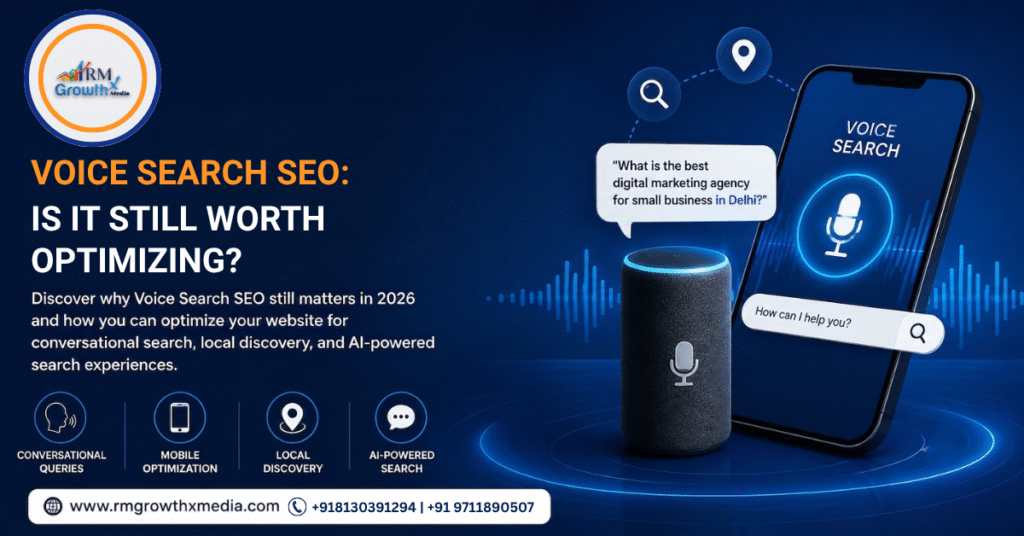
“What is the best digital marketing agency for a small business in Delhi?”
Voice searches are often more conversational and question-based than traditional typed searches.
However, businesses should not create a completely separate version of their website just for voice search. Many of the practices that support voice search—such as clear content, strong mobile usability, fast-loading pages, local optimization, and answering user questions—are already important components of modern SEO.
Is Voice Search SEO Still Worth Optimizing For in 2026?
Yes, Voice Search SEO is still worth optimizing for, but it should be integrated into your broader SEO strategy rather than treated as a standalone ranking system.
Voice search remains relevant because people continue to use voice interfaces and conversational queries across mobile devices and other technologies. At the same time, search itself is becoming more conversational, with Google discussing voice queries alongside broader multimodal and AI-powered search experiences.
The bigger opportunity is therefore not simply “ranking for voice.”
It is optimizing for the way people ask questions and express search intent.
If your content:
- Answers real customer questions
- Uses natural language
- Provides direct and useful information
- Works well on mobile
- Loads efficiently
- Has clear site structure
- Targets relevant search intent
- Provides accurate local information
then you’re building a website that is better prepared for both traditional and conversational search.
How Voice Search Is Different From Traditional Search
Voice queries often have a more conversational structure.
Traditional typed search:
“SEO services Delhi”
Conversational voice search:
“Which SEO company offers affordable SEO services in Delhi?”
Traditional typed search:
“best dentist near me”
Voice search:
“Which dentist is open near me right now?”
The second type of query provides more context.
This is why businesses should understand search intent rather than simply targeting individual keywords.
Voice optimization is less about inserting exact phrases and more about creating content that naturally answers the questions people ask.
Top Voice Search SEO Strategies for Businesses
1. Focus on Conversational Search Queries
One of the most important Voice Search SEO strategies is to understand how your customers actually speak.
People don’t always speak the same way they type.
For example, someone may type:
“website development company Delhi”
but ask:
“Who can build a professional website for my business in Delhi?”
Your keyword research should therefore include conversational variations.
Look for questions such as:
- What is…?
- How does…?
- Why should I…?
- Where can I…?
- Which is the best…?
- How much does…?
- How long does…?
- Is it worth…?
- What are the benefits of…?
These questions can become useful FAQ sections, blog topics, service-page sections, and supporting content.
2. Target Long-Tail Keywords
Voice searches naturally lend themselves to longer queries.
Instead of focusing only on:
“digital marketing”
you might target:
“What digital marketing services are best for a small business?”
Long-tail keywords can help you understand the specific problems, questions, and needs behind a search.
They also allow your content to address a more precise intent.
A useful approach is:
Broad keyword → Long-tail keyword → Question → Helpful answer
For example:
SEO services
↓
SEO services for small businesses
↓
How can SEO help a small business get more customers?
↓
Create a clear answer supported by useful information.
This approach helps make your content more conversational without forcing unnatural keywords onto the page.
3. Create Question-Based Content
Question-based content is particularly useful for conversational search.
Instead of writing every blog around generic topics, consider creating sections that directly answer customer questions.
For example:
What Does SEO Cost for a Small Business?
Then provide a concise answer followed by more detailed information.
Other useful questions could include:
- How long does SEO take?
- What does a digital marketing agency do?
- Is SEO better than paid advertising?
- How can I improve my Google rankings?
- How do I choose an SEO company?
- What is technical SEO?
- How does local SEO work?
The answers should be genuinely useful rather than written solely to target keywords.
Google’s current guidance emphasizes people-first content that provides substantial value and satisfies the user’s needs.
4. Optimize for Local Search
Voice search and local SEO can work particularly well together.
People frequently use conversational queries when looking for nearby businesses or services.
Examples include:
- “Where is the nearest restaurant?”
- “Which SEO agency is near me?”
- “Find a web development company near me.”
- “What restaurants are open near me?”
- “Where can I get a phone repaired?”
For local businesses, your strategy should include:
- Google Business Profile optimization
- Accurate business information
- Local keyword targeting
- Customer reviews
- Location-specific pages
- Local content
- Mobile optimization
If your business serves a specific geographic area, local SEO can make conversational search queries more relevant to your business.
5. Make Your Website Mobile-Friendly
Voice search is closely connected to mobile behavior.
Users often speak their queries into smartphones rather than desktop computers.
This makes mobile usability essential.
Google uses the mobile version of a website’s content for indexing and ranking under mobile-first indexing. Google also recommends responsive web design and emphasizes making mobile content accessible and equivalent to desktop content.
Your mobile website should:
- Load quickly
- Use readable text
- Have clear navigation
- Provide easy-to-use buttons
- Make phone numbers clickable
- Display important information clearly
- Avoid intrusive pop-ups
- Provide the same essential content as desktop
A technically strong mobile experience benefits both voice and traditional search users.
6. Improve Page Speed and User Experience
Imagine someone asks a voice assistant a question, receives a result, visits your website, and then waits several seconds for the page to load.
That creates a poor experience.
Page speed should therefore be part of your overall Voice Search SEO strategy.
Focus on:
- Compressing images
- Reducing unnecessary JavaScript
- Improving server response time
- Using browser caching
- Optimizing CSS
- Reducing third-party scripts
- Using efficient hosting
Google recommends considering overall page experience rather than focusing on a single metric. Core Web Vitals remain useful indicators of real-world user experience, although strong scores do not guarantee rankings.
7. Provide Direct Answers Before Going Into Detail
Voice and conversational searches often require quick answers.
For example:
What Is Technical SEO?
Technical SEO is the process of optimizing a website’s technical infrastructure so search engines can crawl, understand, and index its content effectively.
After providing the direct answer, you can expand with:
- Examples
- Benefits
- Best practices
- Common mistakes
- Tools
- Expert recommendations
This structure is useful for both users and search engines.
It also gives your content a better chance of being useful when users need a quick answer.
8. Use Natural Language Throughout Your Content
Don’t write content that sounds like it was created for a search engine.
For example:
❌ Best SEO company Delhi SEO services affordable SEO agency Delhi
This is unnatural and provides a poor user experience.
Instead:
✅ Looking for an SEO company in Delhi? A professional SEO agency can help your business improve organic visibility, attract qualified traffic, and build a long-term search strategy.
The second version naturally incorporates relevant terms while remaining useful and readable.
This aligns with Google’s people-first content guidance, which recommends creating content primarily to help people rather than manipulating search rankings.
9. Structure Content With Clear Headings
Good heading structure makes content easier to understand.
For example:
H1: Voice Search SEO: Is It Still Worth Optimizing?
H2: What Is Voice Search SEO?
H2: Is Voice Search SEO Still Worth Optimizing?
H2: Voice Search SEO Strategies
H3: Optimize for Conversational Queries
H3: Target Long-Tail Keywords
H3: Create Question-Based Content
This structure helps readers quickly find the information they need.
It also gives search engines clearer context about the page.
10. Build a Strong FAQ Section
FAQ content can be useful because it directly addresses questions customers ask.
However, don’t create FAQs simply to chase a Google rich result.
Google’s documentation updates in 2026 indicate that the FAQ rich-result feature is no longer shown in Google Search results. FAQs can still be valuable for users and content coverage, but you shouldn’t promise that FAQ schema will generate a Google FAQ rich result.
Good FAQ topics include:
- What is Voice Search SEO?
- Is voice search still important?
- How do I optimize my website for voice search?
- Does voice search help local businesses?
- What keywords should I target for voice search?
- Does mobile SEO affect voice search?
- How does conversational search affect SEO?
Voice Search SEO and Technical SEO
Voice search optimization also depends on a technically accessible website.
This is where Technical SEO Mistakes can indirectly interfere with your broader conversational search strategy.
For example, if important content is:
- Blocked from crawling
- Not indexable
- Missing from the mobile version
- Hidden behind problematic scripts
- Difficult to render
- Extremely slow
- Poorly structured
then search engines may have difficulty accessing or understanding it.
Google’s current guidance says websites should ensure that Google can access, crawl, and index their content and that structured data should accurately match visible page content.
Technical SEO Checklist for Voice Search
Check that your website has:
- Mobile-friendly design
- Fast page speed
- HTTPS
- Crawlable pages
- Indexable content
- Clear headings
- Descriptive page titles
- Logical internal linking
- Accessible primary content
- Correct structured data
- Clean URL structure
Voice optimization should therefore be considered part of a broader technical and content SEO strategy.
Structured Data and Voice Search
Structured data helps search engines understand information on a webpage in machine-readable form.
Depending on your business and content, structured data may be appropriate for things such as:
- Organization
- LocalBusiness
- Article
- Product
- Breadcrumb
- Event
However, don’t assume that adding schema automatically makes a page rank for voice queries.
Google’s current guidance says structured data can help its systems understand content and make pages eligible for certain search features, but it does not guarantee that those features will appear. Google also emphasizes that structured data should match visible content.
The correct approach is to use structured data accurately as part of your overall SEO implementation.
Voice Search SEO for Small Businesses
Small businesses can particularly benefit from conversational and local search optimization.
Suppose you own a local plumbing company.
Instead of targeting only:
“plumber Delhi”
you could create useful content answering questions such as:
- How much does emergency plumbing cost?
- How quickly can a plumber reach my location?
- What should I do if my water pipe bursts?
- Do you provide emergency plumbing services?
- Which areas do you serve?
These questions reflect real customer needs.
The same strategy can work for:
- Restaurants
- Healthcare businesses
- Legal firms
- Real estate companies
- Digital agencies
- Home service providers
- Retail stores
- Educational businesses
- Professional services
How to Research Voice Search Keywords
Traditional keyword tools are still useful, but don’t rely solely on search volume.
Step 1: Identify your main services
For example: SEO services
Step 2: Identify customer questions
How can SEO help my business?
Step 3: Identify local intent
How can an SEO company in Delhi help my business?
Step 4: Check Google's related searches
Look for related questions and variations.
Step 5: Review your customer conversations
Sales calls, emails, support tickets, reviews, and social media questions can reveal the exact language customers use.
This can produce highly relevant conversational content.
Common Voice Search SEO Mistakes to Avoid
1. Keyword Stuffing
Adding conversational phrases repeatedly does not make content voice optimized. Write naturally.
2. Creating Separate Pages for Every Question
You don’t need hundreds of thin pages targeting slightly different questions. Combine related questions into comprehensive resources where appropriate.
3. Ignoring Search Intent
A keyword may have multiple meanings. Always understand what the user actually wants.
4. Neglecting Mobile SEO
A voice-optimized strategy without a strong mobile experience is incomplete.
5. Writing Content Only for Search Engines
Your content should solve the user’s problem first.
6. Assuming Schema Guarantees Voice Rankings
Structured data can help search engines understand content, but it does not guarantee rankings or search features.
7. Forgetting Local SEO
For businesses serving specific geographic areas, local optimization can be particularly valuable for conversational searches.
How RM Growth X Media Can Help With Voice Search SEO
Optimizing for modern search requires more than adding question-based keywords to a website.
At RM Growth X Media, we can help businesses build a comprehensive SEO strategy that combines technical SEO, content optimization, website performance, local search, and digital marketing.
Our services include:
Search Engine Optimization Services
Our SEO Services can help improve your website’s technical foundation, content relevance, keyword targeting, and organic search visibility.
Digital Marketing Services
Our Digital Marketing Services can help businesses build a broader online presence and attract relevant audiences through multiple digital channels.
Website Design & Development Services
A well-designed, mobile-friendly website provides the foundation for a strong search experience. Our Website Design & Development Services can help create websites that are user-focused, responsive, and optimized for modern search requirements.
For businesses looking to adapt to conversational search, AI-powered search experiences, and changing user behavior, combining these services can create a more sustainable digital strategy.
Frequently Asked Questions About Voice Search SEO
Yes. Voice Search SEO is still worth considering, particularly for businesses that receive conversational, mobile, or local searches. However, it should be integrated into your broader SEO strategy rather than treated as a separate ranking system.
Focus on natural-language content, question-based keywords, long-tail searches, local SEO, mobile usability, fast page performance, clear answers, logical content structure, and technically accessible pages.
You should not approach voice search as having a completely separate ranking system. Google describes voice queries as part of the broader evolution of Search, alongside multimodal and AI-powered search experiences.
Yes. Conversational queries are often longer and more specific than traditional typed searches, making long-tail and question-based keyword research useful.
It can be particularly valuable for businesses that serve specific geographic areas because users frequently use conversational queries to find nearby businesses, services, locations, and operating information.
You don't need to create an FAQ page solely for voice search. Instead, answer relevant customer questions naturally throughout your service pages, blog posts, guides, and FAQ sections.
Structured data can help search engines understand your content and may make pages eligible for certain search features, but it does not guarantee rankings or specific search appearances.
Voice Search SEO Checklist
Before publishing or optimizing a page, ask:
- Is the content written naturally?
- Does it answer real customer questions?
- Does it match search intent?
- Are conversational keywords used naturally?
- Are relevant long-tail keywords included?
- Is the page mobile-friendly?
- Does the page load efficiently?
- Is the primary content accessible to search engines?
- Are headings clear and descriptive?
- Is the business information accurate?
- Is local information included where relevant?
- Is structured data accurate and supported by visible content?
- Does the content provide genuine value?
- Are internal links helping users discover related information?
If you can answer “yes” to most of these questions, your website is better positioned for modern conversational search.
Conclusion
So, is Voice Search SEO still worth optimizing for? Absolutely—but not in the way it was discussed several years ago.
The future of search is increasingly conversational, mobile, multimodal, and AI-assisted. Google itself describes voice queries as one part of the continuing evolution of Search, while its current guidance emphasizes unique, helpful content, strong page experience, technical accessibility, and adapting to changing user behavior.
Instead of trying to “rank specifically for voice,” businesses should focus on creating content that answers real questions, uses natural language, satisfies search intent, works well on mobile devices, loads efficiently, and provides clear information.
For local businesses, this should be combined with local SEO. For service businesses, it should include question-based and long-tail content. For every website, it should be supported by a technically accessible and user-friendly foundation.
In other words, Voice Search SEO is not dead—it has simply become part of modern SEO.
Businesses that optimize for how people naturally search, ask questions, and interact with information can be better prepared for the changing search landscape.
If you’re ready to adapt your website to modern search behavior, RM Growth X Media can help you build a comprehensive SEO strategy designed around your business, audience, and long-term growth goals.
Get in touch with RM Growth X Media today and take the next step toward a stronger, more search-friendly online presence.