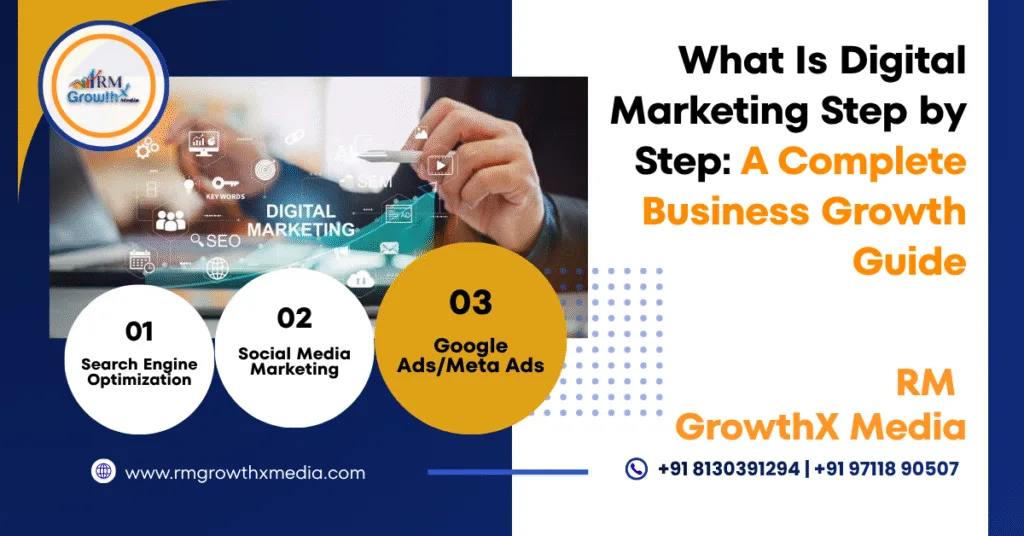
In today’s fast-paced digital economy, relying solely on traditional advertising methods like print, flyers, or offline networking is no longer enough to sustain scalable business growth. Digital marketing provides businesses with a structured, predictable, and data-driven framework to increase brand visibility, drive qualified leads, and maximize return on investment (ROI).
Whether you run a local business, a B2B agency, or a growing e-commerce brand, understanding digital marketing step by step is key to converting online visitors into loyal paying customers. This comprehensive guide outlines the exact 6-step framework businesses must follow to establish a dominant online presence.
Step-by-Step Digital Marketing Explanation
Step 1: Defining Your Digital Marketing Strategy & Target Audience
Launching ad campaigns or creating social media posts without a clear strategy leads to wasted budgets and poor lead quality. A successful digital marketing roadmap starts with thorough market research and business alignment.
- Target Audience Profiling: Identify your exact buyer personas by analyzing demographic data, geographic locations, purchasing behaviors, and key pain points.
- Competitor Benchmarking: Analyze competitor websites, ad strategies, and keyword rankings to spot market gaps and differentiation opportunities.
- Goal Setting & KPI Alignment: Establish clear, measurable Key Performance Indicators (KPIs), such as reducing Customer Acquisition Cost (CAC), increasing website conversion rates, or generating 50 high-ticket B2B leads monthly.
A well-defined strategy ensures that every marketing channel works together towards a single business goal.
Step 2: Building Organic Authority via Search Engine Optimization (SEO)
Search Engine Optimization (SEO) is the cornerstone of sustainable online growth. It optimizes your website to rank at the top of Google search results for high-intent keywords, bringing in consistent organic leads without paying for every click.
- On-Page SEO Optimization: Structure web pages, headings (H1, H2, H3), and meta descriptions around high-converting commercial keywords.
- Technical SEO & Core Web Vitals: Improve page speed, secure your site with HTTPS, fix broken links, and ensure full mobile responsiveness for smooth user experience.
- Local SEO Setup: Optimize your Google Business Profile to capture immediate local inquiries and map pack rankings.
- Authority & Backlink Building: Earn authoritative backlinks from reputed industry publications to build domain trust in Google’s algorithms.
Explore our dedicated Search Engine Optimization Services to build long-term search engine dominance for your business.
Step 3: Social Media Marketing for Brand Credibility & Engagement
Social media platforms like Instagram, LinkedIn, Facebook, and X (Twitter) serve as vital touchpoints for nurturing prospective clients and proving brand authority.
- Channel Alignment: Choose platforms based on your business model—LinkedIn for B2B decision-makers and corporate partnerships; Instagram and Facebook for visual branding, B2C engagement, and lead forms.
- Strategic Content Pillars: Maintain a consistent posting schedule featuring client testimonials, case studies, behind-the-scenes operations, and direct call-to-action (CTA) offers.
- Community & Reputation Management: Actively engage with prospective clients in comments and direct messages to build trust and move leads down the sales funnel.
Discover how our Social Media Marketing Services can help build customer trust and scale your brand identity online.
Step 4: High-Converting Content Marketing & Sales Funnels
Content is the driving engine of digital marketing. A multi-stage content strategy educates your audience and guides potential buyers from interest to final decision.
- Top-of-Funnel (Awareness): Educational blog posts, infographics, and short-form videos that solve common industry challenges.
- Middle-of-Funnel (Consideration): Comparison guides, whitepapers, case studies, and email newsletters that prove your solution’s effectiveness.
- Bottom-of-Funnel (Conversion): Conversion-optimized landing pages, free consultation offers, and custom ROI calculators designed to close deals.
Step 5: Immediate Lead Generation with Google Ads (PPC) & Paid Media
While SEO provides long-term organic growth, Pay-Per-Click (PPC) advertising delivers immediate traffic, high-intent leads, and fast visibility on search engines and social feeds.
- Google Search Ads: Target users who are actively searching for immediate solutions using high-intent buyer keywords.
- Remarketing Campaigns: Serve targeted display and social ads to previous website visitors who left without filling out a lead form.
- Landing Page Optimization: Match ad messaging directly with landing page content to achieve higher Quality Scores and lower Cost-Per-Click (CPC).
Check out our specialized Google Ads & PPC Services to launch high-ROI paid campaigns for your business.
Step 6: Analytics, Conversion Tracking, and Performance Optimization
The greatest advantage of digital marketing over traditional marketing is complete data transparency. Analytics tools allow business owners to track exact performance metrics and refine strategies in real time.
- Conversion Tracking Setup: Utilize Google Analytics 4 (GA4) and Meta Pixel to track key customer actions, such as form submissions, phone calls, and direct purchases.
- Cost Per Lead (CPL) Analysis: Continuously measure which acquisition channels yield the highest ROI at the lowest cost.
- Conversion Rate Optimization (CRO): Conduct A/B tests on landing page headlines, button placements, and ad creatives to maximize conversion rates.
Why Digital Marketing Is Essential for Modern Business Growth
- Laser-Targeted Audience Reach: Target customers based on precise parameters such as location, search intent, job titles, and buying behavior.
- Complete ROI Transparency: Track every rupee or dollar spent to see exactly how many inquiries and sales it generated.
- Scalable Business Growth: Start with small test budgets and scale up advertising investment as campaign profitability is proven.
- Level Playing Field: Compete effectively against larger enterprise competitors through agile, hyper-targeted SEO and digital ad strategies.
Conclusion
The timeline depends on the channels used. Paid advertising channels like Google Ads and Meta Ads can generate traffic and leads within 24 to 48 hours. Organic strategies like SEO and Content Marketing typically take 3 to 6 months to establish domain authority and deliver consistent, sustainable traffic.
Most growing businesses allocate between 5% to 15% of their total revenue toward digital marketing. For startups or businesses scaling aggressively, starting with a targeted paid ad campaign (e.g., Google Search Ads) alongside foundational SEO ensures immediate lead flow while building long-term organic presence.
Both channels serve different stages of growth. Google Ads is best for immediate traffic and high-intent buyer conversions, while SEO provides long-term cost efficiency and brand trust without continuous ad spend. Combining both creates the highest overall conversion rate for your business.
Traffic without conversions usually points to a mismatch between consumer search intent and landing page user experience (UX). Common causes include weak Calls to Action (CTAs), slow page loading speed, non-responsive mobile design, or targeting broad, unqualified keywords instead of buyer-intent keywords.
Yes. Modern consumers rely heavily on local search intent (such as "services near me") and online business reviews before making purchasing decisions. Local SEO, Google Business Profile optimization, and geotargeted social ads allow small businesses to dominate local markets affordably.
Customer Acquisition Cost (CAC) is the total marketing and sales expenditure required to acquire a single paying customer. Tracking CAC helps businesses determine campaign profitability and optimize ad spend toward channels that generate the highest return on investment (ROI).
B2B decision-makers, executives, and business managers primarily engage on LinkedIn, making it ideal for high-ticket service sales, corporate networking, and thought leadership. However, Instagram works exceptionally well as a secondary channel for employer branding, visual portfolio display, and direct messaging outreach.
Partnering with a specialized digital marketing agency gives your business immediate access to an entire team of specialists—SEO strategists, media buyers, copywriters, and analytics experts—for a fraction of the cost of hiring and training an equivalent in-house department.
Conclusion
Understanding digital marketing step by step empowers business owners to replace guesswork with a predictable revenue-generating growth engine. By combining Search Engine Optimization, targeted Social Media Marketing, high-converting Content, and Google Ads, your business can systematically capture and convert online demand.
Ready to accelerate your online business growth with proven strategies? Partner with the expert team at RM GrowthX Media today. Contact us to schedule your comprehensive digital growth audit and start scaling your leads online!