
Introduction
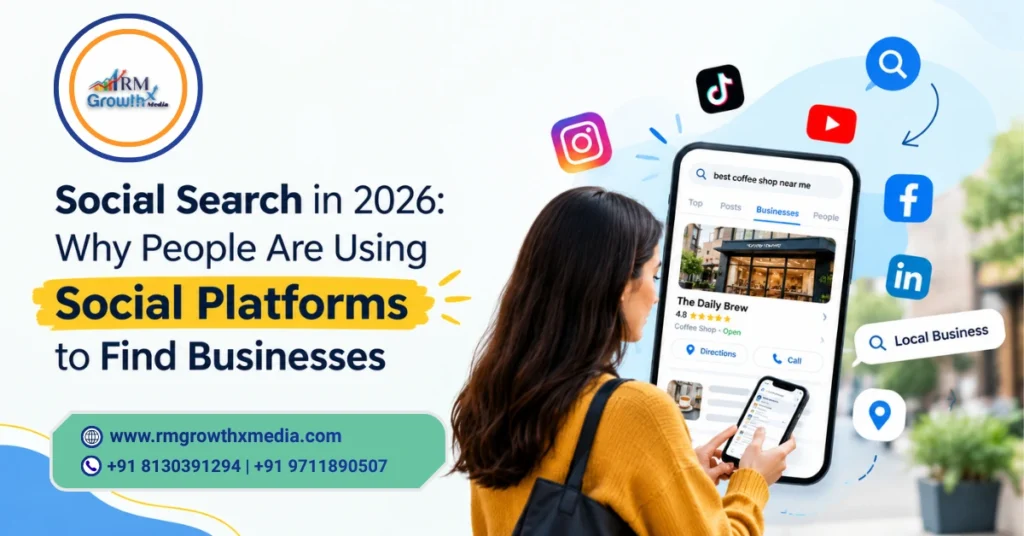
Search behavior is changing rapidly. People no longer rely only on traditional search engines when they want to discover a business, product, service, restaurant, creator, or local recommendation. Increasingly, they are turning to social platforms to search for ideas, reviews, tutorials, recommendations, and businesses.
This shift is making Social Search an important part of digital marketing in 2026.
Instead of typing every query into a traditional search engine, users may search directly on Instagram for a restaurant, YouTube for tutorials, LinkedIn for B2B expertise, or Facebook for local businesses and community recommendations.
For businesses, this means visibility is no longer limited to Google search results. A brand can also become discoverable through social content, platform search, recommendations, hashtags, captions, videos, profiles, comments, and user-generated content.
The businesses that understand this change can build stronger brand visibility and reach potential customers earlier in the buying journey.
What Is Social Search?
Social Search is the process of using social media platforms to discover information, businesses, products, services, recommendations, reviews, and content instead of relying exclusively on traditional search engines.
Users can search directly within platforms such as Instagram, YouTube, LinkedIn, and Facebook. Their searches can be influenced by keywords, captions, hashtags, profiles, video content, engagement, recommendations, and platform algorithms.
For example, someone looking for a digital marketing agency may search:
- “digital marketing agency”
- “SEO agency for small business”
- “best social media marketing tips”
- “Instagram marketing strategy”
- “SEO tips for local businesses”
Instead of immediately searching Google, they may search these phrases on Instagram, YouTube, or LinkedIn.
This creates a new optimization opportunity for brands.
Why Social Search Matters in 2026
Social Search matters because consumers increasingly use social platforms as discovery engines.
Social media is no longer only about following friends, publishing updates, or consuming entertainment. Platforms have become places where users research products, compare businesses, learn new skills, discover services, evaluate brands, and seek recommendations.
Several factors are driving this change.
1. People Want Visual and Practical Answers
Traditional search often produces websites and text-based results. Social platforms can provide visual demonstrations, short videos, tutorials, reviews, before-and-after examples, and real experiences.
For example, someone researching skincare advice may prefer watching several short videos demonstrating a product rather than reading multiple product pages.
The same behavior applies to many industries.
A user researching:
- Restaurants may look for food videos.
- Gyms may search for workout demonstrations.
- Interior designers may search for room transformations.
- Marketing agencies may search for campaign examples.
- Fashion brands may be discovered through visual content.
- Software companies may be discovered through tutorials and product demonstrations.
This makes useful visual content an important component of Social Search optimization.
2. Social Platforms Combine Search and Discovery
Traditional search usually begins with an intentional query.
Social platforms can combine intentional search with algorithmic discovery.
A person may search for “SEO tips” and then discover an agency they were not previously aware of. They may watch several videos, visit the profile, read comments, view additional content, and eventually visit the company’s website.
This creates multiple opportunities for businesses to appear during the discovery process.
3. Users Look for Real Experiences
People often want more than a company’s own marketing message.
They want to see:
- Customer experiences
- Demonstrations
- Reviews
- Tutorials
- Case studies
- Comparisons
- Behind-the-scenes content
- Expert opinions
- User-generated content
Social platforms are particularly useful for this type of information because content can show how products and services are actually used.
Traditional Search vs. Social Search
|
Traditional Search
|
Social Search
|
|---|---|
|
Primarily search-engine driven
|
Primarily platform-driven
|
|
Strong focus on websites
|
Strong focus on profiles and content
|
|
Text and webpages are central
|
Video, images, posts, and creators are central
|
|
Search intent is often explicit
|
Search and discovery can happen together
|
|
SEO is a major visibility factor
|
Social SEO and engagement also matter
|
|
Reviews may appear separately
|
Reviews and experiences can be integrated into content
|
This does not mean traditional SEO is becoming irrelevant.
Instead, businesses should think beyond a single search channel.
A strong digital strategy can combine website SEO, social content, local optimization, paid advertising, and brand-building activities.
How Social Search Is Changing Business Discovery
1. Instagram Is Becoming a Discovery Channel
Instagram can help users discover businesses through posts, Reels, profiles, hashtags, recommendations, and visual content.
For many businesses, Instagram functions almost like a visual search engine.
A user may search for:
“best cafes in Delhi”
“home decor ideas”
“digital marketing agency”
“bridal makeup artist”
or
“fitness trainer near me.”
Businesses that consistently publish relevant content can increase their chances of appearing during these discovery journeys.
How Businesses Can Optimize Instagram for Social Search
Businesses should focus on:
- Using relevant keywords in captions
- Writing clear profile descriptions
- Including service and location information where relevant
- Creating searchable content around customer questions
- Using descriptive text instead of relying only on visuals
- Publishing Reels addressing specific search queries
- Maintaining a consistent brand identity
- Encouraging genuine engagement
The goal is not to insert keywords everywhere.
The goal is to make it easy for both users and platforms to understand what the content is about.
2. YouTube Is a Powerful Search-Driven Platform
YouTube has a strong search component, making it particularly valuable for businesses that can explain complex topics through video.
YouTube users can discover Shorts and other content through Search and additional discovery surfaces, and YouTube explains that search visibility for Shorts considers factors such as metadata matching, viewer behavior, and content performance. Businesses can use YouTube’s official Shorts Search and Discovery guidance to understand how discovery works.
This means businesses should not treat YouTube as only a video-hosting platform.
It can also function as a searchable knowledge library.
Examples of Search-Friendly YouTube Content
A digital marketing company could create:
- “What Is Technical SEO?”
- “How to Improve Local SEO”
- “SEO vs PPC: Which One Should You Choose?”
- “How to Reduce Customer Acquisition Cost”
- “Social Media Marketing Strategy for Small Businesses”
- “How to Create a Content Marketing Strategy”
Each video can target a specific information need.
3. LinkedIn Is Important for B2B Social Search
B2B buyers often research companies, professionals, executives, consultants, and industry experts before making purchasing decisions.
LinkedIn can therefore become an important Social Search channel for B2B businesses.
A potential customer may search for:
- Marketing consultants
- SaaS experts
- Business coaches
- SEO specialists
- Financial professionals
- Technology providers
- Industry insights
Businesses can improve their visibility by publishing educational content rather than only promotional updates.
Build Topical Authority on LinkedIn
For example, a digital marketing professional could regularly publish content about:
- SEO strategy
- Paid advertising
- Content marketing
- AI in marketing
- Social media trends
- Conversion optimization
- Marketing analytics
Over time, consistent expertise can strengthen the association between the person or business and specific topics.
4. Facebook Still Matters for Local Discovery
Facebook remains useful for community-driven discovery.
People may use Facebook groups, business pages, recommendations, posts, and local communities to find businesses.
This can be particularly valuable for:
- Local service businesses
- Restaurants
- Retailers
- Events
- Home services
- Professional services
- Community-focused businesses
A strong Facebook presence should include accurate business information, useful posts, customer interactions, and relevant local content.
How to Optimize Your Business for Social Search
1. Use Search-Friendly Profiles
Your social media profile should clearly communicate:
- Who you are
- What you offer
- Who you serve
- Where you operate, if relevant
- What makes your business different
Avoid vague descriptions.
Instead of:
“Helping businesses grow online.”
Consider something more descriptive:
“Digital marketing agency helping businesses grow through SEO, social media, paid advertising, and content marketing.”
The second description gives users and platforms clearer context.
2. Use Relevant Keywords Naturally
Keywords still matter in Social Search, but keyword stuffing should be avoided.
Use relevant terms naturally in:
- Profile descriptions
- Captions
- Video titles
- Video descriptions
- On-screen text
- Hashtags where appropriate
- Content topics
- Alt text where supported
For example, a local bakery could naturally create content around:
- Bakery in Gurgaon
- Custom birthday cakes
- Wedding cakes
- Eggless cakes
- Cake delivery
- Dessert ideas
The content should answer real customer needs rather than simply repeating keywords.
3. Create Content Around Search Intent
One of the strongest ways to improve Social Search visibility is to understand what users actually want.
Search intent can generally be divided into several categories.
Informational Intent
The user wants information.
Examples:
- What is SEO?
- How does social media marketing work?
- What is Social Search?
Commercial Intent
The user is researching options.
Examples:
- Best SEO agency
- Best marketing tools
- Social media agency for small business
Transactional Intent
The user is ready to take action.
Examples:
- Hire SEO agency
- Book a digital marketing consultation
- Buy social media management services
Local Intent
The user wants a nearby business.
Examples:
- Digital marketing agency near me
- Best cafe in Gurgaon
- Dentist near me
Your content strategy should address multiple types of intent.
Social Search for Local Businesses
Local businesses have a significant opportunity because customers often use social platforms to discover places and services.
A restaurant, salon, gym, clinic, boutique, or home-service company can create location-specific content that helps customers discover the business.
For example:
A restaurant can publish:
“Best dishes to try at our Gurgaon restaurant.”
A salon can publish:
“Trending bridal hairstyles for Gurgaon weddings.”
A fitness studio can publish:
“Beginner-friendly workouts for busy professionals.”
These topics combine business relevance with user intent.
Businesses should also keep their business information accurate and consistent across platforms. Google’s official guidance explains how businesses can establish and maintain accurate business details across their online presence, making Google’s guidance on establishing business details useful when building a consistent digital presence.
The Role of Reviews and User-Generated Content
Social Search is not only about what businesses publish.
What customers publish can also influence discovery.
User-generated content can include:
- Customer reviews
- Product demonstrations
- Testimonials
- Unboxing videos
- Before-and-after posts
- Customer photos
- Social mentions
- Creator collaborations
This type of content can provide social proof.
For example, if someone searches for a restaurant and sees several real customers posting about their experiences, that content may influence the person’s decision more strongly than a traditional advertisement.
Businesses should therefore encourage genuine customer participation without manufacturing fake reviews or misleading content.
Social Search and the Customer Journey
Social Search can influence multiple stages of the customer journey.
Awareness
A user discovers a brand through a video, Reel, post, or recommendation.
Consideration
The user visits the profile and consumes more content.
Evaluation
The user compares reviews, demonstrations, testimonials, and alternatives.
Conversion
The user visits the website, sends a message, makes a booking, or purchases.
Advocacy
The customer shares their experience and creates new content.
This creates a cycle where one customer interaction can potentially contribute to future discovery.
Metrics Businesses Should Track
Social Search should not be measured only through follower growth.
Businesses should monitor metrics connected to discovery and business outcomes.
Important metrics include:
- Search-driven impressions
- Profile visits
- Content reach
- Saves
- Shares
- Engagement
- Website clicks
- Leads
- Messages
- Calls
- Bookings
- Conversions
- Branded searches
- Assisted conversions
The exact metrics available vary by platform.
The most important principle is to connect social visibility with meaningful business outcomes.
For example, 10,000 views may look impressive, but 200 highly relevant profile visits and 20 qualified leads could be more valuable to a service business.
Common Social Search Mistakes Businesses Should Avoid
1. Treating Social Media Only as a Broadcasting Channel
Posting promotional content without considering what people search for limits discovery opportunities.
Create content that answers questions and solves problems.
2. Ignoring Keywords
A beautiful video can still be difficult to discover if its topic is unclear.
Use descriptive language in titles, captions, and supporting text.
3. Using Too Many Hashtags
More hashtags do not automatically mean better visibility.
Focus on relevance rather than quantity.
4. Having an Incomplete Profile
A profile without clear information can lose potential customers.
Make your business description, website, services, and contact information clear.
5. Focusing Only on Followers
A smaller but relevant audience can generate better business results than a large audience with little commercial relevance.
6. Copying Trends Without Context
Trends can increase reach, but they should make sense for your brand.
Use trends as a format or creative opportunity—not as a replacement for strategy.
7. Ignoring Comments
Comments can contain questions that reveal what customers actually want to know.
Use these questions as ideas for future content.
How Businesses Can Build a Social Search Strategy
A practical strategy can follow these steps.
Step 1: Identify Your Audience's Search Questions
Research what customers ask about your products, services, industry, and location.
Step 2: Group Questions by Topic
Create content categories such as:
- Educational
- Product-focused
- Service-focused
- Local
- Comparison
- Problem-solving
- Reviews
- Frequently asked questions
Step 3: Choose the Right Platforms
You do not need to publish identical content everywhere.
Choose platforms based on where your audience searches and consumes information.
Step 4: Create Search-Friendly Content
Use clear titles, captions, descriptions, spoken keywords, and relevant visual context.
Step 5: Repurpose Strong Content
A useful blog post can become:
- Instagram Reels
- YouTube Shorts
- LinkedIn posts
- Facebook posts
- Carousel content
This allows one research effort to support multiple discovery channels.
Step 6: Measure Results
Track discovery, engagement, traffic, leads, and conversions.
Then improve your strategy based on actual performance.
Social Search and SEO Should Work Together
Social Search should not replace traditional SEO.
Instead, both strategies can support each other.
A business can publish a detailed article on its website and then turn the same topic into short-form videos, LinkedIn posts, Instagram content, and YouTube videos.
This creates multiple opportunities for users to discover the brand.
For businesses looking to build this broader visibility, RM GrowthX Media’s search engine optimization services can support the website side of the strategy, while social content can expand discovery across social platforms.
This integrated approach is stronger than treating every marketing channel as an isolated activity.
The Future of Social Search
Social Search is likely to become increasingly important as platforms improve their search, recommendation, personalization, and discovery capabilities.
Several developments are worth watching.
AI-Powered Discovery
AI can make it easier for platforms to understand content, user intent, and context.
Businesses will need to create content that communicates topics clearly rather than relying on isolated keywords.
More Video-Based Searches
Video is likely to remain an important discovery format.
Businesses should learn how to communicate useful information quickly without sacrificing clarity.
Greater Importance of Creators
Creators can introduce brands to highly relevant communities.
Creator partnerships may therefore become an important part of discovery strategies.
Social Commerce Growth
As shopping features continue evolving, discovery and purchasing can become more closely connected.
Users may discover a product, research it, watch demonstrations, and take action without leaving the platform.
Stronger Local Discovery
Local businesses can benefit as users increasingly search for recommendations, experiences, and services through social platforms.
How RM GrowthX Media Can Help
Building visibility through Social Search requires more than simply posting regularly.
Businesses need a strategy that connects content, SEO, social media, audience intent, and measurable business objectives.
RM GrowthX Media helps businesses develop digital marketing strategies focused on visibility, engagement, lead generation, and growth.
From SEO and social media management to content marketing and paid advertising, an integrated approach can help businesses create stronger digital touchpoints across the customer journey.
If your business wants to improve its online visibility and reach customers across search and social platforms, explore RM GrowthX Media’s digital marketing services to develop a strategy aligned with your business goals.
Frequently Asked Questions About Social Search
Social Search refers to using social media platforms to search for businesses, products, services, information, recommendations, and content. Instead of relying exclusively on traditional search engines, users can search directly within platforms such as Instagram, YouTube, LinkedIn, and Facebook.
Social Search is important because users increasingly discover brands, products, services, and recommendations through social platforms. Search and content discovery are becoming increasingly connected, giving businesses additional opportunities to reach potential customers beyond traditional search engine results.
The best platform depends on your audience and industry. Instagram, YouTube, LinkedIn, and Facebook can all support discovery, but they serve different user behaviors. Businesses should prioritize platforms where their target audience actively searches for information and recommendations.
Businesses can optimize by creating clear profiles, using relevant keywords naturally, publishing useful content, answering customer questions, creating searchable videos, maintaining accurate business information, and monitoring discovery-related performance metrics.
No. Social Search is not necessarily replacing traditional search. Instead, users are using multiple platforms for different types of discovery. Businesses should therefore consider both traditional SEO and social optimization as parts of a broader digital visibility strategy.
Yes, keyword research can help businesses understand the language customers use when searching for information. However, keywords should be used naturally. Content quality, relevance, engagement, platform-specific factors, and user experience also matter.
Yes. Local businesses can use social platforms to showcase locations, products, services, customer experiences, demonstrations, and community-related content. Location-relevant content can help potential customers discover businesses when researching local options.
Useful content often includes tutorials, answers to common questions, product demonstrations, comparisons, reviews, educational videos, customer experiences, and problem-solving content. The best format depends on the platform and the audience's search intent.
Not necessarily. Content can be repurposed, but it should be adapted to each platform. A long-form article might become a YouTube video, Instagram Reel, LinkedIn post, and Facebook update, with each version optimized for its specific audience and format.
Businesses can monitor profile visits, search-related reach, impressions, engagement, saves, shares, website visits, leads, messages, calls, bookings, and conversions. The most useful metrics depend on business objectives and should connect social visibility with measurable outcomes.
Conclusion
Social Search is changing how people discover businesses in 2026. Users are increasingly searching for recommendations, products, services, tutorials, reviews, and local businesses across platforms such as Instagram, YouTube, LinkedIn, and Facebook.
For businesses, this means digital visibility is no longer limited to traditional search engine results.
A strong Social Search strategy combines clear profiles, relevant keywords, useful content, search-focused topics, customer experiences, local relevance, and consistent measurement.
The objective should not be to chase every trend or publish endless content.
Instead, businesses should understand what their customers are searching for and create useful content that answers those needs in the places where their audience already spends time.
When traditional SEO and Social Search work together, businesses can create more opportunities for discovery, build stronger brand authority, and guide potential customers from initial search to meaningful action.
If you want to build a stronger digital presence across search and social channels, RM GrowthX Media’s social media management services can help turn your social presence into a more strategic part of your overall digital marketing approach.
The future of search is becoming more distributed—and businesses that optimize for where people actually search will be better positioned to be discovered.