Introduction
Choosing between Google Ads and Meta Ads can be difficult because both platforms can generate traffic, leads, sales, and brand awareness—but they work very differently. Google Ads vs Meta Ads is not simply a question of which platform is better. The right choice depends on your audience, buying intent, business model, campaign objective, creative assets, budget, and conversion journey.
Google Ads is particularly powerful when people are actively searching for a product, service, solution, or business. Meta Ads, covering platforms such as Facebook and Instagram, can be highly effective when businesses need to create demand, reach specific audience segments, showcase visual content, or retarget potential customers.
This guide compares Google Ads vs Meta Ads across targeting, intent, campaign objectives, costs, creative requirements, lead generation, e-commerce, local businesses, B2B marketing, remarketing, and overall ROI so you can determine which platform—or combination—is more appropriate for your business.
Google Ads vs Meta Ads: What Is the Difference?
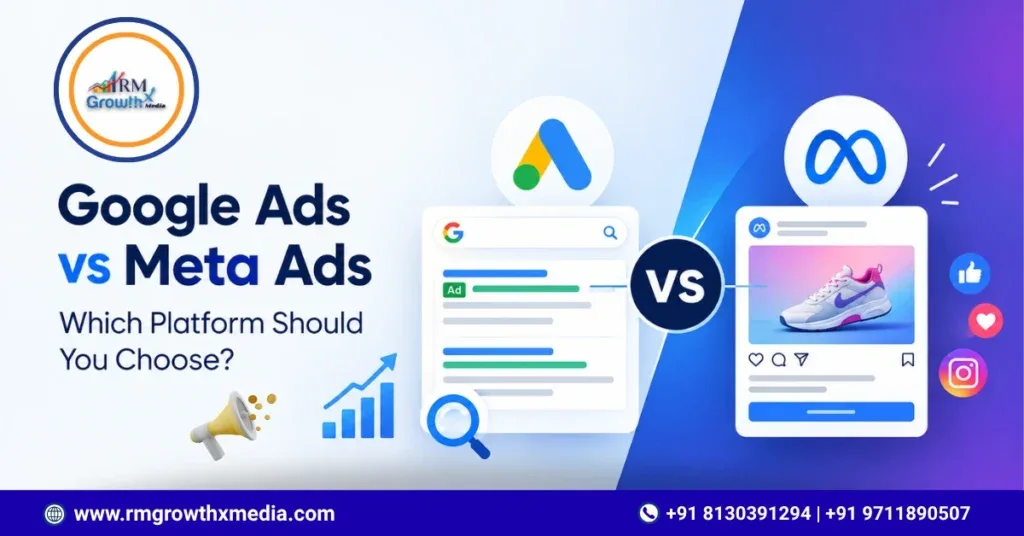
Google Ads vs Meta Ads mainly comes down to intent versus discovery. Google Ads can place businesses in front of people who are already searching for relevant products or services, while Meta Ads can help businesses reach people based on audience characteristics, interests, behaviors, engagement, and other targeting signals.
Google Ads therefore often fits demand capture: someone already has a need and is looking for an answer. Meta Ads often fits demand generation: someone may not be actively searching but can become interested after seeing a relevant product, offer, video, or message.
Neither approach is automatically superior. Your campaign should match the way your customers actually move toward a purchase.
How Google Ads Works
Google Ads is Google’s advertising platform for reaching potential customers across its advertising ecosystem. Search campaigns are particularly useful when users are actively looking for products or services.
For example, imagine a person searches for:
- “dentist near me”
- “best digital marketing agency”
- “buy running shoes online”
- “website development company”
- “AC repair service near me”
These searches reveal some level of intent. A business can create advertising campaigns designed to appear for relevant searches and direct users to an appropriate landing page.
Google Ads also provides campaign options beyond traditional Search advertising, including Display, Video, Shopping, and Performance Max campaigns. The appropriate campaign type depends on the business objective and available assets.
For businesses setting up or optimizing Search campaigns, Google’s official Google Ads Search campaign setup guidance provides information about campaign configuration and related advertising considerations.
Where Google Ads Is Particularly Strong
Google Ads can be a strong option when:
- Customers already know what they need.
- Search demand exists for the product or service.
- The business wants qualified website traffic.
- Lead generation is a major objective.
- Local customers are searching for nearby services.
- The business can create dedicated landing pages.
- Conversions can be accurately tracked.
- Search intent is commercially valuable.
For example, a plumbing company may benefit from search advertising because someone searching for “emergency plumber near me” is already expressing a strong need.
The same principle can apply to lawyers, dentists, real estate companies, home-service businesses, software companies, educational institutions, and many other service categories.
How Meta Ads Works
Meta Ads primarily operates across Meta’s social ecosystem, including Facebook and Instagram. Instead of relying mainly on explicit search queries, Meta advertising can help businesses reach people through audience and behavioral signals.
A business selling skincare products, for example, may not need to wait for a customer to search for a specific product. Instead, it can introduce the product through attractive creative, educational videos, product demonstrations, testimonials, offers, or lifestyle-oriented content.
Meta’s advertising environment can be especially useful for:
- Audience discovery
- Brand awareness
- Product discovery
- Visual storytelling
- Lead generation
- Retargeting
- E-commerce promotion
- Social proof
- Content-driven campaigns
Meta’s advertising tools can use audience characteristics and other signals to help advertisers reach relevant people. Custom and lookalike audience approaches can also be used where applicable.
For additional information about Meta’s audience targeting options, businesses can refer to the official Meta advertising audience targeting resources.
Where Meta Ads Is Particularly Strong
Meta Ads may be a strong option when:
- Your product is visually appealing.
- Your audience spends significant time on Facebook or Instagram.
- You need to create demand rather than capture existing demand.
- Your campaign depends on video or image-based storytelling.
- Social proof influences buying decisions.
- You have strong creative assets.
- You want to build awareness before asking for a conversion.
- Retargeting is an important part of your customer journey.
For example, a fashion brand can show new collections through Reels, carousel ads, product creatives, and lifestyle imagery. The campaign does not necessarily depend on someone actively searching for the brand.
Google Ads vs Meta Ads: Key Differences
The simplest way to understand the two platforms is to compare how they approach the customer journey.
|
Factor
|
Google Ads
|
Meta Ads
|
|---|---|---|
|
Primary strength
|
Capturing existing demand
|
Generating and influencing demand
|
|
User behavior
|
Often actively searching
|
Often discovering or browsing
|
|
Core targeting
|
Keywords, audiences, location and campaign signals
|
Audiences, interests, behaviors and platform signals
|
|
Creative dependency
|
Strong copy and landing pages are important
|
Creative quality is often critical
|
|
Search intent
|
Usually high for relevant queries
|
Usually indirect
|
|
Visual storytelling
|
Useful but varies by campaign
|
Extremely important for many campaigns
|
|
Lead generation
|
Strong for high-intent services
|
Strong when creative and targeting align
|
|
E-commerce
|
Strong, particularly with shopping-oriented campaigns
|
Strong for product discovery and retargeting
|
|
Local businesses
|
Very useful for demand capture
|
Useful for awareness and local promotion
|
|
B2B
|
Often strong for high-intent searches
|
Useful for awareness and retargeting
|
|
Remarketing
|
Available through audience/data strategies
|
Strong retargeting opportunities
|
|
Best starting point
|
Businesses with measurable search demand
|
Businesses with strong audience/creative opportunities
|
The table should not be interpreted as a universal performance ranking. A business can perform differently on each platform depending on its market, offer, landing page, creative quality, tracking, competition, and sales process.
Google Ads vs Meta Ads for Lead Generation
Lead generation is one of the most important reasons businesses compare these platforms.
Google Ads for Lead Generation
Google Ads can be particularly effective when prospects actively search for the service.
Consider a B2B company offering:
“Enterprise cybersecurity consulting.”
A potential buyer who searches for this phrase may already be researching providers. A relevant Google Search campaign can capture that existing intent and send the user to a dedicated service page or lead-generation landing page.
For high-intent services, the path can look like:
Search → Ad → Landing Page → Form/Call → Sales Follow-Up
The quality of the landing page is therefore critical. If the ad promises one thing and the landing page provides something unrelated, the campaign can lose efficiency.
Businesses can strengthen this ecosystem with professional digital marketing services that coordinate paid campaigns with SEO, content, conversion strategy, and other digital channels.
Meta Ads for Lead Generation
Meta Ads can work differently.
A prospect may not be actively searching for your service. Instead, they may see:
- An educational video
- A customer testimonial
- A product demonstration
- A problem/solution advertisement
- A limited-time offer
- A lead-generation form
- A before-and-after creative
The customer journey may therefore look like:
Ad Exposure → Engagement → Consideration → Retargeting → Lead → Sales Follow-Up
This can be especially useful for businesses where customers need education before taking action.
Google Ads vs Meta Ads for E-Commerce
For e-commerce brands, the choice becomes more nuanced.
Google can be valuable when customers are already looking for products. Product-focused campaigns can help businesses capture shopping-oriented demand.
For example, someone searching for:
“women’s running shoes under ₹5,000”
has already expressed a specific commercial need.
Meta can be valuable earlier in the discovery process. A visually compelling product can appear while users are browsing social content and create interest that did not previously exist.
This makes the two platforms complementary.
Example: Fashion E-Commerce Brand
Suppose an online fashion store launches a new collection.
A Meta campaign could introduce the collection using:
- Reels
- Product videos
- Carousel creatives
- Lifestyle photography
- Creator-style content
- Retargeting
Google campaigns could capture people who are already searching for:
- Specific product categories
- Brand-related terms
- Product types
- Shopping-related queries
A combined strategy can therefore cover both discovery and demand capture.
Google Ads vs Meta Ads for Local Businesses
Local businesses should choose based on how customers discover their services.
Consider a dental clinic.
Someone searching for “dentist near me” has a clear service need. Google Ads can therefore be highly relevant because the platform can connect advertising with search intent.
Meta Ads could instead help the clinic promote:
- New-patient offers
- Educational dental content
- Cosmetic dentistry
- Before-and-after information
- Local awareness campaigns
- Seasonal promotions
A local business may benefit from using both platforms at different stages.
Google can capture immediate intent, while Meta can build familiarity and encourage future consideration.
A strong website also matters because paid traffic still needs somewhere useful to land. Businesses that need a conversion-focused online experience can consider professional web design and development services alongside their advertising strategy.
Google Ads vs Meta Ads for B2B Businesses
B2B advertising requires a different approach because the buying cycle may be longer and involve multiple decision-makers.
Google Ads can be useful when a business knows which problems, services, or solutions potential buyers search for.
For example:
- “CRM implementation company”
- “B2B lead generation agency”
- “enterprise software consulting”
- “warehouse management software”
These searches can represent active research.
Meta Ads can support the earlier stages of the funnel by helping businesses build awareness and retarget people who have already interacted with content or visited the website.
For B2B campaigns, do not evaluate either platform only on immediate form submissions. Consider:
- Lead quality
- Sales-qualified leads
- Opportunity creation
- Pipeline value
- Cost per qualified opportunity
- Sales-cycle length
- Revenue contribution
A platform that generates fewer leads but better opportunities may be more valuable than one that generates a large number of low-quality submissions.
Which Platform Is Better for Brand Awareness?
Meta Ads often has a natural advantage for visual brand storytelling because businesses can use images, videos, carousels, Stories, and other social-first creative formats.
This makes it useful for businesses where recognition and emotional connection influence purchase decisions.
Google can also support awareness through Display, Video, YouTube, and broader campaign types, but businesses should distinguish between campaign objectives.
If the primary goal is:
“We need people to discover and remember our brand.”
Meta can be worth testing strongly.
If the goal is:
“We need people actively searching for our service to find us.”
Google Search may deserve priority.
Which Platform Has Lower Advertising Costs?
There is no universal answer to whether Google Ads or Meta Ads is cheaper.
Advertising costs can vary based on:
- Industry
- Competition
- Geography
- Audience
- Campaign objective
- Ad quality
- Creative quality
- Landing-page experience
- Conversion rate
- Bidding strategy
- Seasonality
- Customer value
- Sales cycle
A low cost per click does not automatically mean a campaign is more profitable.
For example, Meta may produce inexpensive clicks, but if those visitors rarely become customers, the apparent cost advantage may disappear.
Conversely, Google clicks may cost more in a competitive industry, but a high-intent visitor may be more likely to submit a form, call the business, or purchase.
The better question is:
Which platform produces the most valuable conversions at an acceptable acquisition cost?
How to Decide Between Google Ads and Meta Ads
Before choosing a platform, evaluate these seven factors.
1. Customer Intent
Ask:
Are people actively searching for what I sell?
If yes, Google deserves serious consideration.
If demand is less explicit and your product can be introduced through creative content, Meta may be more suitable.
2. Product or Service Type
Google can work well for intent-driven services such as:
- Professional services
- Local services
- Repairs
- Healthcare searches
- Legal services
- B2B solutions
- High-intent software searches
Meta can be particularly useful for:
- Fashion
- Beauty
- Lifestyle products
- Food and beverage
- Consumer products
- Visual brands
- Creator-led products
This is not a rigid rule. Strong campaigns can exist outside these categories.
3. Creative Assets
Meta often requires a stronger creative testing engine.
You may need:
- Multiple hooks
- Videos
- Static creatives
- Carousels
- Different offers
- Different headlines
- Different audience angles
If your team can consistently produce quality creative, Meta becomes more attractive.
Google Search relies more heavily on the relationship between search intent, ad messaging, keywords, landing pages, and conversion tracking.
4. Landing Page Quality
Neither platform can completely compensate for a poor website experience.
Before increasing ad spend, review:
- Page speed
- Mobile usability
- Message match
- CTA clarity
- Form length
- Trust signals
- Product/service information
- Pricing information where appropriate
- Contact options
- Conversion tracking
Paid traffic should land on a page designed for the campaign objective.
5. Conversion Tracking
Do not judge a platform based only on impressions, reach, clicks, or engagement.
Track meaningful actions such as:
- Purchases
- Qualified leads
- Calls
- Form submissions
- Bookings
- App installations
- Revenue
- Qualified opportunities
Google’s campaign setup guidance emphasizes conversion tracking as a key part of evaluating advertising effectiveness.
6. Customer Lifetime Value
A customer who generates ₹20,000 over time can justify a different acquisition cost than a customer who generates ₹500 once.
Your advertising decision should therefore consider:
Customer Lifetime Value → Allowable Acquisition Cost → Platform Economics
7. Sales Process
A platform can generate leads without generating customers.
If your business has a sales team, evaluate:
- Lead response time
- Qualification process
- Follow-up frequency
- Appointment rate
- Proposal rate
- Close rate
- Revenue per lead
Advertising performance is ultimately connected to the entire customer acquisition system.
When Should You Use Both Google Ads and Meta Ads?
For many businesses, the strongest strategy is not choosing one platform forever.
Instead, use each platform for the role it performs best.
A Simple Full-Funnel Model
Meta Ads → Awareness and Discovery
↓
Website / Content → Education
↓
Google Ads → Capture Active Intent
↓
Remarketing → Re-engagement
↓
Landing Page → Conversion
↓
Sales / Customer Journey → Revenue
For example, a person may first discover your brand through an Instagram ad. They may not purchase immediately. Later, they search your brand name or service category on Google. They visit your website, compare options, and eventually convert through a remarketing campaign.
The customer does not necessarily experience these platforms as separate marketing channels. They experience one customer journey.
Common Google Ads vs Meta Ads Mistakes
Mistake 1: Choosing a Platform Based Only on CPC
A cheap click is not necessarily a valuable click.
Better approach: Track cost per qualified lead, acquisition cost, revenue, and return on ad spend where appropriate.
Mistake 2: Running the Same Creative Everywhere
A search ad and a social ad serve different user contexts.
Better approach: Adapt messaging and creative to the platform.
Mistake 3: Sending Every Ad to the Homepage
The homepage may not be the best conversion destination.
Better approach: Build landing pages that match the ad’s promise and intent.
Mistake 4: Ignoring Conversion Tracking
Without reliable tracking, optimization becomes guesswork.
Better approach: Define primary conversions before launching the campaign.
Mistake 5: Scaling Before Finding a Winning Combination
Increasing the budget does not automatically fix weak targeting, poor creative, or a weak offer.
Better approach: Test systematically, identify profitable patterns, then scale carefully.
Mistake 6: Judging a B2B Campaign Only by Lead Volume
Ten low-quality leads can be less valuable than two highly qualified opportunities.
Better approach: Connect advertising data with the sales pipeline wherever possible.
Mistake 7: Treating Google and Meta as Competitors
They can perform different roles within the same acquisition strategy.
Better approach: Build a channel strategy around customer intent rather than platform loyalty.
A Practical Testing Strategy for Small Businesses
If your budget is limited, do not launch multiple complicated campaigns immediately.
Start with a clear objective.
Step 1: Define One Primary Conversion
Examples:
- Purchase
- Lead form
- Phone call
- Appointment
- Demo request
Step 2: Identify Customer Intent
Ask whether the customer is:
- Actively searching
- Comparing options
- Discovering solutions
- Unaware of the problem
- Returning after previous interaction
Step 3: Select the Primary Platform
Use Google when search intent is strong.
Use Meta when audience discovery and creative storytelling are stronger.
Step 4: Build a Relevant Destination
Match the landing page to the campaign.
Step 5: Establish Tracking
Track the actions that matter to revenue—not only clicks.
Step 6: Test Before Scaling
Give campaigns enough structured testing to identify useful patterns. Avoid changing every variable simultaneously.
Step 7: Evaluate Business Outcomes
Review:
- Cost per conversion
- Conversion rate
- Lead quality
- Customer acquisition cost
- Revenue
- ROAS where meaningful
- Pipeline contribution
Is Google Ads Better Than Meta Ads?
There is no universal winner in the Google Ads vs Meta Ads comparison.
Google Ads is often the stronger starting point when customers actively search for your product or service and search intent is commercially valuable.
Meta Ads may be the stronger starting point when your business depends on visual discovery, audience targeting, social engagement, product inspiration, or demand generation.
For many established businesses, using both can create a stronger acquisition system than relying on either platform alone.
The best platform is therefore the one that fits your customer journey, objective, offer, audience, creative capability, tracking setup, and economics.
Frequently Asked Questions
Neither platform is universally better. Google Ads can be stronger for capturing existing search intent, while Meta Ads can be stronger for audience discovery, visual storytelling, awareness, and demand generation. The right choice depends on your business model and customer journey.
Not necessarily. Advertising costs vary by industry, audience, competition, geography, objective, creative quality, and conversion performance. Compare platforms using meaningful business metrics rather than CPC alone.
Google Ads can be highly effective for high-intent lead generation when people actively search for a service. Meta Ads can work well when compelling creative, audience targeting, and retargeting can create or develop demand.
Meta Ads can be particularly useful for product discovery, visual storytelling, promotions, and retargeting. However, e-commerce businesses can also benefit from Google campaigns when customers actively search for products.
It can make sense when the budget, tracking, and customer journey support a multi-channel strategy. A common approach is to use Meta for awareness and discovery while using Google to capture active demand.
Measure business outcomes such as qualified leads, purchases, customer acquisition cost, revenue, conversion rate, and return on ad spend where appropriate. Engagement metrics are useful, but they should not replace conversion and revenue analysis.
Start with the platform most closely aligned with existing customer intent. If people actively search for your service, test Google Search first. If your product requires visual discovery or audience education, Meta may be a better starting point.
Conclusion: Choosing the Right Platform for Your Business
The Google Ads vs Meta Ads decision should begin with your customers—not with the advertising platform itself.
If your customers actively search for solutions, Google Ads can help you capture existing demand at moments of high intent. If your business depends on visual discovery, audience targeting, social engagement, and demand generation, Meta Ads can provide a strong environment for reaching and nurturing potential customers.
For many businesses, the best strategy is not choosing one platform permanently. Google and Meta can support different stages of the customer journey, provided campaigns have clear objectives, accurate tracking, relevant landing pages, strong creative, and disciplined optimization.
If you want to turn that strategy into a measurable acquisition system, RM GrowthX Media provides paid advertising services covering Google Ads, Meta Ads, remarketing, campaign planning, optimization, and performance reporting. The goal should not simply be more clicks—it should be a more efficient path from advertising spend to qualified customers and sustainable business growth.
Ready to determine whether Google Ads, Meta Ads, or a combination of both is right for your business? RM GrowthX Media can help evaluate your audience, goals, funnel, creative requirements, and campaign economics to build a focused paid advertising strategy.