
Introduction
Shopping often starts with a picture rather than a product name. Someone notices a handbag in a video, a particular sofa in a home design post, or a pair of shoes worn by a stranger. Instead of trying to describe the item in words, they can use an image to discover similar products, compare options, and find places to buy them. This is where visual search marketing becomes relevant.
As image-recognition technology and AI-powered search tools develop, businesses have new opportunities to connect with customers who discover products visually. For e-commerce brands, retailers, and marketers, the challenge is no longer limited to ranking for typed keywords. It also involves making product images clear, relevant, searchable, and connected to useful shopping pages.
This guide explains how visual search marketing works, why it matters, how businesses can optimize their visual content, and which practical steps can help turn image-based discovery into a better shopping experience.
What Is Visual Search Marketing?
Visual search marketing is the practice of optimizing product images, visual content, website experiences, and marketing campaigns so that people can discover relevant products or businesses through images.
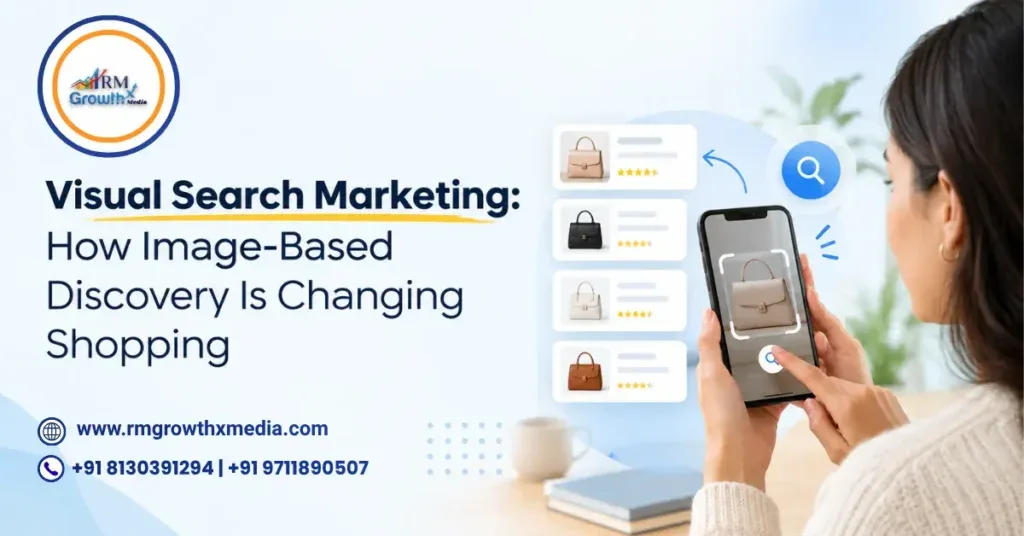
Unlike traditional text-based search, which relies primarily on written queries, visual search allows users to begin with a photograph, screenshot, uploaded image, or an object captured using a camera. Search technology analyzes the visual information and returns related images, products, or webpages.
For example, a shopper who sees a wooden coffee table in an interior design post can use an image-based search tool to find similar tables, explore different finishes, compare prices, and visit retailers selling comparable products.
Visual search marketing combines image SEO, product information, e-commerce optimization, visual content strategy, and conversion-focused website design to help businesses participate in these discovery journeys.
How Does Visual Search Work?
Visual search systems use computer vision and, increasingly, AI-based recognition techniques to analyze the content of an image. Depending on the platform and query, the system may identify objects, shapes, colors, patterns, products, or other visual characteristics before finding relevant results.
A typical shopping journey looks like this:
- Image discovery: A user takes a photo, uploads a screenshot, or selects an image from a website or social platform.
- Visual analysis: The search tool identifies relevant objects and visual characteristics.
- Result matching: The system presents visually similar products, related images, product information, or relevant webpages.
- Product evaluation: The shopper compares available options, prices, reviews, materials, sizes, or other details.
- Purchase consideration: The shopper visits a product page and decides whether the item meets their needs.
The process varies by platform. Some tools emphasize visual similarity, while others combine image recognition with text-based refinement, product information, and shopping results.
For businesses, this means a useful product image needs to do more than look attractive. It should accurately represent the item, appear on a relevant webpage, and lead customers toward the information they need to make a decision.
Why Visual Search Marketing Matters for Online Shopping
Visual discovery helps bridge the gap between seeing something desirable and finding a product that meets the shopper’s requirements.
In its October 2024 update, Google described shopping applications of Google Lens, including identifying products from photos, comparing information across retailers, and refining visual searches with text. These examples illustrate how image-based discovery can become part of the shopping journey.
For brands, the opportunity is to make products easier to discover when customers do not know their exact names or specifications.
1. Customers Can Discover Products Without Knowing Their Names
A shopper may recognize a product’s appearance but have no idea what it is called. This is common with fashion accessories, furniture, decorative items, footwear, and distinctive consumer products.
Visual search reduces the need to describe the item accurately in words. Businesses with clear product photography and useful product pages may therefore become relevant to searches that would be difficult to capture through conventional keyword targeting alone.
2. Product Discovery Can Begin Outside an Online Store
A customer might discover a product in a social media post, a video, a blog article, or a photograph taken in a physical store.
Image-based search can help connect that initial moment of inspiration with further product research. Brands should therefore think beyond their own product catalogue and consider how images appear across their website, social channels, and other digital touchpoints.
3. Visual Comparisons Can Support Purchase Decisions
Shoppers often compare products based on design, color, shape, size, and overall appearance. Relevant images help them understand what a product looks like before opening a detailed product page.
However, visual similarity alone is not enough. Product descriptions, specifications, reviews, delivery information, and pricing remain important when customers evaluate their options.
4. Stronger Image Optimization Can Support Organic Discovery
Image optimization can help search engines understand visual content and make it eligible to appear in relevant search experiences. It also improves accessibility and gives users additional context when images cannot load.
Businesses can review Google’s official image SEO best practices for guidance on image discovery, descriptive alt text, image placement, and landing-page optimization.
Visual search should complement a broader SEO strategy rather than replace it.
Key Visual Search Trends Shaping E-Commerce
Visual search is not a single feature or platform. It is part of a broader shift in how people discover information and products online.
AI-Powered Product Recognition
AI-powered image recognition can help identify objects and find visually related products. As these capabilities develop, product discovery can become more useful for shoppers who have an image but lack specific search terms.
For retailers, this makes accurate product photography and detailed product information increasingly valuable.
Image and Text Search Used Together
Shoppers do not always want an exact visual match. They may like the style of a product but want a different color, size, material, or price range.
Combining an image with a written instruction can help narrow the results. For example, a shopper could start with a photograph of a beige sofa and refine the search with phrases such as “dark grey fabric sofa” or “compact sofa for a small apartment.”
Brands should make relevant product attributes easy to understand on product pages and within their product catalogues.
Shopping From Screenshots and Social Content
A screenshot from a creator’s video or an image saved from a social platform can become the starting point for product research.
This makes visual consistency across product photography, social content, and landing pages more useful. If a product shown in a campaign looks noticeably different from the product page, shoppers may struggle to confirm whether they have found the right item.
Visual Discovery Across Devices
People may begin with a mobile camera, a screenshot, a desktop browser, or an image found while browsing online. A business cannot control every discovery interface, but it can make its own website accessible, responsive, and easy to navigate across devices.
These developments create opportunities, but they do not guarantee rankings, traffic, or sales. Results depend on the platform, product relevance, competition, website quality, and the customer’s needs.
How Businesses Can Optimize for Visual Search Marketing
A practical strategy starts with the assets a business already controls: its images, product pages, website structure, and measurement process.
1. Use Clear, High-Quality Product Images
Product photography should show what the customer is actually buying. Images that are blurry, poorly lit, heavily compressed, or visually cluttered can make product details harder to understand.
For e-commerce websites, consider including:
- A clear primary image that shows the complete product.
- Additional views showing important details.
- Close-ups of textures, materials, finishes, or distinctive features.
- Images showing scale or the product in use, where appropriate.
- Consistent photography that makes products easier to compare.
For example, a furniture retailer could use one clean product image, a side view, a close-up of the upholstery, and a room-setting photograph. Each image serves a different purpose: identification, comparison, detail, or inspiration.
Use genuine product representations. Do not alter colors or features so extensively that the images mislead customers.
2. Write Descriptive Image File Names
Image file names provide useful context about what an image contains. Generic names such as IMG_1045.jpg offer little descriptive information to people managing the site and provide limited context about the image itself.
A more useful name might be walnut-round-coffee-table.jpg, assuming that it accurately describes the product.
Good file-naming practices include:
- Describe the actual subject of the image.
- Keep names concise and readable.
- Use hyphens to separate words.
- Avoid repetitive keyword strings.
- Maintain a consistent naming convention across large catalogues.
Descriptive file names are a supporting optimization practice, not a guarantee that an image will rank in search results.
3. Add Accurate, Contextual Alt Text
Alt text describes an image for people who cannot see it, including users of screen readers. It also helps search engines interpret the image in the context of the page.
For example:
Weak alt text: product image
More useful alt text: Round walnut coffee table with a lower storage shelf
The second example communicates meaningful visual details without forcing unrelated keywords into the description.
Alt text should reflect what is actually visible. Decorative images that add no meaningful information may be handled differently from informative product images.
Avoid adding the same keyword-heavy alt text to every image. Accuracy and accessibility should guide the decision.
4. Build Useful Product Pages Around Images
An image may attract a shopper, but the destination page helps determine whether that shopper can evaluate the product.
A well-structured product page should provide relevant information such as:
- A clear product title.
- A useful, original description.
- Price and availability information.
- Material, dimensions, color, and other applicable specifications.
- Product variants, where available.
- Delivery, return, and warranty information where applicable.
- Customer reviews, when genuine and available.
- A clear purchase action.
Consider a shopper searching visually for a particular backpack. A page showing the matching product but omitting its capacity, dimensions, material, and available colors leaves important questions unanswered.
The objective is to connect visual discovery with a page that supports an informed decision.
5. Improve Image Technical SEO
Search engines need to discover, access, and understand images. Technical problems can make that process more difficult.
Review the following areas:
- Image accessibility: Ensure important images can be crawled and are not unintentionally blocked.
- HTML implementation: Use appropriate image elements for content that should be discoverable, rather than relying exclusively on CSS background images.
- Responsive delivery: Serve suitable image sizes for different screen dimensions.
- File formats and compression: Choose efficient formats and compression settings while preserving adequate quality.
- Image sitemaps: Consider an image sitemap when it helps search engines discover images that may otherwise be difficult to find.
- Page context: Place images near relevant text and on pages that accurately describe the content.
- Loading performance: Optimize image delivery so large files do not unnecessarily slow down the shopping experience.
Businesses can also use Google’s SEO Starter Guide to review foundational practices for making website content easier for search engines to understand.
Technical optimization supports discoverability, but search engines still determine which content appears for a particular query.
6. Maintain Consistent Product Information
Product images and written information should describe the same item. Inconsistent product titles, mismatched colors, missing variants, and outdated availability can undermine customer confidence.
For businesses managing large inventories, establish a process to maintain accurate information across product pages and relevant shopping feeds.
For example, if a retailer sells the same chair in oak, walnut, and black finishes, each variant should have appropriate images and clearly identified attributes. This helps shoppers distinguish between similar-looking options and reduces confusion during product selection.
7. Make the Website Mobile-Friendly and Fast
Visual discovery often begins on a mobile device, so the experience should continue smoothly when a shopper opens the product page.
Check whether:
- Images resize correctly on smaller screens.
- Product galleries work without unnecessary friction.
- Pages load efficiently on mobile connections.
- Product information is readable without excessive zooming.
- Variant selectors and purchase buttons are easy to use.
- Unnecessary pop-ups do not obstruct important information.
A visually appealing image cannot compensate for a slow or difficult checkout experience. Website performance and usability should be considered part of the overall visual search strategy.
8. Use Structured Product Data Where Appropriate
Structured data helps search engines interpret information about a webpage. For eligible product pages, relevant product markup may communicate details such as product name, image, price, availability, and review information when those details are supported and accurately implemented.
Structured data does not force a page to appear in a particular result format, and it is not a substitute for useful content or crawlable images.
E-commerce businesses should ensure that structured data reflects the visible page and remains consistent with the actual product information.
9. Connect Visual Content With a Broader Marketing Strategy
Visual search should not be treated as an isolated SEO activity. Product imagery also supports social media campaigns, content marketing, paid advertising, and website conversion optimization.
A fashion brand, for example, might publish an outfit photograph on social media, feature the same products on its website, and create supporting content explaining styling options. Each touchpoint can help customers explore the products in a different way.
Businesses planning a coordinated approach can explore RM GrowthX Media’s social media advertising services to understand how visual creative, audience targeting, and campaign optimization fit into broader digital marketing activity.
10. Measure Discovery and Business Outcomes
Visual search performance can be difficult to isolate because not every platform exposes detailed image-based referral information. Businesses should establish a realistic measurement plan rather than assuming every image-driven visit can be identified separately.
Useful measures may include:
- Organic traffic to product and image-rich pages.
- Impressions and clicks reported for relevant search experiences.
- Product-page engagement.
- Add-to-cart activity.
- Conversion rate.
- Revenue from measurable organic sessions.
- Image-related landing-page performance.
- Product discovery and search behavior, where analytics support it.
Compare results over time and review changes alongside product updates, seasonality, promotional activity, and technical improvements. Avoid attributing every increase or decrease to visual search alone.
Practical Examples of Visual Search Marketing
Fashion and Accessories
A customer sees a distinctive handbag in a creator’s video and uses an image search tool to find similar styles.
A retailer can improve its chances of being discovered by publishing clear front, side, and detail views; identifying materials and dimensions; maintaining accurate color variants; and providing useful product descriptions.
The retailer should not assume that visual similarity will always produce an exact match. Its goal is to make the product easy to understand and evaluate if it appears in relevant results.
Furniture and Home Décor
Someone saves a photograph of a living room featuring a particular lamp or sofa. They want a similar look but have different space requirements and a specific budget.
A home décor retailer can support this journey through lifestyle images, individual product photographs, dimensions, material details, and clearly organized product categories. Related-product suggestions may also help shoppers explore complementary items.
Beauty and Personal Care
A shopper sees a skincare product in a photograph but cannot read its label. Clear packaging images, accurate product names, ingredient information, and useful descriptions can help them identify and evaluate the product.
For cosmetics, shade representation requires particular care. Screen settings and lighting can affect perceived color, so product pages should provide appropriate disclaimers and additional shade references where necessary.
Small E-Commerce Businesses
A small seller may not have the resources to build a custom visual search system. It can still improve the quality of its existing product imagery, use descriptive file names and alt text, maintain accurate product information, and optimize its website for mobile users.
These foundational practices can improve the overall shopping experience while supporting discoverability across more than one search channel.
Common Visual Search Marketing Mistakes to Avoid
Mistake 1: Prioritizing Appearance Over Accuracy
Highly stylized images may look impressive but fail to show important product details.
Why it matters: Customers may struggle to identify the product or understand what they will receive.
What to do instead: Balance creative lifestyle photography with clear, representative product images.
Mistake 2: Stuffing Keywords Into Alt Text
Repeating search phrases in every image description creates poor accessibility and does not guarantee better visibility.
Why it matters: The description becomes less useful to people who rely on it and may misrepresent the image.
What to do instead: Describe the image naturally, including relevant distinguishing details where appropriate.
Mistake 3: Using One Image for Every Product Variant
A single generic image may not adequately represent products that differ in color, material, size, or design.
Why it matters: Shoppers may select the wrong variant or lose confidence in the listing.
What to do instead: Use accurate variant-specific imagery and label each option clearly.
Mistake 4: Ignoring the Destination Page
An attractive image can lead to a page with missing information, confusing navigation, or an unclear purchase action.
Why it matters: The discovery experience breaks down before the customer can evaluate the product.
What to do instead: Review product-page content, mobile usability, loading speed, and the complete purchase journey.
Mistake 5: Treating Visual Search as a Replacement for SEO
Image optimization alone cannot solve weak website structure, poor content, or technical accessibility issues.
Why it matters: Search engines use multiple signals and systems to discover and understand content.
What to do instead: Combine image optimization with relevant written content, technical SEO, internal links, and useful landing pages.
Mistake 6: Expecting Immediate Sales From Image Optimization
Updating product images does not guarantee that they will appear in visual search results or generate purchases.
Why it matters: Discovery depends on relevance, competition, platform behavior, and customer intent.
What to do instead: Establish a baseline, prioritize high-value pages, monitor measurable indicators, and improve the strategy based on evidence.
What Is Next for Visual Search Marketing?
Visual search is likely to remain relevant as search platforms develop more ways to combine images, text, product information, and AI-assisted discovery. The precise features available will vary by platform, market, and device, so businesses should verify current capabilities before making major investments.
Three developments are particularly worth monitoring.
More flexible search refinement: Image-based discovery can become more useful when shoppers can specify attributes such as color, style, material, or size alongside an image.
Closer connections between discovery and shopping: Search experiences may increasingly help users move from identifying an object to comparing relevant products and evaluating purchase options. Brands should keep product information accurate and product pages useful.
Greater importance of structured visual content: As visual systems interpret images alongside text and other page information, businesses will benefit from maintaining descriptive, accessible, technically sound image libraries.
These developments do not mean every business needs advanced visual search software. For many companies, the practical starting point remains better images, stronger product pages, reliable technical SEO, and measurement that supports informed decisions.
A 30-Day Action Plan for Businesses
Businesses can begin improving their readiness for visual discovery with a focused four-week plan.
Week 1: Audit existing visual assets
- Identify key products and high-priority landing pages.
- Review image quality, file names, alt text, and product information.
- Check whether important images can be crawled.
- Record baseline traffic and conversion indicators where available.
Week 2: Improve priority product pages
- Replace unclear or outdated images.
- Add useful image variations.
- Improve descriptive alt text and product copy.
- Confirm that product variants, prices, and availability are accurate.
Week 3: Review technical performance
- Check responsive image delivery and page loading speed.
- Review product structured data where relevant.
- Confirm that important images are discoverable.
- Test the mobile product-page and checkout experience.
Week 4: Measure and refine
- Compare performance with the original baseline.
- Review search visibility, organic visits, engagement, and conversions.
- Identify pages that still have missing or inaccurate information.
- Prioritize the next round of improvements based on business value.
This plan provides a manageable starting point. Larger catalogues may need a longer implementation period, particularly when image management, development work, or product-data cleanup is required.
Frequently Asked Questions
Visual search marketing involves optimizing images, product pages, and related digital content so customers can discover products or businesses through image-based search. It combines image SEO, accurate product information, technical optimization, and a useful shopping experience.
Visual search allows shoppers to begin with a photograph or screenshot rather than relying entirely on written descriptions. Depending on the platform, they can discover similar products, identify items, compare options, and explore relevant retailers.
Fashion, footwear, furniture, home décor, beauty, accessories, and other visually distinctive product categories can be particularly relevant. However, the value depends on customer behavior, product type, and whether image-based discovery is a meaningful route to purchase.
Use clear and accurate images, descriptive file names, contextual alt text, relevant product-page content, responsive image delivery, and technically accessible image elements. Maintain consistent product attributes and provide useful details that help customers evaluate the item.
No. Image SEO focuses on helping search engines discover, understand, and potentially display images in search results. Visual search marketing is broader: it also considers image-driven product discovery, shopping journeys, product information, marketing touchpoints, and conversion opportunities.
No. Image optimization and visual search readiness can support discoverability, but they do not guarantee rankings, visits, or purchases. Outcomes depend on relevance, competition, platform features, product availability, website quality, and customer intent.
Start with the most important product or service pages. Improve image clarity, add accurate descriptions and alt text, ensure pages work well on mobile devices, and check whether search engines can access the images. Measure changes before investing in more advanced tools.
Conclusion
Visual search marketing is changing how shoppers move from inspiration to product discovery. Instead of relying exclusively on product names or written queries, customers can begin with a photo, screenshot, or image they find while browsing. Businesses can prepare for this behavior by improving image quality, writing accurate alt text, maintaining reliable product information, optimizing technical SEO, and creating useful landing pages.
The strongest approach is not to chase a single search feature. It is to make products easier to discover, understand, compare, and purchase across digital touchpoints. Start with your highest-priority pages, measure what changes, and expand the work based on evidence.
Ready to make your brand easier to discover online? RM GrowthX Media can help your business strengthen its digital marketing strategy through SEO, content, visual creative, and website-focused improvements. Get in touch with the team to discuss how a more connected approach to visual discovery can support your business goals.