Introduction
Every business wants more customers, but attracting website visitors is only one part of the marketing process. The real challenge is guiding potential customers from their first interaction with your brand to the point where they feel confident enough to enquire, purchase, or book a service. A well-planned marketing funnel helps make that journey more structured, relevant, and measurable.
If you are wondering how to build a high-converting marketing funnel from scratch, the starting point is not choosing an advertising platform or designing a landing page. It is understanding your audience, identifying what influences their decisions, and creating a connected journey that moves them towards a specific action.
This guide explains how to plan, build, measure, and optimize a marketing funnel, with practical examples for service businesses, e-commerce brands, startups, and B2B companies.
What Is a Marketing Funnel?
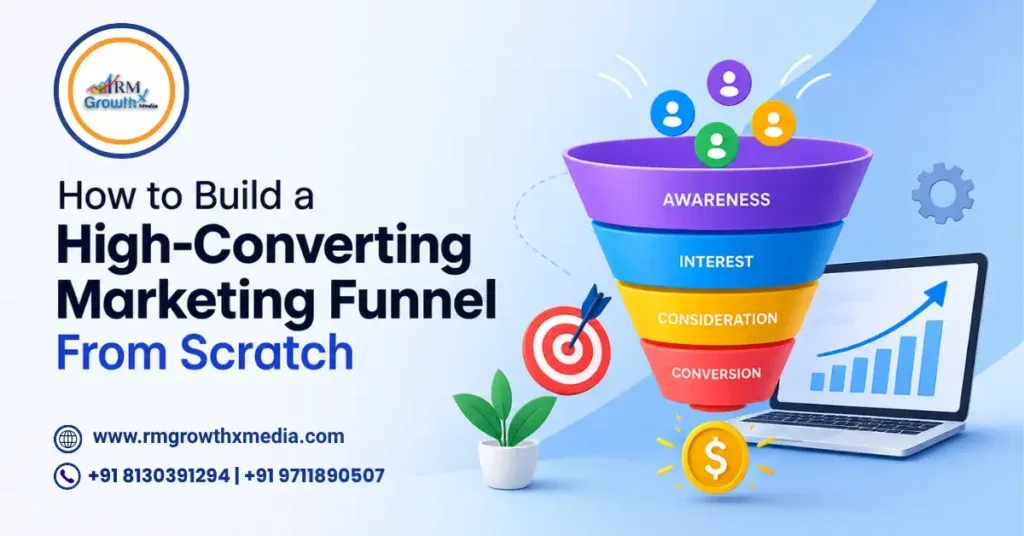
A marketing funnel is a framework that represents the stages potential customers move through as they discover a business, evaluate its offering, and decide whether to become customers. It helps businesses organize marketing activities according to customer intent, from initial awareness to conversion and retention.
A marketing funnel is often divided into three main stages:
- Top of the funnel (TOFU): Attract people who may benefit from your product or service.
- Middle of the funnel (MOFU): Educate interested prospects, address their concerns, and build trust.
- Bottom of the funnel (BOFU): Encourage qualified prospects to take a specific action, such as making a purchase or submitting an enquiry.
After conversion, customer onboarding, support, and retention activities can help build longer-term relationships.
The funnel is a useful planning model rather than a perfectly linear description of customer behaviour. People may discover a brand through social media, compare alternatives through search, return through an email, and convert days or weeks later.
Why Does Your Business Need a Marketing Funnel?
Without a clear funnel, businesses may invest in traffic generation without understanding what happens after someone clicks an advertisement, visits a website, or downloads a resource.
A structured funnel connects each marketing activity to a customer need and a measurable business objective.
Key benefits include:
- Better audience targeting: Deliver messages that reflect the prospect’s interests and readiness to buy.
- More relevant content: Answer questions at the right point in the customer journey.
- Improved lead quality: Give prospects useful information before asking them to make a commitment.
- More effective advertising: Match campaigns and landing pages to the action you want visitors to take.
- Clearer performance measurement: Identify where people disengage and where improvements may be needed.
- Stronger customer relationships: Continue supporting customers after the initial transaction.
For example, a digital marketing agency might attract business owners through educational blog content, offer a website audit to interested visitors, and invite qualified prospects to book a consultation. Each step serves a distinct purpose instead of asking every visitor to become a customer immediately.
How to Build a High-Converting Marketing Funnel From Scratch
Building a marketing funnel becomes easier when you break it into manageable steps. The following process can be adapted to different industries, budgets, products, and sales cycles.
Step 1: Define Your Business Goal and Conversion Action
Before creating content or launching campaigns, decide what the funnel needs to achieve.
Your primary conversion could be:
- A completed purchase.
- A qualified lead submission.
- A booked consultation or demonstration.
- A phone call from a prospective customer.
- A free trial registration.
- A product enquiry or quotation request.
Choose one primary conversion for each funnel. You can track smaller actions along the way, but the final goal should remain clear.
For instance, an online clothing store may focus on completed purchases, while a B2B software company may prioritize qualified demo bookings. A local home renovation business might focus on consultation requests.
The conversion action should match the business model and the prospect’s level of intent. Asking a first-time visitor to schedule a lengthy sales meeting may be premature, whereas a visitor comparing service packages may be ready for a consultation.
Practical tip: Write a simple objective statement before proceeding: “This funnel will help [target audience] solve [specific problem] and encourage them to [desired action].”
This statement becomes the reference point for your content, offer, landing page, advertising, and reporting decisions.
Step 2: Identify Your Target Audience and Their Pain Points
A marketing funnel works best when its messaging reflects the needs of a clearly defined audience.
Start by identifying:
- Who is most likely to need your offering?
- What problem are they trying to solve?
- What outcome do they want?
- What questions or objections could delay their decision?
- What alternatives are they considering?
- What information would help them choose confidently?
Use customer conversations, sales enquiries, reviews, website search terms, support questions, and available analytics to identify recurring patterns. If your business is new, interview prospective customers and document your assumptions before investing heavily in campaigns.
Consider a small business owner looking for digital marketing support. Their concerns might include unclear advertising costs, inconsistent leads, poor website performance, or difficulty understanding campaign results.
These concerns can guide the funnel’s messaging. An educational article might explain how to assess lead quality, a downloadable checklist could help evaluate an existing campaign, and a consultation could provide a tailored assessment.
Avoid treating broad demographic categories as a complete audience strategy. Two people of the same age or profession may have very different needs, budgets, and levels of buying intent.
Step 3: Map the Customer Journey
Once you understand your audience, outline the steps a prospect may take before converting.
A basic customer journey might look like this:
- The prospect discovers your brand through search, social media, an advertisement, or a referral.
- They visit your website to understand the problem or explore possible solutions.
- They engage with useful content, a product page, a service page, or an offer.
- They compare your offering with alternatives and evaluate trust signals.
- They submit an enquiry, book a call, or make a purchase.
- They receive follow-up communication, onboarding, and relevant support.
Not every prospect will follow every step. Your objective is to create a helpful path for the most important customer journeys rather than force every visitor through an identical sequence.
Map the questions prospects are likely to ask at each stage. Early-stage visitors may want to understand a problem, while later-stage visitors may need information about pricing, implementation, delivery, or support.
This exercise also helps identify gaps. If your advertisements promise a specific outcome but the landing page provides little detail, visitors may leave before taking action.
Step 4: Create Awareness at the Top of the Funnel
The top of the funnel introduces your brand to people who may not know that your business exists or may only be beginning to understand their problem.
At this stage, focus on relevance and usefulness rather than an immediate sales pitch.
Useful awareness activities include:
- Search-optimized blog articles.
- Educational videos and social media posts.
- Informative infographics.
- Paid search and social advertising.
- Industry guides and practical checklists.
- Partnerships and referral activity.
For example, a company selling accounting software could publish content explaining common bookkeeping challenges for small businesses. A fitness equipment retailer might create educational product-selection guides. A marketing agency could publish an article about diagnosing low-quality leads.
Search engine optimization can help people discover useful content when they actively search for relevant information. Businesses can explore search engine optimization services to support their organic visibility and content discovery strategy.
Paid campaigns can complement organic content when a business needs to reach a defined audience or promote a specific resource. The right channel depends on customer behaviour, the offer, available budget, and campaign objectives.
Measure this stage using: relevant reach, impressions, qualified website sessions, engagement, and the cost of attracting suitable visitors where applicable.
Do not judge awareness solely by impressions. Large numbers of irrelevant visitors may add little value to the business.
Step 5: Develop a Relevant Lead Magnet or Initial Offer
Once people show interest, give them a useful reason to take the next step.
A lead magnet is a resource or offer provided in exchange for an action, commonly an email address or a completed enquiry form. It should solve a specific problem rather than simply collect contact details.
Examples include:
- A downloadable industry checklist.
- A pricing or budgeting worksheet.
- A product comparison guide.
- A free consultation.
- A relevant webinar or demonstration.
- A sample, trial, or product recommendation.
- A website or campaign audit.
For a B2B marketing agency, a lead magnet could be a checklist for reviewing landing-page performance. For an e-commerce business, it could be a product-selection guide that helps shoppers choose the right item.
Choose an offer that attracts the type of prospect your business can genuinely help. A broad giveaway may produce many sign-ups from people who have no interest in purchasing.
Make the value of the offer clear before asking for information. Explain what the visitor will receive, how it will help, and what happens after they submit the form.
Keep the form proportionate to the offer. A simple checklist may require only an email address, while a high-value B2B consultation may justify asking about business needs, company size, or project requirements.
Step 6: Build a Conversion-Focused Landing Page
A landing page is a dedicated page designed to encourage visitors to complete a particular action. It should connect the promise made in your advertisement or content with a clear, relevant next step.
An effective landing page typically includes:
1. A clear headline
Explain the main benefit or problem the offer addresses. Avoid vague statements that force visitors to guess what they will receive.
2. Supporting copy
Briefly explain what the visitor will get, who it is for, and why it may be useful.
3. A visible call to action
Use a specific action such as “Book a Consultation,” “Download the Checklist,” or “Get Your Quote.”
4. Relevant trust signals
Where available and accurate, include genuine testimonials, verified reviews, credentials, transparent policies, or examples of previous work.
5. A simple form or checkout
Request only the information needed to complete the next step. Remove unnecessary fields and distractions that could interrupt the conversion process.
6. A mobile-friendly experience
Check text readability, button size, form usability, loading behaviour, and page layout on smaller screens.
7. Consistent messaging
If an advertisement promotes a free audit, the landing page should clearly describe that audit rather than redirecting visitors to a generic service page.
Website structure and usability are important parts of the funnel. Businesses that need to improve the visitor experience can consider web design and development services when planning landing pages and conversion-focused website improvements.
Before launching, test the page from the visitor’s perspective. Complete the form, verify the confirmation message, check the mobile layout, and ensure that the next step works correctly.
Step 7: Nurture Leads Through Relevant Follow-Up
Not every prospect is ready to buy when they first engage with your business. Lead nurturing helps maintain the relationship by providing useful information and addressing questions over time.
Depending on the business and the customer’s consent, follow-up can take place through email, phone, messaging, or relevant remarketing campaigns.
A simple email sequence might include:
- Email 1 — Deliver: Provide the promised resource or confirm the enquiry.
- Email 2 — Educate: Explain a common problem and how to approach it.
- Email 3 — Build confidence: Answer a frequent objection or explain your approach.
- Email 4 — Demonstrate value: Share a relevant example, product detail, or service explanation.
- Email 5 — Invite action: Offer a suitable next step, such as a consultation or product purchase.
The timing and number of messages should reflect your offer and sales cycle. A prospect requesting a quote may need a prompt personal response rather than a long automated sequence. A person downloading an educational guide may benefit from a slower, informative series.
Segment leads according to relevant information, such as the resource requested, product category, expressed interests, or stage of the sales process. Do not assume that every contact wants the same communication.
Personalization should improve relevance, not simply insert a first name into a generic message.
For ongoing lead nurturing, email marketing services can support the planning of segmented campaigns, automated follow-ups, and performance measurement.
Always follow applicable privacy requirements, obtain consent where required, and provide appropriate unsubscribe options for marketing emails.
Step 8: Optimize the Bottom of the Funnel for Conversion
At the bottom of the funnel, prospects are closer to making a decision. They may be comparing suppliers, evaluating product features, reviewing pricing, or deciding whether your solution is worth the investment.
Your task is to remove avoidable friction and help them make an informed choice.
For service businesses, useful elements may include:
- Clear service descriptions and deliverables.
- A straightforward quotation or consultation process.
- Transparent information about pricing where appropriate.
- Answers to common questions.
- Relevant proof of expertise and experience.
- A clear explanation of the next steps.
For e-commerce businesses, focus on product information, delivery details, return policies, checkout usability, payment options, and any unexpected costs.
Calls to action should match the prospect’s readiness. “Request a Proposal” may suit a business evaluating an agency, while “Complete Purchase” is more appropriate for a shopper who has already selected a product.
Avoid artificial urgency, fabricated scarcity, misleading discounts, or unsupported guarantees. Trust is part of conversion optimization, and a sale gained through misleading information can create future complaints and cancellations.
Paid campaigns can support this stage by reaching people with relevant buying intent or re-engaging eligible audiences who have already interacted with your business. The campaign should lead to a page that directly supports the intended conversion.
Step 9: Track Funnel Performance and Conversion Rates
A marketing funnel should be measurable from the first interaction to the final business outcome.
Start by defining the events that represent progress. For example, an e-commerce funnel may track product views, add-to-cart actions, checkout initiation, and purchases. A lead-generation funnel may track landing-page visits, form starts, completed submissions, qualified leads, and sales.
Useful metrics include:
|
Metric
|
What it helps you understand
|
|---|---|
|
Traffic or reach
|
Whether your marketing is reaching an audience
|
|
Click-through rate (CTR)
|
How often people click after seeing an ad or link
|
|
Landing-page conversion rate
|
How effectively visits produce the intended action
|
|
Cost per lead (CPL)
|
How much it costs to generate a lead
|
|
Lead-to-customer rate
|
How effectively leads become paying customers
|
|
Customer acquisition cost (CAC)
|
The cost of acquiring a customer
|
|
Average order value (AOV)
|
The average revenue per order for an e-commerce business
|
|
Return on ad spend (ROAS)
|
Revenue attributed to advertising relative to advertising spend
|
|
Customer retention rate
|
How effectively the business retains customers over time
|
Use the metrics that match your business model. A lead-generation business may prioritize qualified leads and acquisition cost, while an online retailer may focus on purchases, order value, and contribution margin.
To understand where users stop progressing, Google’s GA4 Funnel exploration guide explains how to visualize the steps users take towards completing a task and identify potential drop-off points.
Before relying on the results, confirm that your tracking setup is working. Test form submissions, purchase events, confirmation pages, advertising tags, and campaign parameters. Inconsistent tracking can make a healthy funnel appear weak or make a poorly performing campaign look successful.
Step 10: Test, Improve, and Scale the Funnel
Your first funnel is a starting point, not a finished system. Once enough reliable data is available, identify the biggest obstacle and prioritize improvements.
Start with a clear question. For example:
- Are visitors clicking advertisements but leaving the landing page?
- Are people reading the offer but not submitting the form?
- Are leads responding to follow-up messages but not booking calls?
- Are shoppers adding products to their carts but abandoning checkout?
Choose one important problem and develop a test that addresses it.
You might compare two headlines, simplify a form, change the order of landing-page content, clarify an offer, or test a more relevant call to action. Where practical, change one major variable at a time so you can better understand what influenced the result.
Define the primary success metric before running a test. A higher click-through rate is not necessarily an improvement if it attracts less qualified traffic or reduces purchases.
Allow sufficient time and data for a meaningful assessment. Small samples, seasonal fluctuations, and differences in audience quality can make early results misleading.
Once an improvement is supported by evidence, consider applying it more broadly. Increase budgets or expand distribution carefully while monitoring lead quality, acquisition costs, customer experience, and profitability.
A Practical Marketing Funnel Example
Consider a hypothetical digital marketing agency that wants to generate enquiries from small and medium-sized businesses.
The objective is to encourage suitable prospects to book an introductory consultation.
|
Funnel stage
|
Marketing activity
|
Desired action
|
Key measurement
|
|---|---|---|---|
|
Awareness
|
SEO articles, educational social posts, targeted ads
|
Visit relevant content
|
Qualified traffic and engagement
|
|
Interest
|
Service pages and a campaign audit checklist
|
Explore the offer
|
Offer engagement and landing-page visits
|
|
Consideration
|
Follow-up emails and useful service information
|
Evaluate the agency
|
Email clicks and consultation-page visits
|
|
Conversion
|
Consultation landing page and enquiry form
|
Submit an enquiry or book a call
|
Conversion rate and qualified leads
|
|
Retention
|
Onboarding, reporting, and ongoing communication
|
Continue the relationship
|
Retention and client satisfaction
|
This example illustrates how different channels can support one shared objective. SEO attracts people searching for information, advertising can reach relevant audiences, email can nurture interested prospects, and a focused landing page can make the next action clear.
The agency should evaluate lead quality as well as lead volume. If many people submit forms but few match the target audience, the offer, targeting, or qualification process may need improvement.
The same principle applies to other business models. An e-commerce funnel may emphasize product discovery and checkout, while a software company may focus on educational content, a free trial, product engagement, and a paid subscription.
Common Marketing Funnel Mistakes to Avoid
1. Targeting Everyone
The problem: Broad messaging tries to appeal to people with different needs and levels of intent.
Why it matters: Visitors may not recognize how the offer relates to their specific problem, reducing engagement and lead quality.
The solution: Define a priority audience and build messaging around its most important needs. Expand into additional segments when you can support them with relevant offers and content.
2. Sending All Traffic to the Homepage
The problem: An advertisement promoting a specific service sends visitors to a general homepage with many competing options.
Why it matters: Visitors have to search for the information they expected to find, creating unnecessary friction.
The solution: Match each campaign to the most relevant service, product, resource, or landing page.
3. Asking for a Sale Too Early
The problem: First-time visitors receive aggressive sales messages before they understand the offer.
Why it matters: The commitment may be too large for someone who is still researching.
The solution: Offer helpful educational content or a low-friction next step, then provide a more direct sales invitation when appropriate.
4. Ignoring Lead Nurturing
The problem: Businesses collect contact details but do not follow up consistently.
Why it matters: Prospects may forget the brand, lose interest, or choose a competitor that answers their questions more effectively.
The solution: Create a relevant follow-up process, establish response expectations, and assign responsibility for enquiries.
5. Measuring Clicks Instead of Business Outcomes
The problem: Campaigns are judged mainly by reach, clicks, or engagement.
Why it matters: Those metrics do not necessarily show whether the business is generating qualified leads or profitable sales.
The solution: Connect marketing activity to meaningful conversions and downstream outcomes. Review both channel metrics and sales quality.
6. Neglecting Mobile Users
The problem: Forms, buttons, page layouts, or checkout processes are difficult to use on smaller screens.
Why it matters: Visitors may abandon the journey even when the offer is relevant.
The solution: Test key funnel steps on mobile devices, reduce unnecessary inputs, and resolve usability or performance issues.
7. Changing Too Many Things at Once
The problem: Several campaign and landing-page changes are introduced simultaneously.
Why it matters: It becomes difficult to determine which changes influenced performance.
The solution: Prioritize the largest known bottleneck, document each test, and evaluate results against a predefined metric.
How AI and Automation Can Support Marketing Funnels
AI and automation can help marketers organize repetitive tasks, analyze patterns, and deliver more relevant experiences. Their value depends on the quality of the underlying data, the usefulness of the workflow, and appropriate human oversight.
Potential applications include:
- Content assistance: Developing initial outlines, adapting messaging, or generating ideas for different customer questions.
- Lead routing: Directing enquiries to the appropriate team based on submitted information.
- Email automation: Sending relevant follow-ups when a person requests a resource or completes a defined action.
- Audience analysis: Grouping customers by relevant behaviour or stated interests.
- Performance monitoring: Helping teams identify unusual changes in campaign or conversion data.
Automation should not replace a clear strategy. Poorly targeted messages can become more frequent without becoming more useful, and inaccurate AI-generated information can damage customer trust.
Protect customer information, review automated communications, and ensure that tracking and personalization comply with applicable privacy requirements. Start with a specific operational problem rather than adding technology simply because it is available.
How to Get Started With Your First Marketing Funnel
You do not need a complex technology stack or numerous campaigns to build a useful first funnel. Begin with the minimum set of activities needed to attract a relevant audience, explain your offer, and measure a meaningful conversion.
Use this practical checklist:
- Choose one goal: Define the action that represents success.
- Identify one priority audience: Document its needs, questions, and objections.
- Create one relevant offer: Give visitors a clear reason to engage.
- Build one focused landing page: Align the headline, content, and call to action.
- Select suitable traffic channels: Start with channels your audience actually uses.
- Set up conversion tracking: Verify that important events and enquiries are recorded.
- Create a follow-up process: Respond promptly and provide relevant information.
- Review the results: Find the largest drop-off and prioritize one improvement.
For a small business, this could mean publishing one useful article, promoting a relevant service page, offering a consultation, and measuring completed enquiries. Once the process is working reliably, you can expand the content, channels, and automation according to the evidence.
Frequently Asked Questions
A high-converting marketing funnel is a structured customer journey designed to turn relevant prospects into customers by providing appropriate information, clear next steps, and a smooth conversion experience. Its effectiveness depends on lead quality, the offer, the sales process, and the business objective.
Start by defining a business goal and target audience. Map the customer journey, create relevant awareness content, develop an offer, build a focused landing page, establish follow-up communication, and track conversions. Use the results to identify and improve the biggest bottlenecks.
The three commonly used stages are awareness, consideration, and conversion. Awareness introduces the business, consideration helps prospects evaluate the solution, and conversion encourages a purchase or enquiry. Retention activities can continue the relationship after conversion.
The tools depend on your requirements. A basic funnel may need a website or landing-page builder, an analytics platform, a form or checkout system, and an email marketing tool. Paid advertising, a CRM, and marketing automation can be added when they support a clear business need.
The timeline depends on the complexity of the offer, website requirements, integrations, content, and tracking. A simple lead-generation funnel may be launched relatively quickly, while a complex B2B or e-commerce funnel may require more planning and testing. Launch readiness and data quality matter more than an arbitrary deadline.
Track relevant metrics at each stage, such as qualified traffic, click-through rate, landing-page conversion rate, cost per lead, lead-to-customer rate, and customer acquisition cost. For e-commerce, purchase conversion rate, average order value, and return on ad spend may also be important.
Yes. Small businesses can use a simple funnel to attract relevant prospects, explain their services, collect enquiries, and follow up consistently. The most useful starting point is a focused offer and a measurable customer journey rather than an expensive or complicated technology setup.
Conclusion
Building a high-converting marketing funnel from scratch begins with understanding your customers and defining the action you want them to take. From there, connect relevant awareness content, a useful offer, a conversion-focused landing page, timely follow-up, and reliable measurement into one coherent journey.
Remember that funnel performance is not determined by traffic alone. The quality of your audience, clarity of your offer, usefulness of your content, and ease of the conversion process all influence business outcomes. Measure each stage, identify where prospects disengage, and make improvements based on reliable evidence.
Start with a manageable funnel, verify that it works, and expand only when you understand what is helping your audience move forward. A well-planned marketing funnel gives your business a practical foundation for more consistent lead generation, customer acquisition, and long-term growth.
Build a Marketing Funnel That Supports Your Business Goals
RM GrowthX Media helps businesses connect digital strategy, content, advertising, website experiences, and performance measurement around clear marketing objectives. If you want to attract more relevant prospects and create a better path from first interaction to enquiry or purchase, the right starting point is a funnel tailored to your audience and offering.
Get in touch with RM GrowthX Media to discuss your goals and explore a practical approach to building and improving your marketing funnel.