
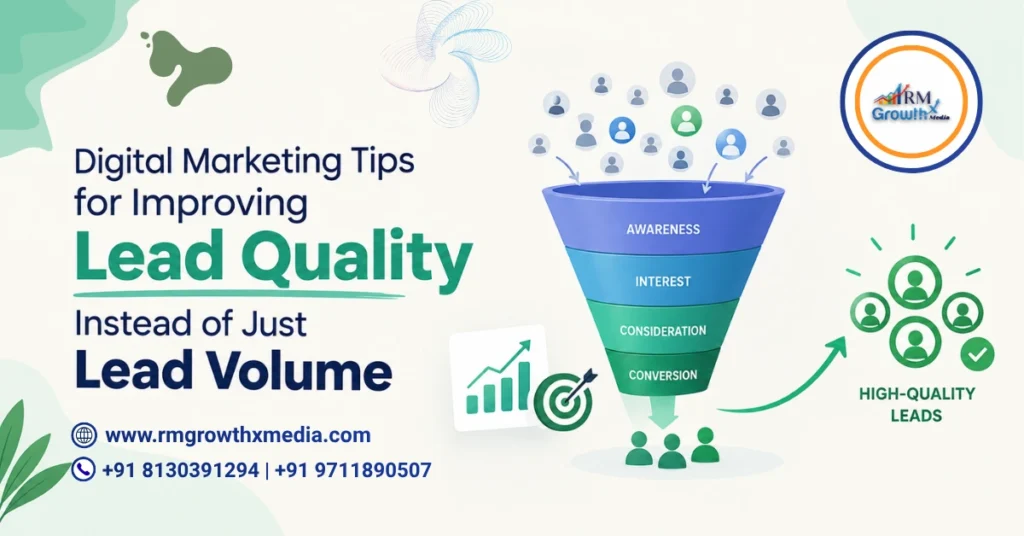
Introduction
Getting hundreds of leads may look impressive in a marketing report, but lead volume alone does not guarantee business growth. If most leads are irrelevant, unqualified, low-intent, or unlikely to buy, your sales team spends more time filtering prospects instead of closing deals.
This is why businesses need to shift their focus from simply generating more leads to generating better leads. The right Digital Marketing Tips can help businesses attract prospects who genuinely match their target audience, understand their needs, have buying intent, and are more likely to become customers.
From audience targeting and landing page optimization to lead scoring, content marketing, paid advertising, and nurturing, every stage of your digital marketing strategy can influence lead quality.
In this guide, we will explore practical Digital Marketing Tips that can help you improve lead quality, increase conversion rates, reduce wasted marketing spend, and build a more efficient sales funnel.
What Is Lead Quality and Why Does It Matter?
Lead quality refers to how closely a prospect matches your ideal customer profile and how likely that prospect is to take a valuable action, such as booking a consultation, requesting a quotation, scheduling a demo, or making a purchase.
A high-quality lead generally has:
- A genuine need for your product or service
- A strong fit with your target audience
- Relevant budget or purchasing ability
- Decision-making authority or influence
- A reasonable purchase timeline
- Higher engagement with your brand
For example, generating 500 random inquiries may sound better than generating 100 qualified prospects. But if only 10 of those 500 leads become customers while 30 of the 100 qualified prospects convert, the smaller lead pool is actually more valuable.
The goal should not always be more leads. The goal should be more leads that can realistically become customers.
Lead Volume vs. Lead Quality: Which Should Businesses Prioritize?
Lead volume measures how many leads your marketing activities generate.
Lead quality measures how valuable those leads are.
A business focused only on lead volume may optimize campaigns for cheap form submissions, clicks, or registrations. This can increase the number of leads while simultaneously decreasing their relevance.
A quality-focused strategy looks deeper into the funnel:
Visitor → Lead → Qualified Lead → Sales Opportunity → Customer
The further a prospect moves through this journey, the more valuable that lead becomes.
Google Ads provides qualified lead and converted lead conversion goals that can help advertisers measure and optimize toward deeper stages of the lead-to-sale journey instead of focusing only on initial lead submissions. This makes lead quality an increasingly important part of modern performance marketing.
10 Digital Marketing Tips to Improve Lead Quality
1. Define Your Ideal Customer Before Generating Leads
One of the most important Digital Marketing Tips is to clearly define who you actually want to attract.
Without an ideal customer profile, your campaigns may reach a very broad audience. While that can produce more impressions and leads, many of those leads may have little interest in buying.
Create an ideal customer profile based on:
- Industry
- Location
- Age or demographic information
- Job role
- Business size
- Income or purchasing capacity
- Interests
- Pain points
- Buying behavior
- Previous interactions with your brand
For B2B businesses, consider factors such as company size, job title, industry, decision-making authority, and business requirements.
For B2C businesses, focus on customer needs, preferences, purchase behavior, demographics, and location.
Why This Improves Lead Quality
The more clearly you understand your ideal customer, the easier it becomes to create advertisements, content, landing pages, and offers specifically designed for that audience.
Instead of asking, “How can we generate more leads?”, ask:
“How can we attract more people who are likely to become customers?”
That simple shift can improve the entire marketing funnel.
2. Use More Specific Audience Targeting
Broad targeting can sometimes help platforms discover new audiences, but businesses should still have a clear understanding of who represents a valuable prospect.
Your audience targeting strategy should align with your ideal customer profile.
Depending on the platform, you can use factors such as:
- Location
- Interests
- Search intent
- Demographics
- Professional information
- Previous website activity
- Customer lists
- Engagement behavior
- Retargeting audiences
For example, a local dental clinic does not necessarily need thousands of leads from people outside its service area. It needs inquiries from people who live nearby and are actively interested in dental services.
Similarly, a B2B software company should focus on decision-makers and businesses that actually need its solution.
RM GrowthX Media’s Social Media Advertising Services can help businesses build targeted campaigns across platforms such as Facebook, Instagram, LinkedIn, Pinterest, and YouTube.
The objective should always be relevance before reach.
3. Create Landing Pages That Pre-Qualify Visitors
Your landing page can influence both the number and quality of leads you generate.
A generic landing page may attract a large number of submissions because it makes the offer extremely easy to access. However, if visitors do not understand what you offer, who it is for, or what happens next, the resulting leads may not be valuable.
A quality-focused landing page should clearly communicate:
- Who the offer is for
- What problem it solves
- What makes your solution different
- What customers can expect
- Who should contact you
- What the next step is
You can also use specific messaging to discourage irrelevant prospects.
For example:
“Looking for enterprise SEO services for a growing business?”
is more qualifying than:
“Need SEO? Contact us today.”
The first message communicates a specific audience and use case.
A strong website and landing page experience can also improve trust and conversion. RM GrowthX Media’s Web Design & Development Services focuses on responsive, SEO-friendly, performance-oriented websites and high-converting landing pages.
4. Add Qualifying Questions to Your Lead Forms
One of the simplest Digital Marketing Tips for improving lead quality is to stop making your forms unnecessarily generic.
Instead of asking only:
- Name
- Phone number
consider adding one or two relevant qualifying questions.
For example:
What is your approximate monthly marketing budget?
or:
Which service are you interested in?
or:
How soon are you planning to start?
You can also ask:
- Company size
- Current solution
- Main business challenge
- Required service
- Project type
- Estimated budget
However, avoid making the form unnecessarily long.
The goal is to introduce useful qualification, not create excessive friction.
Businesses using Google Ads can also use qualifying responses in lead forms to identify higher-quality leads by collecting information about users’ needs, interests, and purchase readiness.
5. Improve Your Ad Messaging to Attract the Right People
Your advertising copy should clearly communicate what you offer and who it is for.
Weak messaging can attract curiosity-driven clicks.
For example:
“Get More Leads Today!”
may generate attention, but it does not tell users much about your service.
A more specific message could be:
“Generate Qualified B2B Leads With Data-Driven Google Ads Campaigns.”
The second message is more specific about:
- Audience
- Outcome
- Channel
- Service
This helps create better alignment between the advertisement and the people who click it.
Google’s best practices for generating high-quality leads emphasize aligning campaign optimization with meaningful business outcomes and using appropriate conversion signals when lead quality matters.
That principle should also influence your ad copy.
6. Optimize for Qualified Leads Instead of Raw Conversions
Another important Digital Marketing Tip is to reconsider what your marketing platform defines as a conversion.
A form submission should not automatically be treated as equal to a customer.
Consider creating different funnel stages such as:
Lead → Marketing Qualified Lead → Sales Qualified Lead → Opportunity → Customer
Then measure how many prospects move from one stage to the next.
For example:
|
Funnel Stage
|
Example
|
|---|---|
|
Lead
|
Form submitted
|
|
Qualified Lead
|
Meets target criteria
|
|
Sales Qualified Lead
|
Sales team confirms interest
|
|
Opportunity
|
Serious buying conversation
|
|
Customer
|
Deal closed
|
This gives your marketing team a much clearer understanding of campaign performance.
Google’s qualified and converted lead guidance explains how advertisers can measure deeper lead-to-sale funnel events and use those signals to improve campaign optimization.
7. Use Lead Scoring to Identify High-Intent Prospects
Lead scoring helps businesses rank prospects based on their likelihood of becoming customers.
You can assign points based on actions such as:
- Visiting important service pages
- Downloading a high-value resource
- Requesting a quotation
- Booking a consultation
- Opening multiple emails
- Watching product videos
- Returning to your website
- Spending significant time on key pages
- Matching your ideal customer profile
For example:
+10 points: Requested a quotation
+8 points: Booked a consultation
+5 points: Visited pricing page
+3 points: Downloaded a guide
+1 point: Opened an email
A prospect with 40 points may deserve immediate sales attention, while someone with 3 points may need further nurturing.
Lead scoring becomes especially useful when a business receives enough leads that manually evaluating every prospect becomes difficult.
8. Build Content Around Buyer Intent
Not every person searching for information is ready to buy.
Your content strategy should therefore address different stages of the customer journey.
Awareness Content
Targets people who are discovering a problem.
Examples:
- What is lead generation?
- Why are my ads not converting?
- How does digital marketing work?
Consideration Content
Targets people comparing solutions.
Examples:
- SEO vs paid advertising
- Google Ads vs social media advertising
- How to choose a digital marketing agency
Decision Content
Targets people who are close to purchasing.
Examples:
- Digital marketing service pricing
- Best digital marketing agency for small businesses
- How to choose an SEO company
This approach helps your content attract prospects with different levels of intent while giving high-intent users clear pathways toward conversion.
For businesses that need stronger organic visibility, Search Engine Optimization Services can help build visibility around relevant search queries and attract users actively looking for solutions.
9. Use Retargeting to Reconnect With High-Intent Visitors
Someone who visited your pricing page or service page but did not submit a form may already be more valuable than a completely new visitor.
Retargeting allows businesses to reconnect with people who previously interacted with their brand.
You can create retargeting campaigns for people who:
- Visited a specific service page
- Viewed a product
- Started but didn’t complete a form
- Watched a video
- Engaged with social content
- Visited multiple pages
- Added something to a cart
Instead of showing the same generic advertisement to everyone, create messages based on previous behavior.
For example:
“Still Comparing Digital Marketing Agencies? Book a Free Strategy Call.”
This type of messaging speaks directly to users who have already shown interest.
RM GrowthX Media’s Paid Advertising Services can help businesses use audience targeting, campaign optimization, remarketing, and performance tracking to improve advertising results.
10. Track What Happens After the Lead Is Generated
This may be one of the most important Digital Marketing Tips in this entire guide.
Many businesses stop measuring performance when a form is submitted.
But the real question is:
What happened to that lead afterward?
Track:
- Leads generated
- Qualified leads
- Sales-qualified leads
- Appointments booked
- Opportunities created
- Customers acquired
- Revenue generated
- Cost per qualified lead
- Cost per customer
- Customer acquisition cost
A campaign generating 1,000 leads at a low CPL may appear successful.
But if only five leads become customers, the campaign may be far less effective than a campaign generating 200 leads with 30 customers.
Google recommends using meaningful conversion goals and conversion values to better understand the business impact of campaigns. Google’s conversion goal guidance explains how conversion actions and goals can be used to optimize advertising toward outcomes that matter to the business.
How to Improve Lead Quality From Paid Advertising
Paid advertising can generate leads quickly, but campaign optimization should go beyond reducing cost per lead.
Instead of asking:
“How cheap can we generate a lead?”
ask:
“How much does it cost us to acquire a qualified customer?”
For example:
- Campaign A: ₹200 CPL, 2% qualified
- Campaign B: ₹500 CPL, 20% qualified
Campaign B may actually be more valuable.
RM GrowthX Media’s Paid Advertising Services focuses on audience targeting, campaign optimization, tracking, and ROI-oriented advertising across Google, Facebook, Instagram, YouTube, and LinkedIn.
Businesses should therefore monitor cost per qualified lead, not only cost per lead.
How Content Marketing Can Improve Lead Quality
Content can act as a qualification mechanism.
When your content clearly explains:
- Who your service is for
- What problems you solve
- What your process looks like
- What results customers can expect
- What investment may be required
it naturally filters some unsuitable prospects.
For example, an in-depth service page can discourage users looking for an extremely cheap solution while attracting businesses that value expertise and measurable outcomes.
This is one reason Digital Marketing Tips should not focus exclusively on advertising.
SEO, content, website experience, email marketing, paid media, and social media all influence lead quality.
How Email Marketing Helps Turn Leads Into Better Opportunities
Not every lead is ready to buy immediately.
Some prospects may need:
- More information
- Case studies
- Product education
- Testimonials
- Pricing details
- Comparison content
- Follow-up communication
Email nurturing helps businesses stay connected until prospects become more sales-ready.
A simple lead nurturing sequence could include:
Email 1: Welcome + useful resource
Email 2: Explain the problem
Email 3: Introduce your solution
Email 4: Share proof or case study
Email 5: Offer consultation/demo
This approach can prevent your sales team from spending too much time chasing cold leads.
Why Your Sales and Marketing Teams Must Work Together
Marketing cannot accurately optimize for lead quality if the sales team does not provide feedback.
Sales teams should regularly share information about:
- Which leads were qualified
- Which leads were irrelevant
- Which industries convert best
- Which campaigns generate customers
- Common objections
- Average sales cycle
- Reasons leads fail to convert
This information should then go back into marketing campaigns.
For example, if sales discovers that leads from one audience segment have a significantly higher closing rate, marketing can increase focus on that segment.
This creates a feedback loop:
Marketing → Leads → Sales → Customer Data → Marketing Optimization
That loop is essential for sustainable lead-generation performance.
Key Metrics to Track for Lead Quality
Do not rely only on lead volume.
Track a combination of quantity, quality, and revenue metrics.
|
Metric
|
What It Tells You
|
|---|---|
|
Lead Volume
|
Number of leads generated
|
|
Lead-to-MQL Rate
|
Percentage becoming qualified
|
|
MQL-to-SQL Rate
|
Quality of marketing leads
|
|
Lead-to-Customer Rate
|
Overall lead effectiveness
|
|
Cost Per Qualified Lead
|
Cost of generating valuable prospects
|
|
Customer Acquisition Cost
|
Cost of acquiring customers
|
|
Conversion Rate
|
Percentage taking desired action
|
|
Revenue Per Lead
|
Financial value of leads
|
|
ROAS
|
Return from advertising spend
|
|
Customer Lifetime Value
|
Long-term customer value
|
The more your reporting connects marketing activity with actual business outcomes, the easier it becomes to make better decisions.
Common Mistakes That Reduce Lead Quality
Even strong campaigns can generate poor-quality leads when businesses make these mistakes.
Optimizing Only for Cheap Leads
A low CPL does not necessarily mean a successful campaign.
Using Extremely Broad Targeting
Large audiences can produce volume but may reduce relevance.
Making Unrealistic Promises
Overpromising attracts people who may not actually be suitable customers.
Using Generic Landing Pages
Your landing page should match the message and intent behind the advertisement.
Ignoring Sales Feedback
Marketing performance should ultimately connect with sales outcomes.
Tracking Only Form Submissions
A lead is not the same as a customer.
Failing to Nurture Leads
Some good prospects need multiple interactions before making a decision.
A Practical Lead Quality Optimization Framework
Businesses can use this simple framework to improve their lead-generation strategy:
Step 1: Define
Identify your ideal customer and qualification criteria.
Step 2: Attract
Use SEO, content, paid advertising, and social media to reach relevant audiences.
Step 3: Qualify
Use messaging, landing pages, forms, and lead scoring to identify stronger prospects.
Step 4: Nurture
Educate prospects through email, content, remarketing, and personalized communication.
Step 5: Measure
Track qualified leads, opportunities, customers, revenue, and acquisition costs.
Step 6: Optimize
Use sales feedback and conversion data to improve campaigns continuously.
This creates a system where marketing is optimized for business value rather than vanity metrics.
FAQs About Improving Lead Quality
Digital marketing can improve lead quality through better audience targeting, relevant messaging, optimized landing pages, qualifying forms, lead scoring, retargeting, nurturing, and deeper conversion tracking.
In many cases, yes. A smaller number of highly qualified leads can generate more revenue than a large number of low-intent leads. The right balance depends on the business model, sales capacity, and conversion rates.
A qualified lead is a prospect who matches important criteria such as customer fit, need, purchasing ability, intent, or decision-making authority and has a realistic potential to become a customer.
Start by defining your ideal customer, targeting relevant audiences, creating specific messaging, building conversion-focused landing pages, adding qualification questions, and tracking what happens after leads enter your funnel.
If you have enough reliable conversion data, optimizing toward qualified or converted leads can provide stronger signals than optimizing only toward initial form submissions. Google's guidance on qualified and converted leads explains how deeper funnel stages can be used for measurement and optimization.
Yes. Social media can generate high-quality leads when audience targeting, creative messaging, lead forms, landing pages, qualification, and follow-up are aligned with the ideal customer profile.
There is no single metric for every business. Cost per qualified lead, lead-to-customer rate, customer acquisition cost, conversion rate, and revenue per lead are often more useful than raw lead volume.
Conclusion: Focus on Better Leads, Not Just More Leads
Generating more leads can create the appearance of marketing success, but lead quality is what ultimately determines how much value your marketing generates.
The most effective Digital Marketing Tips focus on understanding your ideal customer, improving audience targeting, creating specific messaging, optimizing landing pages, qualifying prospects, nurturing leads, using retargeting, and measuring what happens beyond the initial conversion.
Instead of celebrating every form submission, businesses should ask:
Did this lead match our ideal customer?
Did the lead become qualified?
Did sales consider it valuable?
Did it eventually generate revenue?
When your marketing strategy answers these questions, you can move from simply generating lead volume to building a predictable pipeline of valuable prospects.
At RM GrowthX Media, the focus is on data-driven digital marketing strategies designed around measurable growth, performance, conversions, and ROI.
If your business is generating plenty of leads but struggling to convert them into genuine opportunities, now is the time to rethink your strategy. Better targeting, better messaging, better qualification, and better measurement can turn your digital marketing efforts into a stronger customer acquisition engine.