
Introduction
B2B Digital Marketing Updates in 2026 are changing how businesses attract, influence, and convert decision-makers. B2B buyers are no longer relying on sales representatives as their first source of information. They are researching companies online, comparing solutions, watching videos, reading expert content, checking reviews, using professional networks, and increasingly interacting with AI-powered search and discovery tools before speaking with a sales team.
This change has made the B2B buyer journey more complex.
A potential customer might discover a company through LinkedIn, search for its services on Google, read a detailed blog, watch a product demonstration, compare competitors, download a guide, and only then contact the sales team. In many cases, several people from the same organization may participate in the buying decision.
LinkedIn describes B2B purchases as typically involving multiple decision-makers and longer, more complex buying journeys, which makes reaching the right people with relevant information increasingly important. LinkedIn’s B2B Marketing insights also highlight channels such as professional content, thought leadership, and targeted advertising as important ways to reach B2B audiences.
For B2B brands, the challenge in 2026 is therefore not simply generating more leads. It is about reaching the right decision-makers, building credibility before the sales conversation, creating useful digital experiences, and staying visible throughout a longer buying journey.
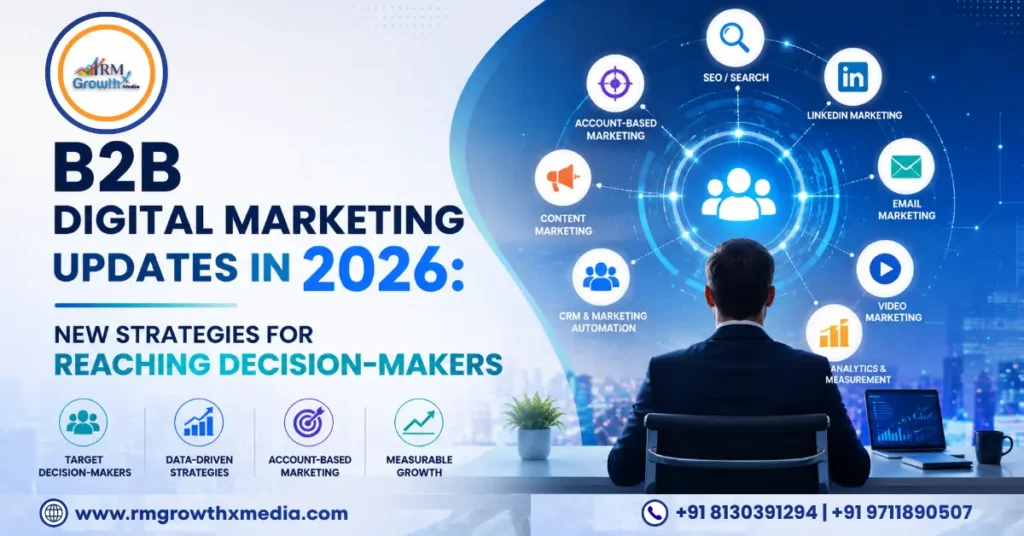
This article explores the most important B2B digital marketing updates in 2026, including AI-powered marketing, search changes, account-based marketing, first-party data, thought leadership, video, personalization, social selling, and full-funnel measurement.
What Are the Latest B2B Digital Marketing Updates in 2026?
The biggest B2B digital marketing updates in 2026 include the growing use of AI for marketing operations, greater emphasis on first-party data, AI-influenced search and discovery, account-based marketing, executive thought leadership, short-form and long-form video, personalized content, social selling, and stronger alignment between marketing and sales.
Instead of focusing only on lead volume, successful B2B marketers are increasingly focusing on:
- Decision-maker visibility
- Brand credibility
- Buying-group engagement
- High-intent content
- Account-based marketing
- AI-assisted customer research
- First-party data
- Marketing and sales alignment
- Pipeline contribution
- Customer lifetime value
The central shift is from lead generation to buying-group influence.
1. AI Is Becoming a Core Part of B2B Marketing Strategy
Artificial intelligence is one of the most significant developments in B2B marketing in 2026.
AI is no longer limited to generating blog outlines or social media captions. Marketing teams are increasingly using AI across research, personalization, content workflows, campaign analysis, customer segmentation, and marketing automation.
How B2B Marketers Can Use AI in 2026
AI can support activities such as:
- Customer research
- Market analysis
- Lead qualification
- Content personalization
- Audience segmentation
- Email optimization
- Campaign analysis
- Predictive insights
- Chat-based customer interactions
- Sales enablement
- Content repurposing
However, using AI effectively requires more than producing large amounts of content.
The biggest opportunity is using AI to understand customers and improve decision-making.
For example, an AI-supported marketing system could help identify which accounts are showing increasing engagement, which topics are attracting decision-makers, and which leads are moving closer to purchase intent.
AI Should Support Expertise, Not Replace It
One of the biggest mistakes businesses can make in 2026 is publishing generic AI-generated content without expert review.
B2B buyers often make high-value decisions involving budgets, risk, compliance, technology, operations, or long-term business outcomes.
They need evidence and expertise.
That means AI should help marketers work faster while human experts provide:
- Original insights
- Industry experience
- Real examples
- Expert opinions
- Data interpretation
- Case studies
- Practical recommendations
This combination can strengthen both credibility and content quality.
2. AI Search Is Changing How Decision-Makers Discover Brands
Search behavior is evolving rapidly.
Traditional search often involved entering a keyword and choosing one of several results.
AI-powered search experiences increasingly allow users to ask longer and more specific questions.
For example, instead of searching:
“Best CRM for B2B companies”
a decision-maker might ask:
“Which CRM is best for a mid-sized B2B company with a long sales cycle and a distributed sales team?”
This creates a new opportunity for B2B brands.
Businesses need content that directly answers complex questions rather than focusing only on short keywords.
What B2B Brands Should Do
Create content around:
- Detailed buyer questions
- Industry-specific challenges
- Product comparisons
- Use cases
- Implementation considerations
- Pricing factors
- ROI questions
- Common mistakes
- Expert explanations
- Customer outcomes
This is where B2B SEO becomes more strategic.
A strong SEO strategy should not only target search volume. It should also demonstrate expertise and address the questions decision-makers ask during research.
Businesses can strengthen this part of their digital strategy through relevant SEO services that focus on search visibility, useful content, and long-term organic growth.
3. Account-Based Marketing Is Becoming More Precise
Account-Based Marketing, or ABM, has been important in B2B marketing for years. In 2026, however, it is becoming more data-driven and personalized.
Instead of marketing to a broad audience, ABM focuses on specific companies or high-value accounts.
For example, a technology company might identify 100 target businesses that fit its ideal customer profile.
The marketing team can then create campaigns specifically designed around:
- Industry
- Company size
- Business challenges
- Technology environment
- Decision-maker roles
- Buying stage
- Business objectives
LinkedIn’s guidance on ABM emphasizes that buying committees are made up of individual decision-makers who may be at different stages of the buying journey. This makes personalized, relevant communication particularly important in B2B campaigns. LinkedIn’s ABM guidance provides examples of how marketers can identify and engage key decision-makers within target accounts.
ABM in 2026: From Company-Level to Person-Level Relevance
A CFO may care about:
- Cost savings
- ROI
- Financial risk
- Business efficiency
An IT leader may care about:
- Security
- Integration
- Scalability
- Technical performance
A marketing leader may care about:
- Pipeline
- Attribution
- Customer acquisition
- Campaign performance
The company may be the same, but each decision-maker has different priorities.
Successful B2B marketing therefore needs to combine account-level targeting with role-specific messaging.
4. Thought Leadership Is Becoming a Competitive Advantage
B2B buyers are surrounded by marketing messages.
Every company claims to be:
- Innovative
- Customer-focused
- Results-driven
- Industry-leading
- Trusted
These statements alone are not enough to establish credibility.
Thought leadership can help businesses differentiate themselves by sharing meaningful expertise.
What Makes B2B Thought Leadership Effective?
Strong thought leadership should provide:
- Original opinions
- Industry analysis
- Proprietary insights
- Practical frameworks
- Expert commentary
- Research
- Case studies
- Lessons from real experience
Instead of saying:
“AI is changing marketing.”
A stronger thought-leadership approach could explain:
“The biggest challenge with AI adoption in B2B marketing is not content production; it is integrating AI into customer data, workflows, measurement, and human decision-making.”
The second statement provides a point of view.
Executive-Led Content
B2B businesses can also build credibility through expert voices from:
- CEOs
- Founders
- CMOs
- CTOs
- Sales leaders
- Subject-matter experts
This creates a human layer around the brand.
In 2026, authenticity matters because audiences are increasingly exposed to large amounts of generic AI-generated content.
5. LinkedIn Is Becoming More Important for Decision-Maker Engagement
Professional networks remain highly relevant to B2B marketing because decision-makers are often active in professional environments.
LinkedIn’s current B2B marketing resources emphasize professional audiences, thought leadership, paid advertising, and content as important mechanisms for reaching business buyers.
However, successful LinkedIn marketing in 2026 should not simply mean posting company updates every day.
Better B2B LinkedIn Content
Companies can create:
- Executive insights
- Industry opinions
- Customer success stories
- Short educational videos
- Research summaries
- Case studies
- Data-driven posts
- Expert interviews
- Behind-the-scenes business insights
- Practical frameworks
The key is to create content that helps decision-makers learn something, solve something, or rethink something.
Employee and Executive Advocacy
Employees and executives can also help amplify company expertise.
Instead of relying entirely on branded company posts, businesses can encourage subject-matter experts to share genuine professional insights.
This can make B2B communication more human and credible.
6. Video Marketing Is Moving Deeper Into the B2B Funnel
Video is no longer only a brand-awareness tool.
B2B buyers increasingly use video to understand complex products, services, technologies, and business solutions.
Useful B2B video formats include:
Short-Form Videos
Ideal for:
- Quick tips
- Industry insights
- Common mistakes
- Statistics
- Expert opinions
- Product features
Long-Form Videos
Useful for:
- Webinars
- Product demonstrations
- Expert interviews
- Customer case studies
- Tutorials
- Industry discussions
Video for Sales Enablement
Marketing teams can also create videos that help sales teams answer common buyer questions.
For example:
- How does the product work?
- What does implementation involve?
- How long does onboarding take?
- What integrations are available?
- What results can customers expect?
This helps marketing content become a practical part of the sales process.
7. First-Party Data Is Becoming More Valuable
Data remains one of the most important assets in B2B marketing.
Businesses can collect first-party data through:
- Website forms
- Newsletter subscriptions
- Webinar registrations
- Content downloads
- CRM interactions
- Customer conversations
- Product usage
- Event registrations
- Surveys
The goal is not to collect data simply because it is available.
The goal is to use appropriate data to understand customer needs and improve experiences.
First-Party Data and Personalization
For example, a visitor who downloads an introductory guide may need educational content.
A visitor who downloads a pricing document may be closer to making a purchasing decision.
A customer who repeatedly views an advanced technical page may have a different need from a first-time visitor.
These signals can help marketers create more relevant experiences.
8. Personalization Is Moving Beyond First Names
Personalization in B2B marketing used to be relatively simple.
For example:
“Hi Sarah, here is your marketing guide.”
That is no longer enough.
In 2026, personalization should focus on business context.
A marketing manager may need information about:
- ROI
- Lead generation
- Attribution
- Campaign performance
A CEO may need:
- Business impact
- Growth
- Risk
- Competitive advantage
A technical decision-maker may need:
- Security
- Integration
- Performance
- Implementation
Therefore, B2B personalization should consider:
Who is the buyer? → What is their role? → What problem are they solving? → What stage are they in?
This produces more meaningful personalization.
9. Customer Journey Mapping Is Becoming Essential
B2B buying journeys can involve multiple interactions and multiple stakeholders.
A typical journey may look like:
Awareness → Research → Evaluation → Comparison → Internal Discussion → Demo → Negotiation → Purchase
But different stakeholders may enter the journey at different points.
Marketing therefore needs to create content for each stage.
Awareness
Use:
- Blogs
- Social posts
- Videos
- Industry reports
- Educational guides
Research
Use:
- Detailed articles
- Whitepapers
- Webinars
- Expert guides
- Research reports
Evaluation
Use:
- Comparison pages
- Case studies
- Product demonstrations
- ROI calculators
- Technical documentation
Decision
Use:
- Testimonials
- Customer proof
- Pricing information
- Consultation pages
- Implementation details
This approach helps businesses guide prospects instead of simply pushing them toward a sales form.
10. Content Quality Is Becoming More Important Than Content Volume
AI makes it easier than ever to produce content.
That means the internet is becoming more crowded with generic articles.
As a result, publishing more content does not automatically create more visibility.
B2B companies should focus on useful, differentiated content.
High-Value B2B Content Should Include
- Original research
- Expert commentary
- Real customer examples
- Industry-specific insights
- Data
- Practical frameworks
- Detailed comparisons
- Actionable recommendations
For example, instead of publishing ten generic articles about digital marketing, a B2B company might create one comprehensive report analyzing digital marketing challenges faced by its specific target industry.
Quality creates differentiation.
11. Marketing and Sales Alignment Is Becoming Critical
One of the biggest problems in B2B marketing is the disconnect between marketing and sales.
Marketing may define success as:
“We generated 5,000 leads.”
Sales may respond:
“Only 100 were relevant.”
This creates friction.
In 2026, marketing teams should increasingly measure whether their activities are contributing to qualified pipeline and revenue.
Better Marketing and Sales Alignment
Marketing and sales teams should agree on:
- Ideal customer profile
- Target accounts
- Lead qualification criteria
- Buyer personas
- Content requirements
- Follow-up processes
- Pipeline stages
- Revenue goals
Marketing should understand the questions sales teams hear every day.
Sales teams should also provide feedback about which content helps prospects move forward.
This creates a feedback loop.
12. B2B Websites Are Becoming Conversion and Trust Platforms
A B2B website is no longer just an online brochure.
It can function as:
- A research hub
- A lead-generation platform
- A trust-building resource
- A product education center
- A conversion environment
- A customer support resource
Decision-makers may visit a website several times before contacting sales.
Therefore, businesses need websites that answer important questions quickly.
What Should a B2B Website Include?
A strong B2B website should provide:
- Clear value propositions
- Service or product details
- Industry-specific solutions
- Case studies
- Testimonials
- FAQs
- Strong calls to action
- Educational content
- Easy navigation
- Mobile responsiveness
- Fast page performance
A good digital marketing strategy can bring qualified visitors to the website, but the website needs to convert that attention into meaningful engagement.
Businesses looking to strengthen this foundation can integrate their marketing strategy with professional web design and development services.
13. Data-Driven Measurement Is Moving Beyond Vanity Metrics
B2B marketers have traditionally tracked metrics such as:
- Impressions
- Likes
- Clicks
- Followers
- Website traffic
These metrics can be useful, but they do not always demonstrate business impact.
In 2026, marketers should increasingly connect marketing activity to:
- Marketing-qualified leads
- Sales-qualified leads
- Pipeline
- Revenue
- Customer acquisition cost
- Customer lifetime value
- Conversion rates
- Account engagement
- Sales cycle length
Account-Level Measurement
For ABM campaigns, marketers can also track:
- Target account engagement
- Number of engaged stakeholders
- Content consumption
- Demo requests
- Opportunities created
- Pipeline generated
- Account conversion rate
This provides a more complete picture of whether marketing is influencing the buying committee.
14. B2B Marketing Automation Is Becoming More Intelligent
Marketing automation remains valuable, but automation is becoming more sophisticated.
Traditional automation might say:
If someone downloads a guide, send three emails.
Modern systems can potentially incorporate additional signals such as:
- Job role
- Company size
- Website activity
- Previous engagement
- Content interests
- Account status
- Buying stage
This allows businesses to create more relevant workflows.
Example
Suppose a decision-maker downloads an introductory guide.
The next experience could be:
Guide → Related Case Study → Webinar → Product Comparison → Consultation
Rather than sending the same generic five-email sequence to everyone, the journey can be designed around the person’s likely information needs.
15. Human Expertise Is Becoming a Bigger Differentiator
One of the most important B2B digital marketing updates in 2026 is actually not a technology.
It is the increasing value of human expertise.
As AI makes content production easier, genuine experience becomes more valuable.
B2B companies should demonstrate:
- Who is behind the business
- What the team has learned
- How solutions work in real situations
- What customers have achieved
- What mistakes the company has seen
- What industry changes mean for buyers
This supports the principles of experience, expertise, authoritativeness, and trust that modern search and content strategies increasingly emphasize.
How to Build a B2B Digital Marketing Strategy in 2026
Businesses can use the following framework to update their B2B marketing strategy.
Step 1: Define Your Ideal Customer Profile
Identify:
- Industry
- Company size
- Location
- Revenue range
- Technology environment
- Business challenges
Step 2: Identify Decision-Makers
Map the buying committee.
For example:
CEO → CFO → Marketing Leader → IT → Procurement
Understand what each stakeholder needs to know.
Step 3: Map the Buyer Journey
Document:
Discovery → Research → Evaluation → Decision → Retention
Then create content for every stage.
Step 4: Build an AI-Assisted Content System
Use AI for research, ideation, analysis, and workflow acceleration while keeping expert review and original insights at the center.
Step 5: Strengthen SEO and AI Search Visibility
Create content that answers specific decision-maker questions and demonstrates genuine expertise.
Step 6: Build Thought Leadership
Develop expert-led content through executives, specialists, case studies, original research, and industry commentary.
Step 7: Connect Marketing and Sales
Create shared definitions for qualified leads, target accounts, buying stages, and pipeline.
Step 8: Measure Business Outcomes
Track pipeline, revenue contribution, qualified leads, account engagement, conversion rates, and customer acquisition cost.
Common B2B Digital Marketing Mistakes to Avoid in 2026
1. Creating Generic AI Content
AI-generated content without original expertise can make a brand look interchangeable.
2. Targeting Everyone
B2B marketing becomes more effective when messaging is designed around specific industries, accounts, roles, and problems.
3. Focusing Only on Lead Quantity
Thousands of low-quality leads are not necessarily better than a smaller number of highly qualified opportunities.
4. Ignoring Decision-Making Groups
B2B purchases often involve multiple stakeholders.
Your content should address different concerns within the buying committee.
5. Publishing Without a Distribution Strategy
Creating great content is only half the job.
Businesses also need search, social, email, paid promotion, sales enablement, and other distribution channels.
6. Ignoring the Website Experience
A slow, confusing, or outdated website can reduce the effectiveness of every marketing campaign driving traffic to it.
7. Measuring Only Traffic
Traffic matters, but B2B marketers should ultimately understand how marketing contributes to qualified opportunities and revenue.
What Are the B2B Digital Marketing Updates in 2026?
The major B2B digital marketing updates in 2026 include AI-powered marketing, AI-influenced search, account-based marketing, first-party data, personalized buyer journeys, thought leadership, video marketing, social selling, marketing automation, and stronger marketing-sales alignment. The focus is shifting from generating large volumes of leads to reaching the right decision-makers, building trust, influencing buying groups, and generating qualified pipeline.
The Future of B2B Digital Marketing in 2026 and Beyond
The future of B2B marketing will not be defined by one platform or technology.
Instead, successful businesses will combine multiple capabilities.
AI will help marketers analyze data and automate repetitive tasks.
SEO will help brands become discoverable when buyers research solutions.
Thought leadership will build authority.
Video will make complex information easier to understand.
ABM will help businesses focus on high-value accounts.
First-party data will support more relevant experiences.
Marketing automation will help nurture prospects.
Websites will act as central information and conversion platforms.
And sales alignment will help turn marketing engagement into revenue.
The biggest change is that the B2B buyer journey is becoming increasingly self-directed.
Decision-makers can conduct extensive research before speaking with sales.
That means businesses need to earn attention and trust earlier in the journey.
FAQs About B2B Digital Marketing Updates in 2026
The biggest trends include AI-powered marketing, AI search visibility, account-based marketing, first-party data, thought leadership, video marketing, personalization, social selling, marketing automation, and stronger marketing-sales alignment.
AI is helping B2B marketers with research, content workflows, personalization, audience analysis, automation, campaign optimization, and customer insights. Human expertise remains important for accuracy, originality, credibility, and strategic decisions.
B2B companies can reach decision-makers through targeted SEO, LinkedIn content, thought leadership, account-based marketing, video, email nurturing, webinars, industry-specific content, and personalized digital experiences.
Yes. LinkedIn remains an important professional environment for B2B marketers because it allows businesses to engage professional audiences through organic content, thought leadership, targeted advertising, and executive or employee advocacy.
Account-based marketing is a strategy that focuses marketing and sales resources on specific high-value companies or accounts. It uses targeted messaging and personalized campaigns to engage relevant stakeholders within those organizations.
First-party data helps businesses understand customer interactions and preferences using information collected directly through their own channels, such as websites, forms, CRM systems, events, and customer interactions.
Useful B2B content includes original research, case studies, expert guides, comparisons, webinars, product demonstrations, industry analysis, ROI information, and content that directly answers specific buyer questions.
B2B marketers should look beyond traffic and engagement to measure qualified leads, account engagement, sales opportunities, pipeline contribution, conversion rates, customer acquisition cost, revenue contribution, and customer lifetime value.
Conclusion: Winning B2B Digital Marketing in 2026 Means Reaching the Right Decision-Makers
B2B Digital Marketing Updates in 2026 show that successful B2B marketing is becoming more focused on relevance, expertise, personalization, and measurable business impact.
Decision-makers have more information available to them than ever before. They can research companies independently, compare alternatives, watch videos, read expert opinions, use search engines and AI-powered discovery tools, and consult professional communities before they ever contact a salesperson.
For B2B companies, this means the marketing strategy must evolve.
Instead of asking:
“How can we generate more leads?”
businesses should increasingly ask:
“How can we become visible, credible, and useful to the right decision-makers throughout their buying journey?”
That requires a combination of B2B SEO, AI-assisted marketing, account-based marketing, thought leadership, video content, first-party data, personalization, social selling, marketing automation, and strong digital experiences.
It also requires alignment between marketing and sales.
The companies that succeed will not necessarily be the ones publishing the most content or using the most marketing tools. They will be the companies that understand their buyers, provide genuinely useful information, demonstrate expertise, and create connected experiences from the first interaction through the final purchase.
For businesses looking to strengthen their B2B digital presence, RM Growth X Media can help bring these digital marketing activities together through a strategic, results-focused approach. Explore the company’s digital marketing services to build a stronger foundation for reaching and converting modern B2B audiences.
The B2B buyer journey is changing. The businesses that adapt their digital marketing strategy now will be better positioned to earn attention, build trust, influence decision-makers, and create sustainable growth in 2026 and beyond.